
Watch Winder Box FAQ: Use, Safety, Rolex Compatibility, and Storage Questions
If you source watch packaging or watch accessories, you have probably heard buyers ask the same thing in ten different ways: *Do customers really need a winder? Is it safe? Will it work with Rolex? Can a watch stay inside for months?* This watch winder box FAQ answers those practical questions from a factory point of view.
We make packaging, display boxes, and watch presentation units, and in our experience, most problems do not come from the wood finish or the PU leather. They come from poor motor selection, wrong turns-per-day settings, cheap adapters, and unrealistic buyer expectations.
From the production side, I can say this is where many importers misjudge the category: they buy a watch winder as if it were only a gift box. On our inspection tables, the real pass-or-fail points are usually motor stability, TPD programming, cushion fit, hinge durability, wiring layout, adapter quality, and drop protection during shipping.
A watch winder box can be a useful product, but only when the watch type, motor program, storage conditions, and compliance requirements are matched correctly.
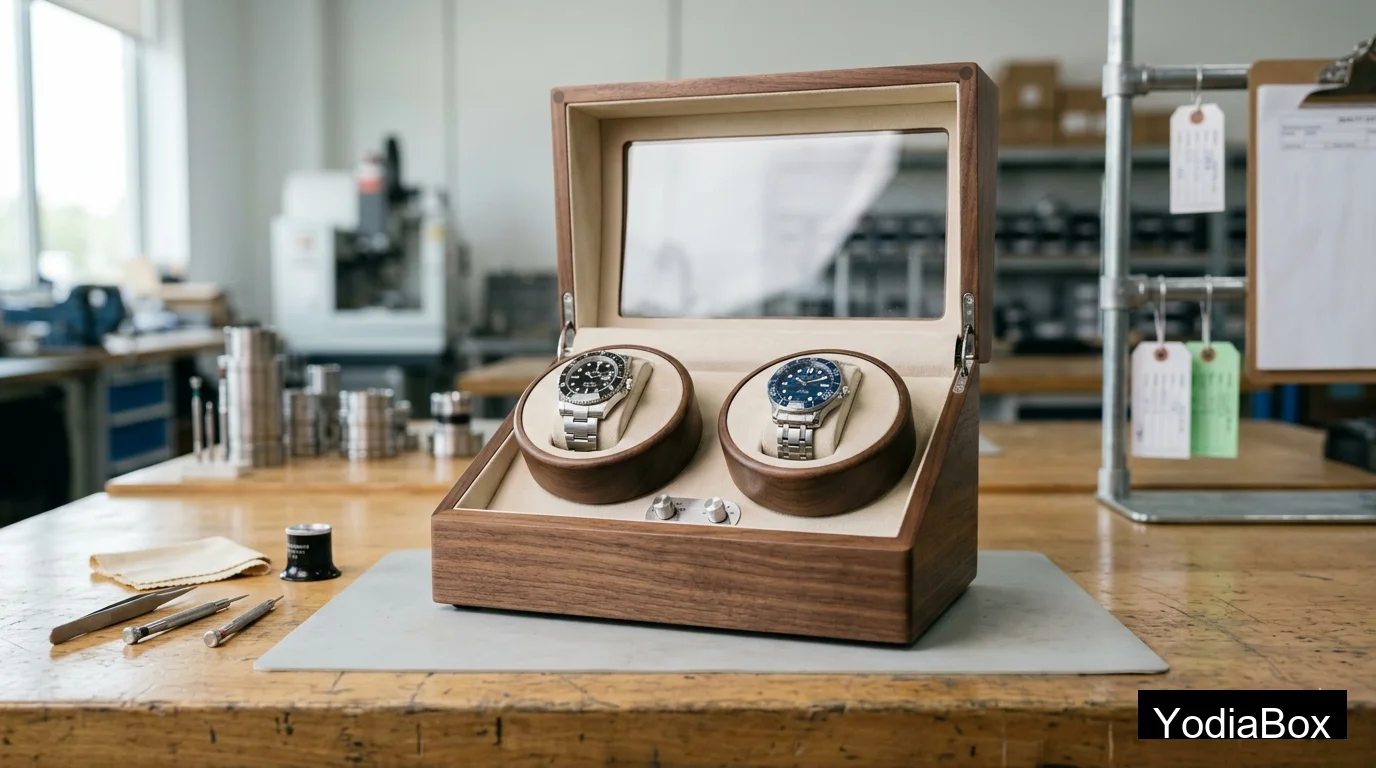
Quick answer: what is a watch winder box for?
A watch winder box is a storage case with a small motor that rotates an automatic mechanical watch to keep the movement running when not worn.
That matters for three common buyer groups:
– retailers selling automatic watches with date/moonphase functions
– collectors rotating between 3 to 20 watches
– gifting brands that want a premium upsell item with a watch purchase
It is especially relevant for automatic watch owners who wear one piece on Monday, another on Friday, and leave the rest in storage. Resetting calendar, date, day, month, or moonphase complications every time is the main reason many end users look for a watch winder box, automatic watch winder, or watch winding box.
For OEM projects, our common specs are:
– 1-watch unit: 160 x 160 x 190 mm
– 2-watch unit: 220 x 180 x 210 mm
– 4-watch unit: 320 x 260 x 240 mm
– motor noise target: below 25 dB at 1 meter
– power input: 100-240V, 50/60 Hz adapter or 2 x D batteries
– MOQ for custom housing: usually 100-300 pcs
– sample lead time: 7-12 days
– mass production: 30-45 days
Here is the first key comparison buyers usually need:
| Type | Best for | Typical price range | Main risk |
|---|---|---|---|
| Static watch box | Storage only | $8-$28 | Watch stops running |
| Single watch winder | One daily-wear automatic watch | $28-$85 | Wrong settings can over-wind concern buyers |
| Dual watch winder | Couples, collectors | $45-$140 | More motor heat and adapter quality matters |
| 4-6 watch winder cabinet | Premium gifting or collector sets | $95-$260 | Shipping damage and noise complaints increase |
Who should actually buy a watch winder?
Not every customer needs one. In practice, the strongest buyer fit is:
– owners of automatic mechanical watches
– users with multiple watches in rotation
– buyers of luxury gift sets
– collectors of watches with calendar complications
– retailers seeking higher average order value through accessories
The weakest fit is usually:
– owners of quartz watches
– buyers looking for only dust storage
– price-sensitive projects where the electronic return risk is not acceptable
– customers who rarely wear their automatics and are comfortable resetting them manually
This distinction matters because it affects positioning, warranty planning, and return rates.
Is a watch winder box safe for watches?
Usually yes, if the rotation program is appropriate for the movement and the unit is built with a stable motor and power supply.
This is where cheap products fail. In our factory sampling, the three most common defects are:
1. TPD too high — some generic boards run above 1,800 turns per day
2. No rest cycle — continuous rotation creates unnecessary wear
3. Magnetic leakage or unstable motors — rare but possible in low-grade assemblies
Most quality winders use programmable cycles such as:
– 650 TPD
– 900 TPD
– 1,200 TPD
– clockwise
– counterclockwise
– bi-directional
For many mainstream automatic watches, 650-900 TPD is a practical starting range. But this depends on the movement, not just the brand name.
From our own sample review experience, the “safe” label should never be based on appearance alone. I have seen glossy piano-finish units with excellent exterior workmanship fail after prolonged run tests because the board had no true pause cycle, or because the adapter output fluctuated under load. By contrast, some simpler models with less dramatic finishes performed much better over 24-hour and 48-hour bench tests.
When we build OEM units for EU buyers, electrical parts and adapters are usually reviewed against Low Voltage Directive 2014/35/EU, RoHS Directive 2011/65/EU, and general CE Marking requirements if the product is placed on the EU market.
> Pro Tip
> For private-label watch winders, ask your supplier for the real motor cycle program, adapter spec, and internal wiring photos. “Silent motor” is not enough. We prefer to confirm TPD range, rest interval, voltage, plug type, and noise test result before approving a sample.
Safety checklist for buyers
If safety is a real buying concern, these are the points I would verify first:
– actual turns per day program, not just marketing copy
– whether there is a rest interval between rotations
– measured noise level at 1 meter
– adapter input/output rating and destination market plug type
– whether the watch sits securely without wobble or rotor shock
– whether the unit creates noticeable heat after 8-24 hours of operation
– whether wiring, solder points, and board fixing look clean inside the housing
That checklist is often more useful than broad claims like “premium quality” or “luxury motor.”
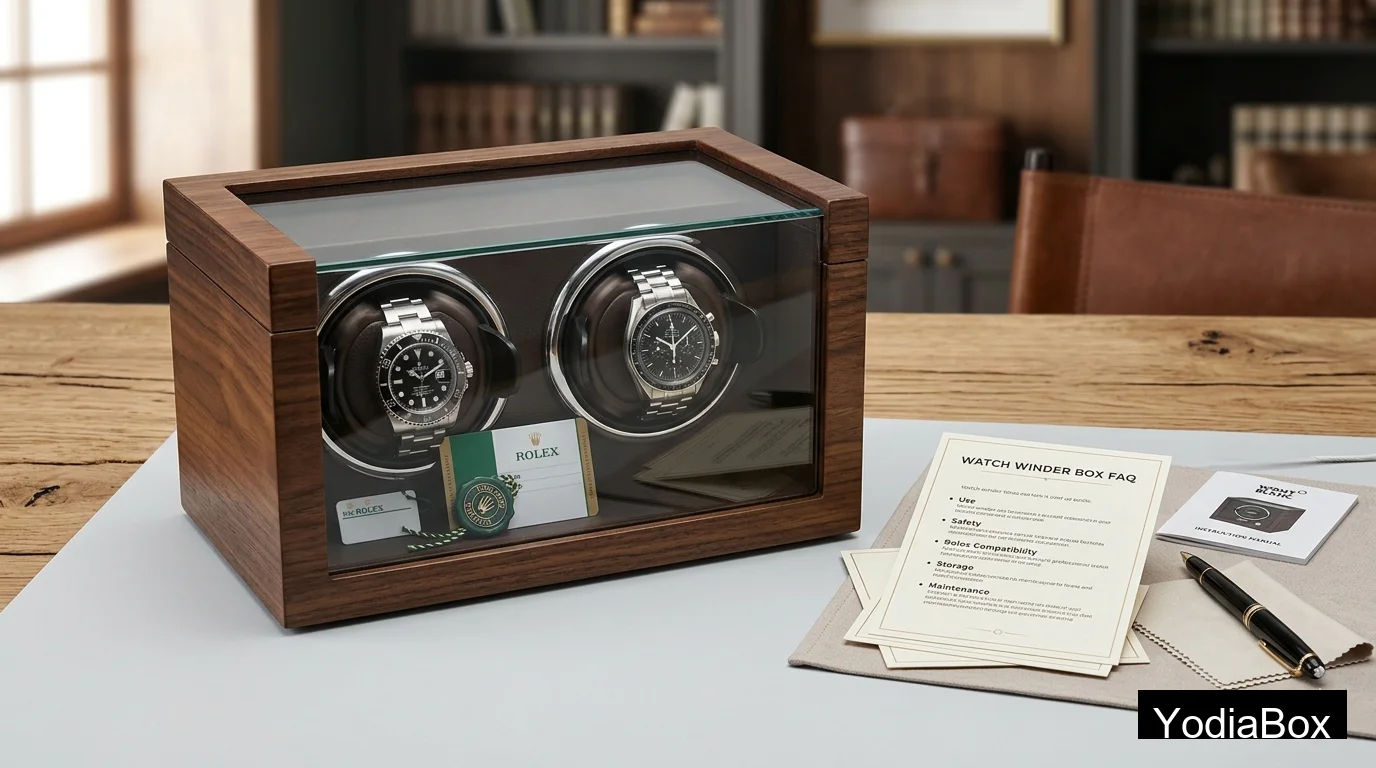
Will a watch winder work with Rolex?
This is one of the top questions in any watch winder box FAQ.
The short answer: yes, many Rolex automatic watches can work well with a watch winder, but only with correct settings.
Rolex movements are generally automatic mechanical movements, so a winder can keep them running. What buyers often get wrong is assuming “Rolex compatible” means one fixed mode works for every model. It does not. The right setting can vary by movement family and wearer habits.
That is also why buyers search related phrases like best watch winder for Rolex, watch winder settings for Rolex, and is a watch winder safe for Rolex. The practical answer is still the same: compatibility depends on correct TPD, direction, and stable movement support, not just on branding.
In procurement terms, if you plan to print “compatible with Rolex” on packaging or product pages, keep the language careful. Better wording is:
– “Suitable for many automatic mechanical watches”
– “Multiple TPD and direction settings”
– “Recommended to verify ideal setting by movement model”
We do not recommend promising one exact setting for every Rolex model unless your technical file supports it.
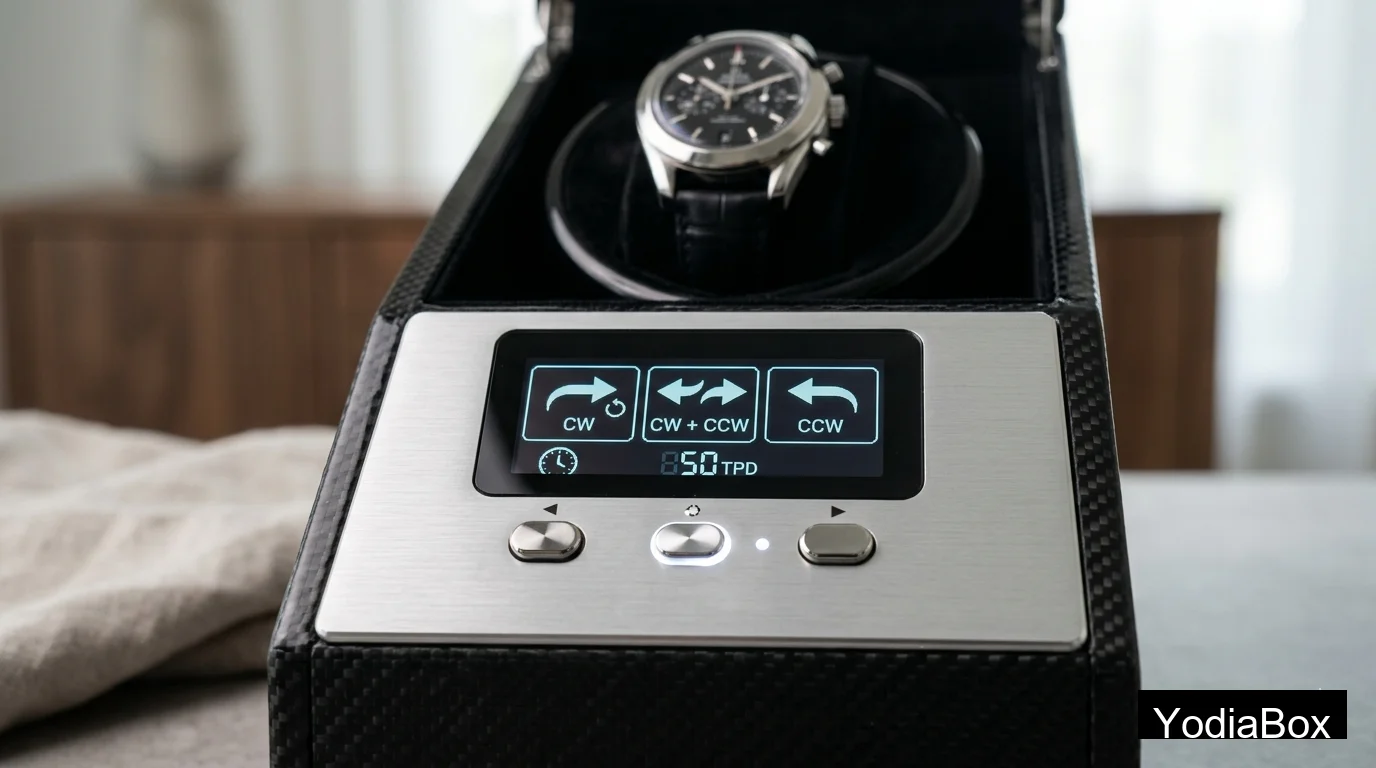
What does “Rolex compatible” really mean?
From a sourcing and compliance perspective, “Rolex compatible” should mean:
– the unit supports multiple rotation directions
– the board offers a reasonable TPD range
– the cushion fits common bracelet and strap sizes securely
– the motor runs with low vibration
– the watch can remain stable without internal knocking
It should not mean:
– one universal setting for every Rolex
– guaranteed performance for every movement family
– a branding claim made without technical basis
That is an important distinction for SEO copy, packaging claims, Amazon listings, and private-label manuals.
Can a watch be overwound in a winder?
This question comes up almost every time.
Modern automatic watches usually have a slipping bridle system in the mainspring, so normal winding from wrist motion or a properly programmed winder does not “overwind” them in the old manual-watch sense. But that does not mean every winder is harmless.
What actually causes trouble in real use:
– excessive TPD
– non-stop rotation without rest cycles
– poor watch fit on the cushion, causing rotor shock
– strong vibration from low-quality gearboxes
For that reason, we prefer programs with rotation + pause cycles, for example:
– 2 minutes rotate / 6 minutes rest
– 5 minutes rotate / 25 minutes rest
That is closer to realistic use than continuous spinning.
> Common Mistake
> Buyers focus on the exterior finish and ignore the watch cushion size. If the cushion compresses a 160 mm wrist watch too tightly, leather straps crease. If it is too loose for a 175-190 mm bracelet, the case shifts during rotation and customers hear knocking inside the box.
Overwinding concern vs. real failure risk
In actual factory discussions, “overwinding” is often the wrong fear. The more realistic product risks are:
– too many daily rotations
– poor-quality motors
– unstable gear transmission
– loose interior support
– watches hitting the sidewall or window area
– user confusion from unclear instructions
I have seen more return claims caused by noisy operation, loose cushions, and bad adapters than by any true technical “overwinding” issue.
How long can a watch stay in a watch winder box?
Mechanically, a watch can stay in a quality winder for extended periods, but we do not advise treating a winder as permanent long-term storage without checks.
A practical guideline we give buyers:
– daily-use rotation: fine for actively worn watches
– 1-4 weeks: usually fine if humidity and dust are controlled
– 2-6 months: acceptable if the program is conservative and the watch is periodically inspected
– over 6 months: better to stop, clean exterior, and store safely unless the owner specifically wants it continuously running
For long-term storage, environment matters more than people think:
– room temperature around 18-24°C
– relative humidity around 45-55%
– away from direct sunlight
– away from speakers, induction devices, and vibration sources
For general jewelry and watch care guidance, GIA’s care advice is useful here: GIA Jewelry Care & Cleaning.
Long-term storage vs. active display
This is an area where buyer expectations should be managed clearly.
A watch winder can support:
– active display
– short-term ready-to-wear storage
– collector rotation
– gift presentation
It is less ideal as:
– neglect-free indefinite storage
– humid environment storage
– high-vibration showroom storage
– direct-sunlight shelf storage
In our factory communication with importers, I usually suggest asking one question first: *Is the end user trying to keep the watch ready to wear, or simply keep it safe?* If the goal is simple protection, a static watch box may be the better product.
Is a watch winder box also a storage box?
Yes, but not always a good one.
Many low-cost winders look like storage boxes, yet have poor dust sealing, no humidity consideration, and thin interior lining that sheds fiber. If a buyer wants a dual-use product, we usually suggest these construction points:
– MDF body thickness: 9-12 mm
– hinge life target: 5,000-10,000 cycles
– window material: tempered glass or acrylic 2-3 mm
– lining: short plush, suede microfiber, or PU-free velvet
– clearance: at least 8-12 mm between watch case and lid/window
For premium projects, some brands ask us to combine a 2-watch winder with 3-5 static storage slots for quartz or manual watches. That gives better retail value than making every slot motorized.
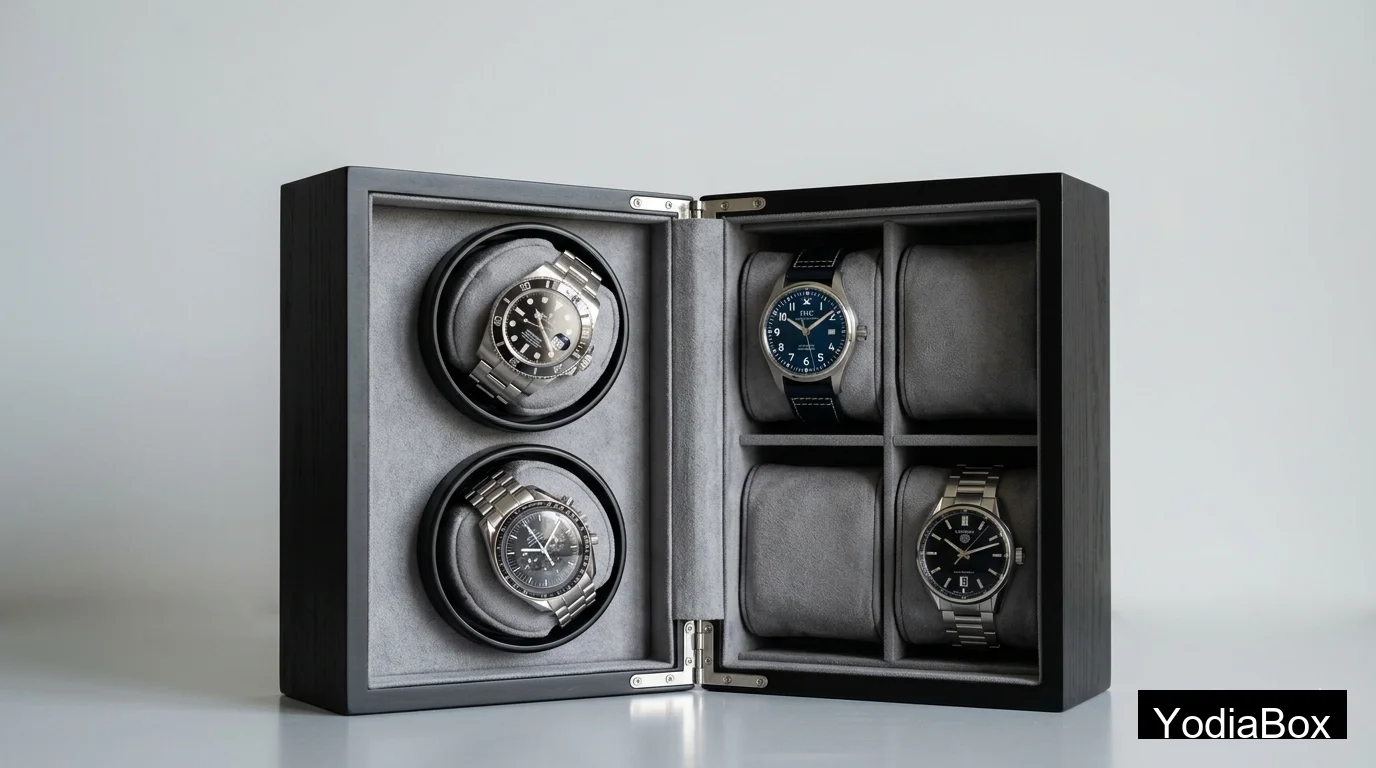
Storage quality features that matter
If the customer wants true storage value, I would check these details:
– fiber shedding from the lining after repeated opening
– hinge alignment and lid stay angle
– glass or acrylic scratch resistance
– dust entry around the lid gap
– whether the interior has enough clearance for larger watch cases
– bracelet and strap compatibility across different cushion widths
A box can look premium online but still perform badly as actual watch storage if those details are weak.
What should procurement managers check before ordering?
If you are sourcing private-label units, this is where the project is won or lost.
| Check point | Good factory answer | Risky answer | Typical target |
|---|---|---|---|
| Motor type | Mabuchi-type or tested equivalent, noise data provided | “Silent motor” only | <25 dB at 1 m |
| Cushion size | Multiple cushion sizes offered | One size for all | 60-75 mm pad width |
| Electrical compliance | Adapter and BOM reviewed for EU/US market | No compliance file | RoHS/LVD/CE pathway clear |
| QC method | AQL sampling with function test | Visual only | 100% run test + AQL spot check |
In our experience, good suppliers also understand packaging, not just electronics. If you need matching outer cartons, gift sleeves, or branded inserts, it helps to work with a jewelry box manufacturer that already handles custom packaging, custom logo, and low MOQ projects together.
> Engineering Note
> For export projects, we normally ask buyers whether the watch winder is sold as a gift box, an electronic accessory, or both. That affects carton labeling, instruction manual content, adapter selection, drop-test standard, and compliance document preparation. A 2-watch unit weighing 2.8-3.6 kg packed with adapter and lid window needs stricter transit protection than a normal rigid jewelry box.
Buying criteria: how to choose the right watch winder supplier
To strengthen the buyer decision path, I would break the purchase decision into six checkpoints:
1. Define the end market
– EU retail
– US e-commerce
– boutique gifting
– watch brand accessory line
– department store private label
Different markets affect adapter type, carton labeling, instruction language, and compliance file depth.
2. Match the product to the end user
– single watch owner
– couple set
– collector set
– luxury gifting
– mixed watch storage with static slots
3. Confirm the technical program
– TPD options
– rotation directions
– rest cycle logic
– power mode
– noise level
4. Review construction quality
– body thickness
– cushion fit
– hinge life
– lining quality
– internal module fixing
5. Validate packaging and shipping protection
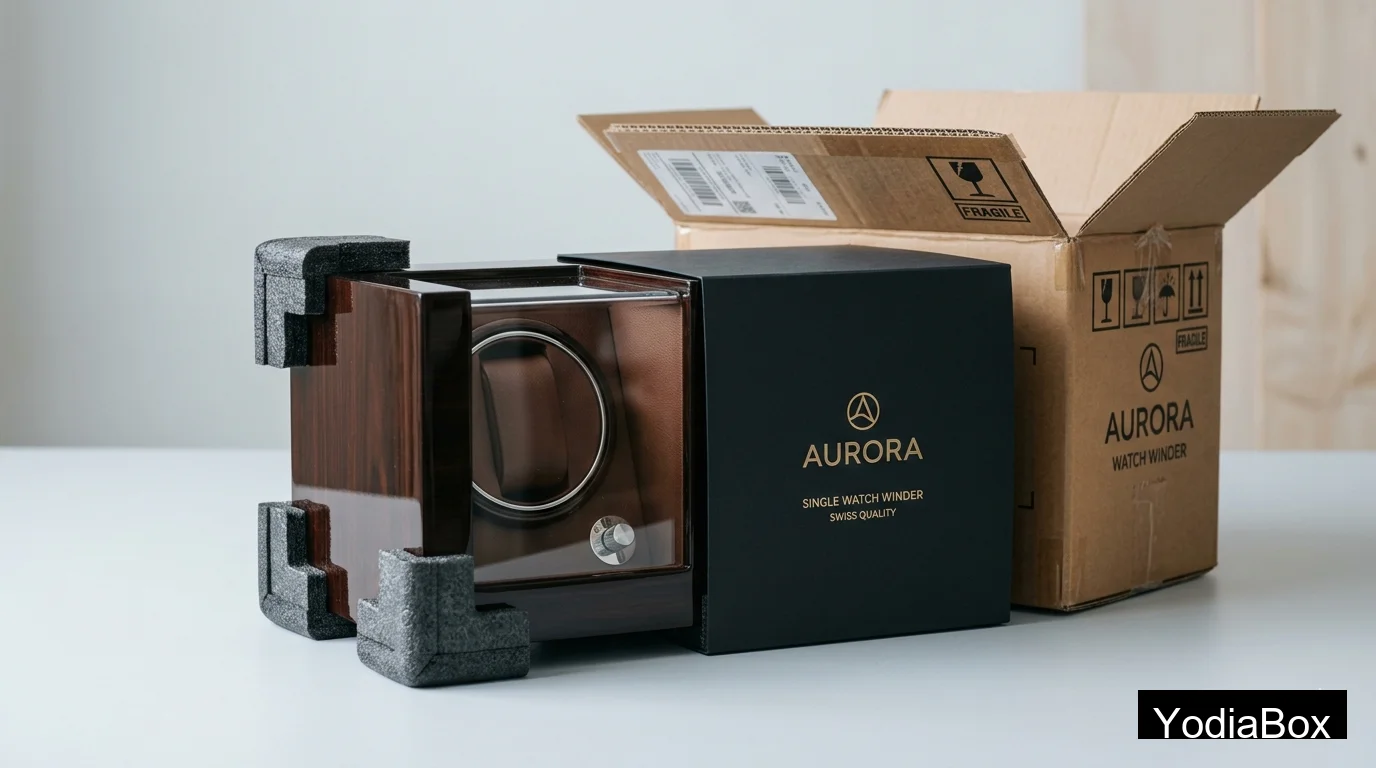
– foam corner protection
– inner carton fit
– drop-test logic
– glass window protection
– master carton loading
6. Audit after-sales risk
– defect replacement terms
– adapter failure support
– spare parts availability
– QC records
– run-test evidence
This process reduces the common mistake of approving a sample based only on cosmetics.
FAQ: Real buyer questions
Do all automatic watches need a watch winder box?
No. If the wearer uses the watch every day, a winder may add little value. It is more useful for watches worn occasionally, especially ones with date, day, month, or moonphase settings that are annoying to reset.
Can I use a watch winder for quartz watches?
No, not as a winding function. Quartz watches are battery powered. They can be stored in the box if there is space, but they do not need rotation.
Are watch winders bad for Rolex?
Not inherently. A properly set winder is generally suitable for many Rolex automatic watches. The important part is matching direction and TPD to the movement. We suggest conservative settings first, then adjusting if power reserve drops.
How many turns per day should I use?
A common starting point is 650-900 TPD for many automatic watches. Some movements need more or less. There is no universal setting for every brand and model.
Should the winder rotate clockwise or counterclockwise?
It depends on the movement. Many good winders offer clockwise, counterclockwise, and bi-directional modes so the user can test or follow the watch maker’s recommendation.
Can I leave my watch in the winder all the time?
You can, but we would not call that ideal for every owner. If the watch is not being worn for months, periodic rest and normal storage may be more sensible than endless operation.
Does a watch winder box drain a lot of power?
No. Most units use low-power motors. A typical single-unit adapter setup is often around 3-6W. Battery operation is convenient for display, but adapter power is better for long-term daily use.
Why is my watch still losing time in the winder?
Common reasons:
– wrong TPD
– wrong rotation direction
– watch not secured correctly on cushion
– mainspring or movement service issue
– cheap motor not delivering stable rotation
If a watch loses significant time even after setting adjustments, the issue may be the watch, not the box.
Is a wooden watch winder better than PU leather?
Not automatically. Wood veneer on MDF gives a premium look and often better gifting value. PU leather is usually lower cost and easier to match to branded colorways. From a failure-rate view, the motor and hinge matter more than the outer wrap.
What MOQ is normal for custom watch winder boxes?
For our factory, a realistic MOQ is:
– 100 pcs for logo change on existing design
– 200-300 pcs for color/material customization
– 500 pcs+ for new mold or major structure revision
If the buyer also wants matching wholesale jewelry boxes or full jewelry packaging sets, we can often combine development work more efficiently.
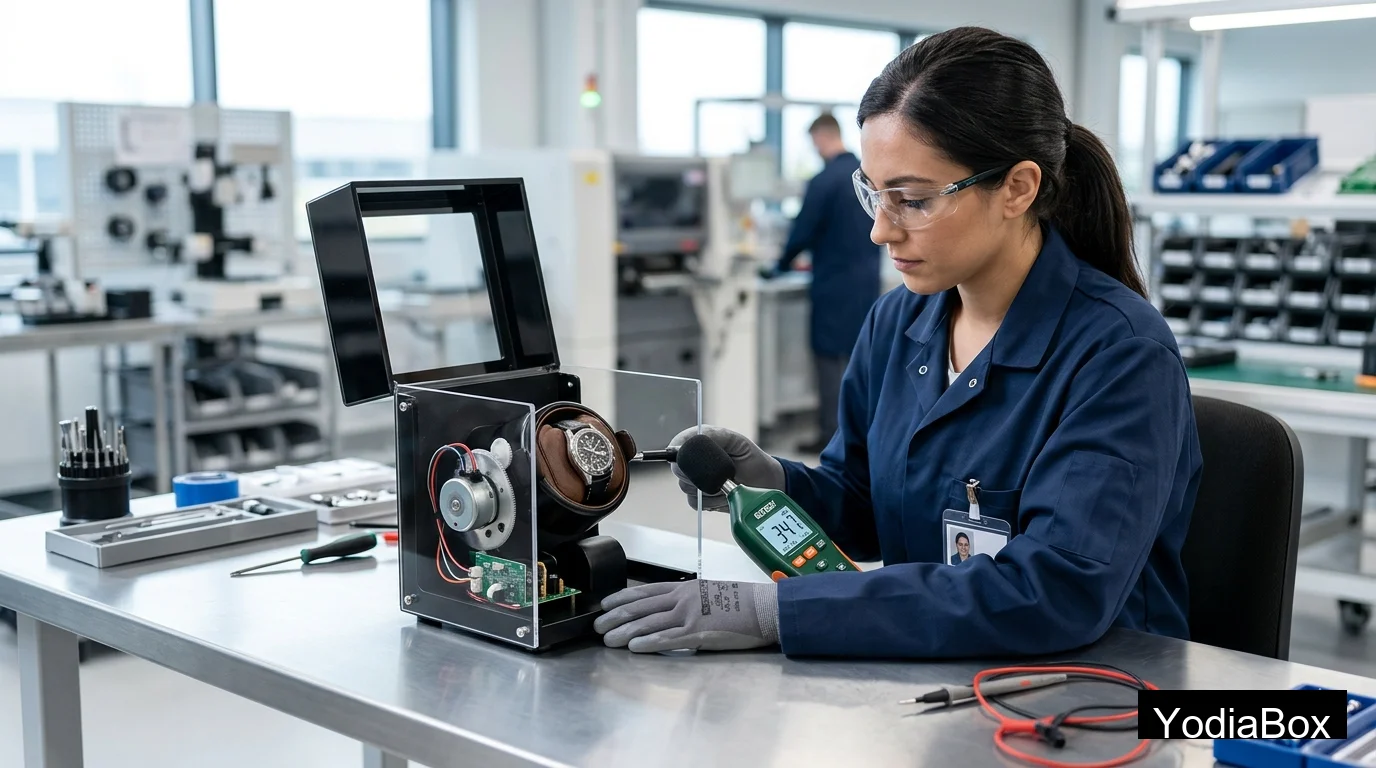
What materials are best for a watch winder box?
The best material depends on your price target.
Typical configurations we produce:
– MDF + walnut veneer + microfiber lining for premium retail
– MDF + PU leather + velvet lining for mid-range gift market
– ABS shell + acrylic window for budget e-commerce models
Approximate OEM ex-works pricing at 300 pcs:
– single winder: $32-$48
– dual winder: $46-$78
– four-watch winder: $88-$145
Those numbers depend heavily on motor source, finish quality, adapter market, and packaging spec.
If your customer wants a unified brand story across watch boxes, jewelry boxes, and counter displays, it is smarter to develop the winder together with your custom jewelry boxes and broader jewelry packaging range instead of sourcing from unrelated factories.
Material selection by market position
From a factory pricing and returns point of view, material choice usually follows the channel:
– premium retail: MDF + real wood veneer + microfiber
– gifting programs: MDF + PU leather + velvet or suede-like lining
– e-commerce value line: ABS shell + acrylic window
– brand collection launch: matching material language across watch boxes, jewelry boxes, and displays
In my experience, premium-looking materials help conversion, but only if the internal electromechanical parts match the promise. A high-gloss veneer housing with an unstable motor often causes more disappointment than a simpler finish with better performance.
Final sourcing advice
If we can give one honest recommendation, it is this: buy a watch winder box as an electromechanical product first, decorative packaging second.
A beautiful box with a noisy motor, loose cushion, or weak adapter creates returns. A plain box with stable performance gets repeat orders.
I have seen buyers spend days approving walnut tone, stitching color, logo foil, and gift sleeve texture, then spend only a few minutes on motor program and adapter review. In the factory, that is backwards. The finish sells the first order; the motor quality and fit consistency determine whether you get the second order.
Before mass production, ask for:
– 1 full finished sample
– 24-hour run test video
– adapter certification file
– user manual draft
– drop-test packing proposal
– QC plan using AQL sampling if required
If possible, also ask for:
– internal assembly photos
– real noise test data
– cushion size options
– outer carton spec
– replacement parts policy
– pilot-run defect summary if available
If you are developing a branded watch accessory line and want one supplier to handle structure, finish, logo, gift box, and export packing, contact us. We can review your target market, MOQ, price band, and whether a watch winder should be positioned as packaging, accessory, or premium gift set.
References & Sources
1. [Low Voltage Directive 2014/35/EU](https://eur-lex.europa.eu/legal-content/EN/TXT/?uri=CELEX:32014L0035)
2. [[RoHS Directive 2011/65/EU](https://eur-lex.europa.eu/legal-content/EN/TXT/?uri=CELEX:32011L0065)](https://eur-lex.europa.eu/legal-content/EN/TXT/?uri=CELEX:32011L0065)
3. [CE Marking](https://single-market-economy.ec.europa.eu/single-market/ce-marking_en)
4. GIA Jewelry Care & Cleaning
Written by: Sarah Jenkins
Senior Content Specialist
Seasoned Industry Editor with 5 years of experience, dedicated to delivering in-depth technical and market reports.
Reviewed by: Dr. Eric Shao
Chief Technical Director
With 12 years of experience in material science and custom manufacturing, ensures the scientific accuracy and technical compliance of all published content.
Recommended Reads
Gift packaging
10 产品
Jewelry display
12 产品
Jewelry Organizer
12 产品
Jewelry pouch
7 产品
Jewelry suitcase
6 产品
Leather jewelry box
13 产品
LED Jewelry box
8 产品
Paper jewelry box
10 产品
Velvet Jewelry box
11 产品
Watch box
7 产品
Wood jewelry box
6 产品
The Complete Watch Box Guide: How to Store, Display & Protect Your Collection
We build watch boxes for retailers, microbrands, gift programs, and private-label buyers, and we keep [...]
Jun
Watch Winder Box: The Complete OEM Buyer’s Guide to Automatic Watch Winder Manufacturing
If you are sourcing a watch winder box for your brand, the short answer is [...]
Jun
Watch Box Price Tiers: A Factory Engineer’s OEM Pricing Guide
Every week, buyers send us inquiry emails that start the same way: "Can you give [...]
Jun
Automatic Watch Winder Box: Features, Materials, and OEM Customization Options
If you are developing an automatic watch winder box for your brand, the hard part [...]
Jun
Box Hoop Earrings Packaging: The Complete B2B Sourcing & Selection Guide
Box Hoop Earrings Packaging: The Complete B2B Sourcing & Selection Guide Choosing the right box [...]
Wooden Watch Box OEM Guide: Wood Species, Joinery, Finishing & Customization for Bulk Buyers
Most buyers come to us with a simple request: "I want a wooden watch box, [...]
Jun