
Single vs Multi Watch Winder Box: Which Configuration Is Best for Your Brand?
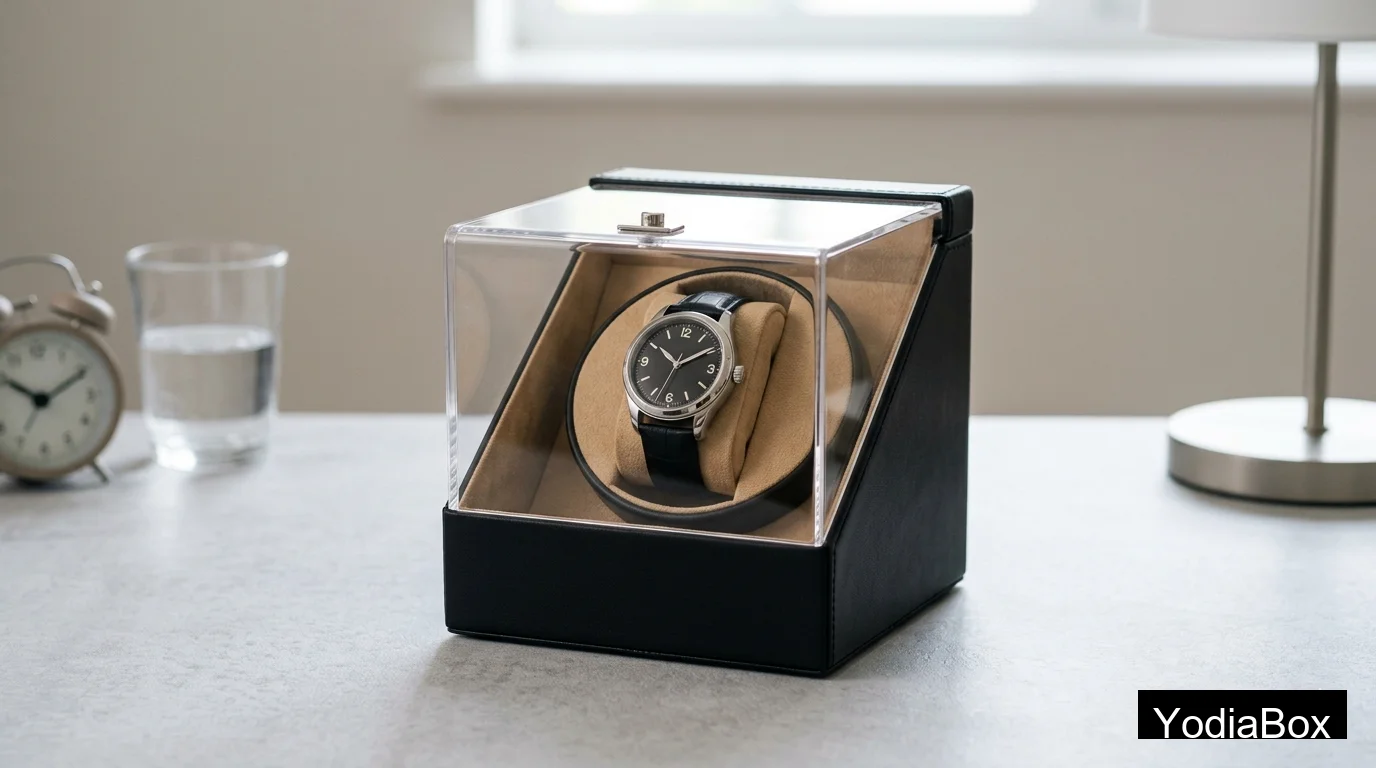
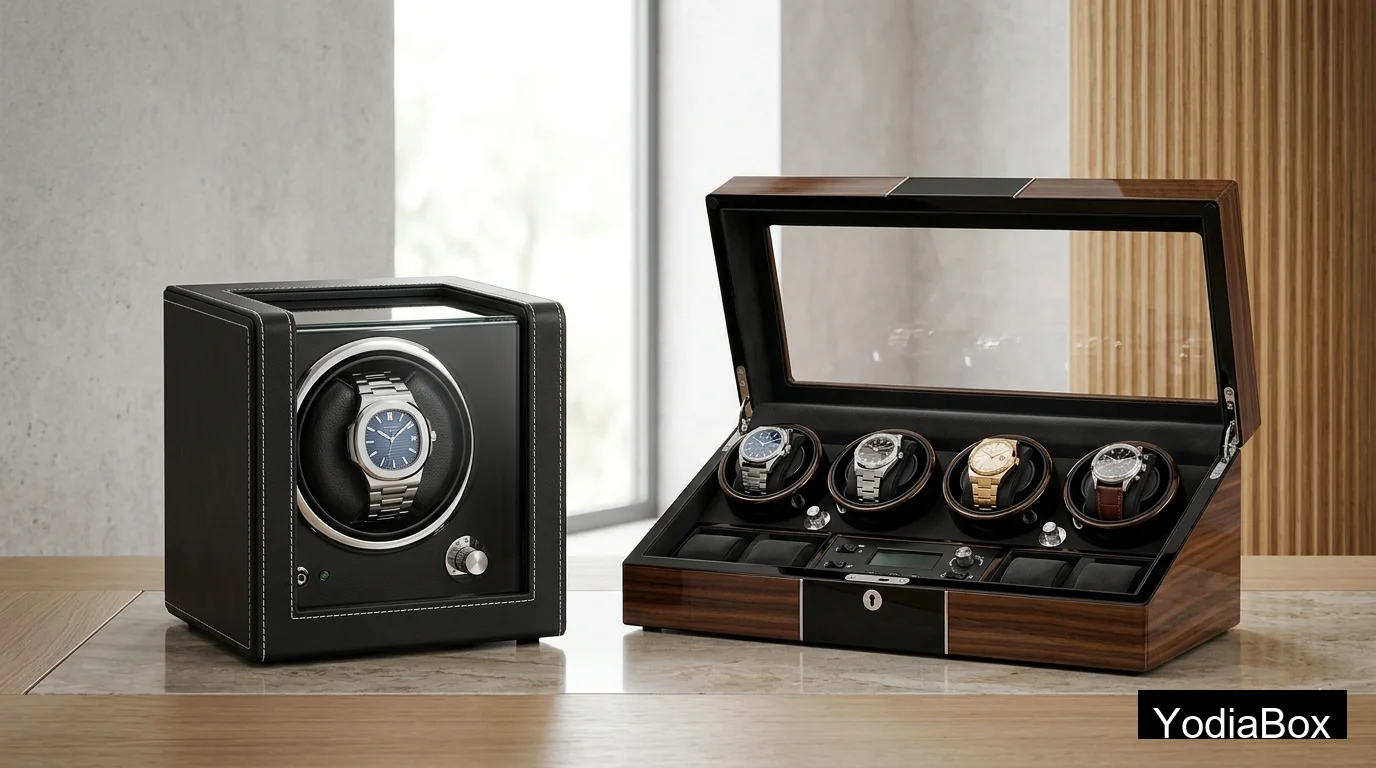
If you are sourcing a multi watch winder box line, the first decision is not wood color or logo position. It is configuration: do you launch a single-unit winder first, or go straight into 2-watch, 4-watch, 6-watch, or 8-watch models?
We have built both for private-label buyers, jewelry brands, watch retailers, and gift programs. In our factory experience, the wrong configuration creates problems fast: oversized cartons, unstable motors, higher return rates, and slow stock turnover. The right configuration gives you a cleaner SKU strategy, better landed cost, and fewer after-sales complaints.
Here is the short version:
– Single watch winder boxes are easier to test, cheaper to launch, and safer for entry-level or online-first brands.
– Multi watch winder box programs usually deliver higher average order value and stronger “giftable luxury” positioning, but they need tighter engineering on motor isolation, lid alignment, power safety, and packaging drop performance.
If you are buying for a brand, not for personal use, the best option depends on your target retail band, sales channel, and return-risk tolerance.
Why this choice matters more than buyers expect
A lot of procurement teams assume the difference is simple: one unit winds one watch, four units wind four watches. On the factory floor, that is not how it works.
Once you move from single to multi configuration, several cost and quality variables change at the same time:
– Motor quantity: 1 motor vs 2-4 motors, or 1 motor with belt/gear distribution
– Power architecture: DC adapter load rises from 3W-5W to 12W-24W
– Noise control: acceptable lab reading may move from 35-40 dB to 45-50 dB if not designed well
– Cabinet structure: MDF wall thickness often needs to increase from 8 mm to 10-12 mm
– Gross weight: from 1.2-2.0 kg for single units to 4.5-9.0 kg for multi units
– Gift box and shipping carton size: dimensional weight can become a bigger cost than material cost
That is why a configuration decision should happen before final industrial design.
Single vs multi: the commercial difference
For brand owners, the main question is not “which is better?” It is “which one will sell with less friction at our price point?”
Below is how we usually frame it with buyers.
| Factor | Single watch winder box | Multi watch winder box |
|---|---|---|
| Typical target retail | USD 79-149 | USD 179-599 |
| Common MOQ in custom production | 100-200 pcs | 50-100 pcs per model, but higher total value |
| Typical buyer use case | First luxury accessory purchase, personal desk item | Collector, gifting, watch storage system |
| Return-risk level | Lower, simpler electronics | Medium to higher, more motors and more user expectations |
In our experience, single units are easier to move in e-commerce because the product story is simple and carton size is manageable. A common finished size is 145 x 160 x 180 mm, with a gross packed weight around 1.8 kg. That works for courier shipping without shocking the customer on freight.
A 4-watch multi watch winder box, by comparison, often lands around 320 x 260 x 240 mm finished size, with packed weight 5.8-7.2 kg depending on material. It looks much more premium, but dimensional shipping cost can erase your margin if the retail price is below USD 249.
Hook: If your retail target is under USD 120, a 4-watch winder can become a logistics problem before it becomes a bestseller.
When a single watch winder box is the smarter brand move
Single units are usually the right starting point for brands in five situations.
1. You are testing the category
If this is your first powered watch accessory, single units reduce exposure. Typical custom development for a single unit uses:
– exterior: PU leather, microfiber, or walnut veneer
– body: MDF 8-9 mm
– lid window: acrylic 3 mm or mineral glass 2-3 mm
– motor: 1 Japanese or Chinese Mabuchi-type equivalent
– adapter: 100-240V, output 3V/6V/12V depending on module
– MOQ: 100 pcs
– ex-factory range: USD 28-55 each for standard customization
That makes it easier to validate retail pricing, customer reviews, and power-spec compliance before expanding into a larger range.
2. Your main channel is DTC or marketplace
Amazon, Shopify, TikTok Shop, and regional marketplaces punish heavy, return-prone products. A single box has:
– fewer electronic failure points
– lower damage rate in last-mile shipping
– lower customer hesitation
– easier replacement handling
We have seen clients launch a single model at USD 99 retail, then add a 2-watch model after 3-6 months once review data stabilizes above 4.4/5.
3. Your customer owns 1-2 automatic watches
Not every buyer is a collector. Many just want to keep one daily-wear automatic watch ready. For that customer, a multi watch winder box can feel oversized and overpriced.
4. You need faster packaging development
Single winders are also faster to pack safely. A common packaging structure is:
– 1 inner PE bag
– EPE foam end caps 20-30 mm
– rigid gift box
– 5-layer export carton
For drop testing, this setup usually passes 76 cm corner/edge drop more easily than larger multi units.
5. You want lower warranty reserve
A single unit may have a 12-month defect rate around 1.5%-3% depending on motor grade and QC. Multi units can go 3%-6% if the motor matching, wire routing, or switch quality is not stable.
That does not mean multi is bad. It means QC matters more.
When a multi watch winder box is the better commercial product
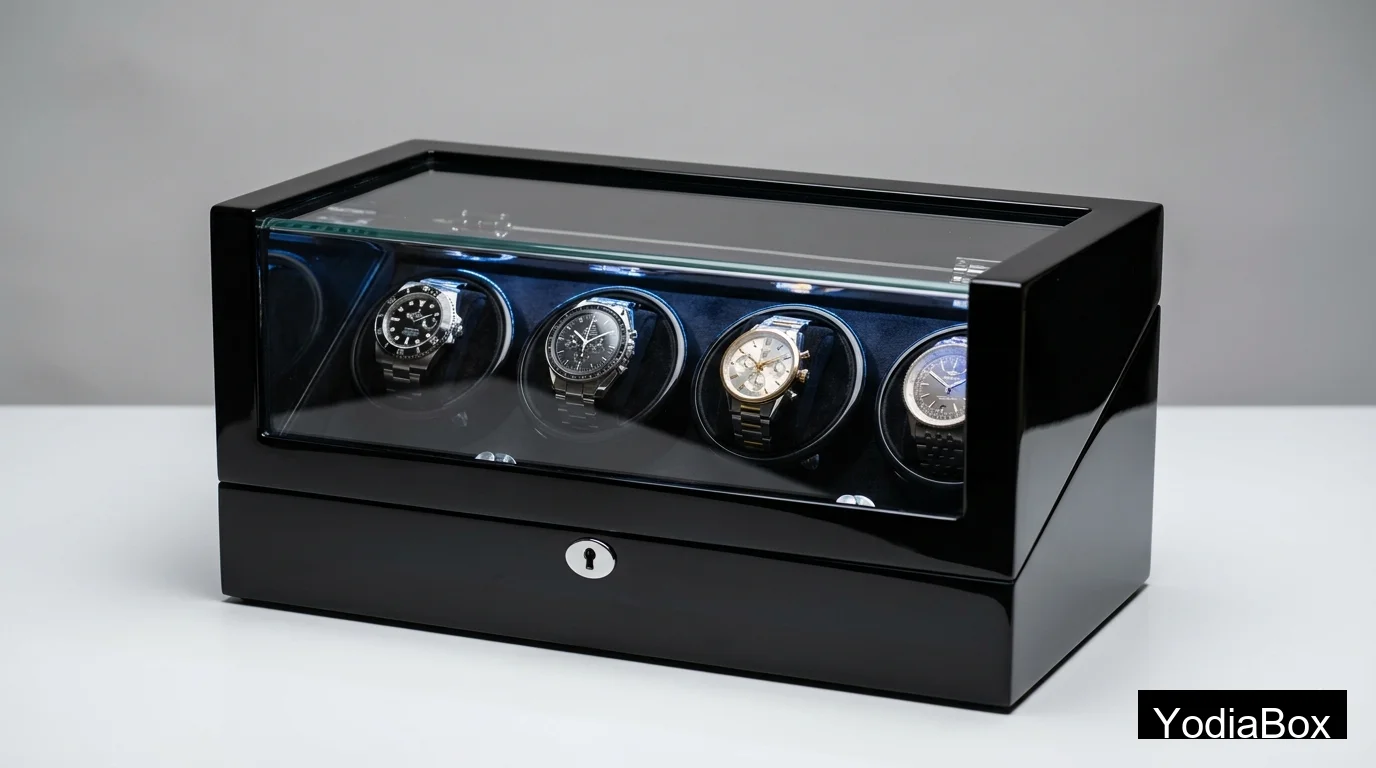
Now the other side. A multi watch winder box is often the stronger product if your brand positioning is premium, collector-focused, or gift-oriented.
1. Higher perceived value
A 4-slot or 6-slot unit gives immediate visual impact. Buyers see a system, not an accessory. That supports better margins, especially when paired with:
– piano lacquer wood
– carbon fiber PU
– vegan leather
– suede or velvet lining
– brushed metal control plate
– hidden drawer for straps or cufflinks
A good 4-watch model can retail at USD 249-399, while ex-factory cost may sit at USD 68-135 depending on motor spec, finish, and packaging.
2. Better upsell for established watch brands and retailers
If you already sell automatic watches from USD 500+ upward, a multi unit fits your customer profile better. It also works well in bundle campaigns, VIP rewards, or holiday gifting.
3. Better shelf impact in offline display
In a showroom or authorized dealer network, a larger unit creates more presence. We often coordinate finish direction with broader custom packaging programs so the winder line matches watch boxes, shopping bags, and service kits.
4. Stronger logo presentation
You simply have more real estate for branding. Common placements include:
– foil logo on lid top: 40-70 mm width
– metal logo plate on front panel: 25 x 12 mm
– embossed logo on pillow holders
– silk-screen logo on adapter or user card
5. More SKU depth
A single well-designed shell can be extended into:
– 2-watch
– 4-watch
– 6-watch with storage drawer
– 8-watch cabinet
That helps larger buyers build a layered product ladder.
Hook: If your brand story is “collector lifestyle,” a one-slot unit often looks like an entry product, not a flagship.
The engineering trade-offs buyers should know
This is where many sourcing conversations become too optimistic. A multi watch winder box is not just a bigger shell.
Motor layout: independent vs linked
For single units, one motor and one control board is straightforward.
For multi units, you usually choose between:
1. Independent motor per slot or per pair
– better control consistency
– higher part cost
– easier after-sales isolation
2. Linked system
– lower cost
– fewer electronics
– more risk if one drive point fails
We usually recommend independent control for 4-watch and above if the target retail is over USD 299.
Noise and vibration
A complaint we hear from end users: “It works, but it is too loud for bedroom use.”
Typical acceptable factory targets:
– single unit: <38 dB at 30 cm
– 2-watch unit: <42 dB at 30 cm
– 4-watch unit: <45 dB at 30 cm
These numbers depend on room background noise, so they are not universal. But if your supplier gives no dB target at all, that is a warning sign.
Pillow size and watch fit
This is one of the biggest return drivers. Many brands focus on the outside box and ignore the cushion compression range.
A practical cushion circumference range is:
– 170-210 mm for flexible foam pillows
– 150-190 mm for firmer PU core pillows
Large men’s watches with 42-45 mm cases and thick bracelets need enough slot width. We usually keep clear spacing at 60-65 mm per watch for a 4-slot premium model.
Hook: The most expensive finish means nothing if the customer’s bracelet cannot close around the pillow.
Cost structure: where the extra money really goes
Buyers often assume a multi watch winder box should cost 2x a single unit because it holds four times more watches. In production, the math does not scale cleanly.
| Cost element | Single unit share | Multi unit share | Factory comment |
|---|---|---|---|
| Motor/electronics | 22%-30% | 28%-40% | Biggest driver if using independent motors |
| Cabinet material | 18%-25% | 20%-28% | Wall thickness and reinforcement increase |
| Interior + pillows | 12%-18% | 10%-16% | More pieces, but efficient to batch |
| Packaging + freight impact | 10%-15% | 15%-25% | Multi units get hit by dimensional weight |
In our quotations, the most common cost surprises are not veneer or logo fees. They are:
– upgraded adapters with market-compliant plugs
– extra foam protection
– stronger master cartons
– rework from lid-gap inconsistency
– higher QC labor for function testing
If you are importing into the EU, the electrical side also needs attention. For powered products, buyers should confirm applicable compliance on components and final product claims, especially around CE Marking, the Low Voltage Directive 2014/35/EU, and material restrictions such as RoHS Directive 2011/65/EU. The exact obligation depends on voltage range, market, and how the product is declared, so we always tell buyers to review compliance with their importer or test lab before mass production.
> Pro Tip
> If you are launching your first multi watch winder box, start with one 2-watch model and one 4-watch model, not four sizes at once. We see fewer packaging revisions, less dead stock, and cleaner customer feedback that way.
Material and finish choices by configuration
Single and multi units do not always want the same finish.
For singles, the best-selling finishes in our orders are:
– black PU leather
– dark walnut veneer
– matte carbon-pattern PU
– beige microfiber lining
For multi units, buyers more often choose:
– piano black lacquer
– ebony veneer
– saffiano PU
– dark gray suede interior
– champagne gold or gunmetal hardware
The reason is visual scale. A larger cabinet can carry a more formal finish without looking bulky.
That said, glossy lacquer is beautiful and also risky. We see more surface scratch claims on piano black than on textured PU. If your main channel is e-commerce, textured synthetic leather is usually a safer choice.
For broader line consistency, some clients pair the winder program with custom jewelry boxes, wholesale jewelry boxes, or a full jewelry packaging collection so the watch accessory line looks intentional instead of added later.
Quality control points that differ between single and multi
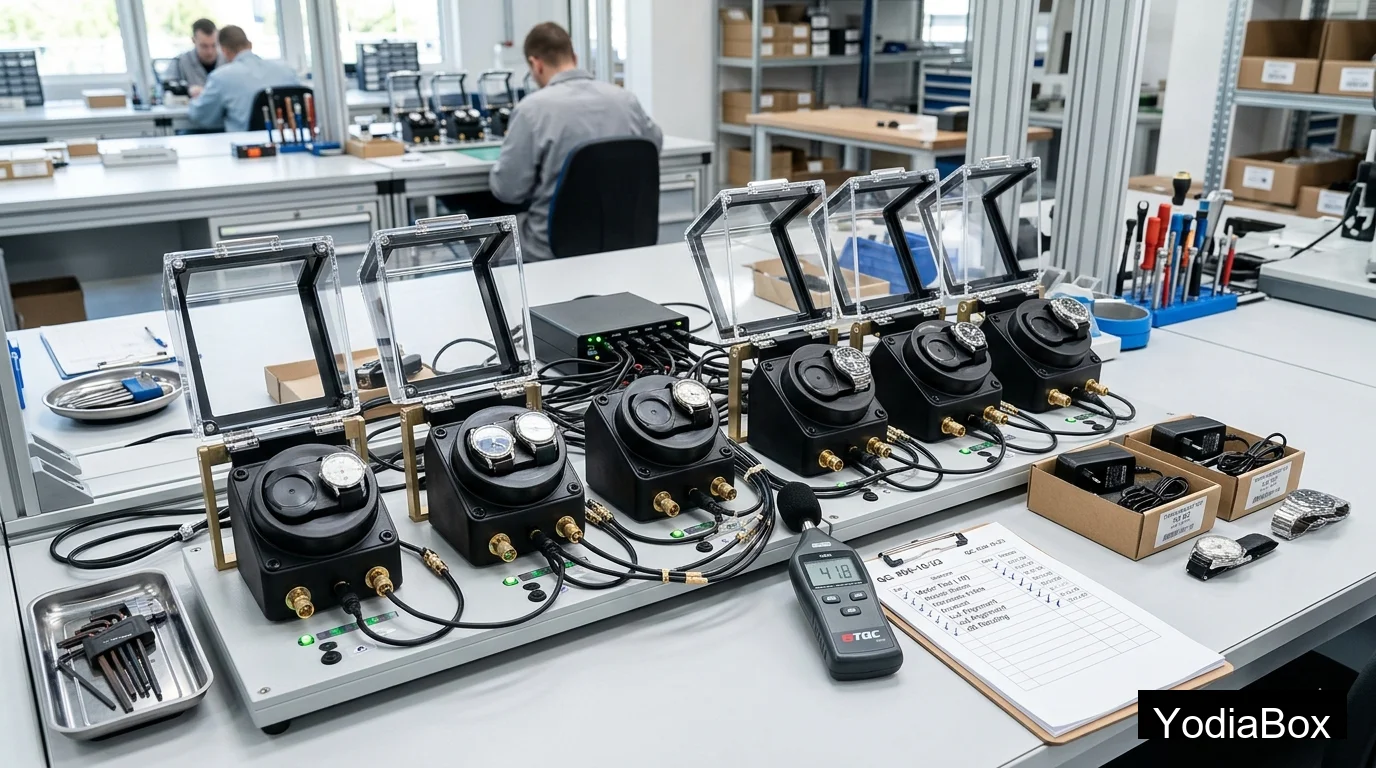
A good-looking sample is not enough. We normally build a QC checklist around the exact configuration.
Single-unit critical checks
– rotation mode change works correctly
– stop/start timing stable over 24 hours
– pillow compression returns shape
– lid hinge torque consistent
– adapter plug fit and polarity correct
Multi-unit critical checks
– all slots rotate in programmed sequence
– no synchronized stalling after 8-12 hours
– front gap tolerance within 1.0-1.5 mm
– LED heat buildup controlled
– drawer rail and lock alignment stable
– noise difference between slots not obvious
If buyers ask for inspection, we usually suggest AQL-based sampling rather than random eyeballing. The framework many importers use is ISO 2859 Sampling, though the exact AQL level depends on your defect tolerance and retailer requirements.
> Common Mistake
> Approving a silent pre-production sample and assuming mass production will sound the same. Noise variation often appears batch to batch because of motor sourcing, screw torque, foam pressure, and cavity resonance.
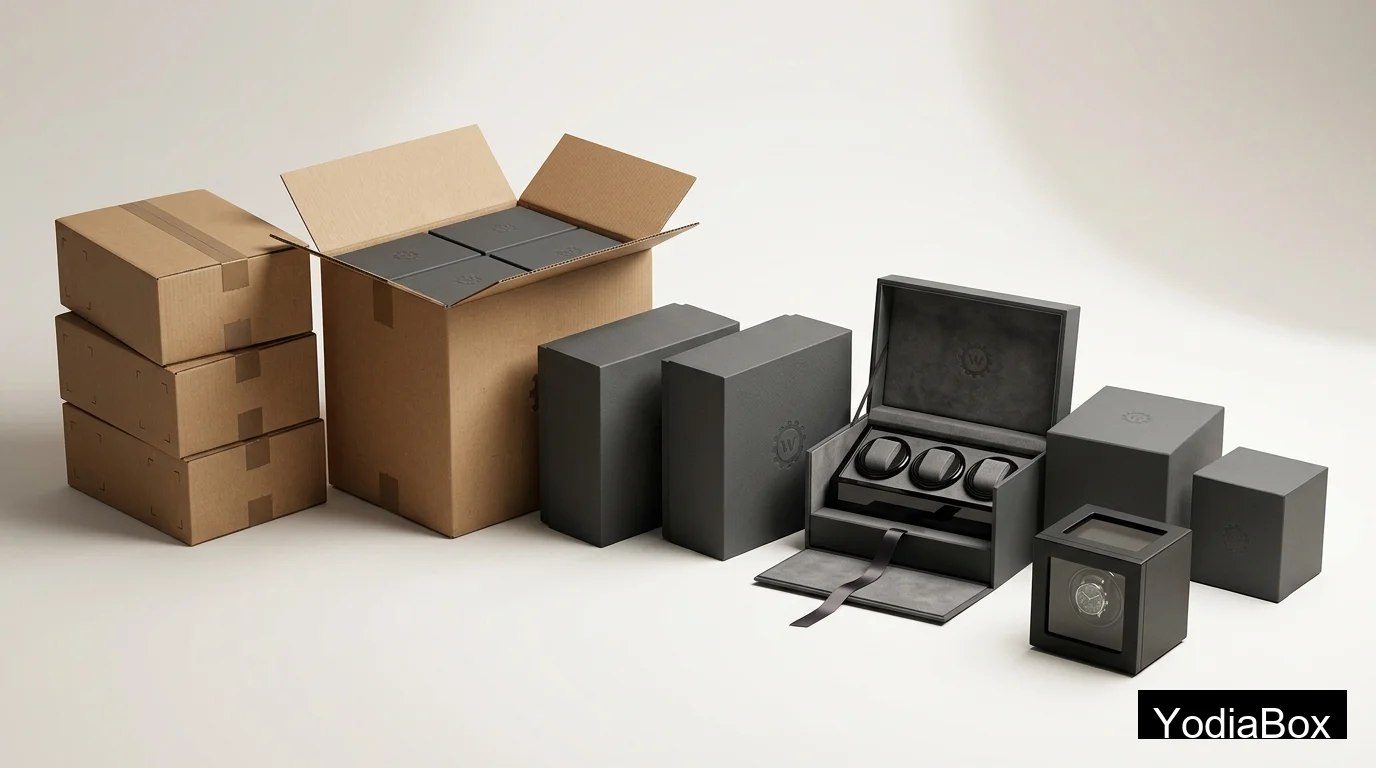
Packaging and shipping: the hidden factor in configuration choice
This is where many projects win or lose margin.
A single unit can often fit into an outer carton around 230 x 220 x 250 mm. A 4-watch model may need 410 x 350 x 330 mm or more once protective foam is added.
That affects:
– courier pricing
– pallet density
– container load count
– damage rate
– warehouse shelf space
A rough example from our shipping files:
– Single unit packed volume: about 0.013 m³
– 4-watch unit packed volume: about 0.047 m³
That is not 4x product value, but it can be 3.5x the volume.
Hook: A cheaper factory price can still lose once your freight team calculates dimensional weight.
If you are a brand trying to keep inventory flexible, we often advise fewer carton sizes and modular foam tooling. That also helps when extending the line later through the same jewelry box manufacturer or broader custom gift packaging supplier setup.
> Engineering Note
> For 4-watch and larger cabinets, we prefer EPE or EVA support blocks at the motor base area, not only at the corners. Corner-only protection passes some drop tests but still allows internal shock to affect the drive assembly.
Which configuration is best for your brand?
Here is the practical answer.
Choose a single watch winder box if:
– your target retail is USD 79-149
– you are new to powered accessories
– your channel is DTC, marketplace, or small-batch wholesale
– you want MOQ around 100-200 pcs
– you need lower warranty and shipping risk
Choose a multi watch winder box if:
– your target retail is USD 199-599
– your customers own multiple automatic watches
– your brand story is premium, collector, or gifting
– you can manage stricter QC and larger freight cost
– you want stronger average order value
In many cases, the best answer is not one or the other. It is a staged line:
1. launch 1-slot
2. add 2-slot after sales validation
3. introduce flagship 4-slot for holiday or VIP channel
We have seen this approach work better than launching six SKUs at once.
Our factory recommendation by buyer type
If we are advising a procurement manager, we usually break it down this way:
– Startup brand: start with 1-slot, MOQ 100 pcs, 2 finishes max
– Mid-market retailer: launch 1-slot + 4-slot together, MOQ 100 + 50 pcs
– Premium watch/jewelry brand: skip basic single if your AOV is already high; build a 2-slot and 4-slot family with matched packaging and custom logo details
– Corporate gifting buyer: 2-slot often works best because it looks substantial without the freight burden of a 4-slot
Hook: The best-selling configuration is often not the most impressive sample on the table. It is the one your customer can buy without hesitation.
FAQ
Is a multi watch winder box always more profitable than a single unit?
Not always. Multi units usually have higher ticket value, but also higher freight, packaging, QC, and warranty cost. We have seen single units deliver better net margin for online sellers at retail below USD 129.
What is the usual MOQ for custom watch winder boxes?
For a single watch winder box, a realistic MOQ is 100-200 pcs for custom exterior, logo, and packaging. For a multi watch winder box, many factories accept 50-100 pcs per design, but component requirements can push the practical MOQ higher if you need custom control boards or special finishes.
Which configuration has fewer quality issues?
Single units usually have fewer issues because they have fewer motors, simpler wiring, and smaller cabinets. In our after-sales records, multi units need more attention on motor consistency, lid alignment, and transport protection.
Are multi watch winders better for luxury branding?
Usually yes. A 2-slot or 4-slot cabinet gives more visual impact and supports a higher perceived value. That is why premium buyers often combine them with matching low MOQ packaging development for pilot runs before larger production.
What size should each watch slot be in a multi watch winder box?
For most men’s watches, we suggest 60-65 mm clear width per slot and pillow fit for wrists around 170-210 mm. If your brand sells larger sports watches over 44 mm, ask for a fit test with the actual bracelet sample.
Do watch winder boxes need CE or RoHS compliance?
For powered products sold into the EU or claimed as compliant, buyers should review the applicable requirements for electronics, adapters, and materials. The exact scope depends on product voltage, market, and declaration route. At minimum, ask your supplier what testing documents exist for the adapter, PCB, and material restrictions.
Final decision: build the line around risk, not only appearance
If your goal is to enter the category with controlled risk, start with a single watch winder box.
If your goal is to raise perceived value and sell into a collector audience, invest in a multi watch winder box with proper engineering, stronger packaging, and realistic QC standards.
We say this from experience: the beautiful sample wins the meeting, but the stable production version wins the business. Configuration is where that difference starts.
If you are comparing options now, contact us with your target retail price, quantity, market, and preferred finish. We can help you narrow the right watch winder structure, MOQ, and packaging plan before sampling.
References & Sources
1. [CE Marking](https://single-market-economy.ec.europa.eu/single-market/ce-marking_en) — European Commission
2. [Low Voltage Directive 2014/35/EU](https://eur-lex.europa.eu/legal-content/EN/TXT/?uri=CELEX:32014L0035) — European Commission
3. [[RoHS Directive 2011/65/EU](https://eur-lex.europa.eu/legal-content/EN/TXT/?uri=CELEX:32011L0065)](https://eur-lex.europa.eu/legal-content/EN/TXT/?uri=CELEX:32011L0065) — European Commission
4. [ISO 2859 Sampling](https://www.iso.org/standard/16578.html) — ISO
Written by: Sarah Jenkins
Senior Content Specialist
Seasoned Industry Editor with 5 years of experience, dedicated to delivering in-depth technical and market reports.
Reviewed by: Dr. Eric Shao
Chief Technical Director
With 12 years of experience in material science and custom manufacturing, ensures the scientific accuracy and technical compliance of all published content.
Recommended Reads
Gift packaging
10 产品
Jewelry display
12 产品
Jewelry Organizer
12 产品
Jewelry pouch
7 产品
Jewelry suitcase
6 产品
Leather jewelry box
13 产品
LED Jewelry box
8 产品
Paper jewelry box
10 产品
Velvet Jewelry box
11 产品
Watch box
7 产品
Wood jewelry box
6 产品
Jewelry Organizer Ideas: Complete Guide to Storing & Displaying Every Type
We’ve worked in jewelry packaging for more than a decade, and the question we hear [...]
Jun
Box Hoop Earrings Packaging: The Complete B2B Sourcing & Selection Guide
Box Hoop Earrings Packaging: The Complete B2B Sourcing & Selection Guide Choosing the right box [...]
Silver Bracelet Box: Custom Packaging Solutions for Jewelry Brands
Silver Bracelet Box: Custom Packaging Solutions for Jewelry Brands Custom silver bracelet boxes are specialized, [...]
Wooden Watch Box OEM Guide: Wood Species, Joinery, Finishing & Customization for Bulk Buyers
Most buyers come to us with a simple request: "I want a wooden watch box, [...]
Jun
Watch Box Cushion & Pillow Design: An OEM Engineer’s Complete Guide
Every watch box we produce lives or dies on one component most buyers never think [...]
Jun
Initial Travel Jewelry Box Guide: How to Choose the Best One
Initial Travel Jewelry Box Guide: How to Choose the Best One To choose the best [...]