
Automatic Watch Winder Box: Features, Materials, and OEM Customization Options
If you are developing an automatic watch winder box for your brand, the hard part is usually not the outer look. It is getting the motor noise, rotation logic, lid fit, interior protection, power compliance, and retail cost to land in the same product.
We build packaging and presentation boxes in the jewelry and watch category, and in our experience, watch winder projects go wrong in very predictable ways: buyers over-spec the exterior, under-spec the motor, ignore pillow compression, and leave compliance questions until the sample is already approved.
This guide is written from the factory side. We will cover what an automatic watch winder box actually needs to do, which materials work in production, what OEM options are realistic, and where cost moves fastest.
Quick hook: a good-looking winder that returns at a 6% defect rate is not a good product.
Another hook: the quietest sample is often not the most stable mass-production unit.
And one more: a 2 mm gap mistake at the cushion stage can make a $12 movement look like a $2 product.
Jump to
– [What an automatic watch winder box must do](#what-an-automatic-watch-winder-box-must-do)
– [Core features that affect real performance](#core-features-that-affect-real-performance)
– [Materials and construction choices](#materials-and-construction-choices)
– [OEM customization options](#oem-customization-options)
– [Typical specs, MOQ, and price ranges](#typical-specs-moq-and-price-ranges)
– [Quality, testing, and compliance](#quality-testing-and-compliance)
– [FAQ](#faq)
What an automatic watch winder box must do
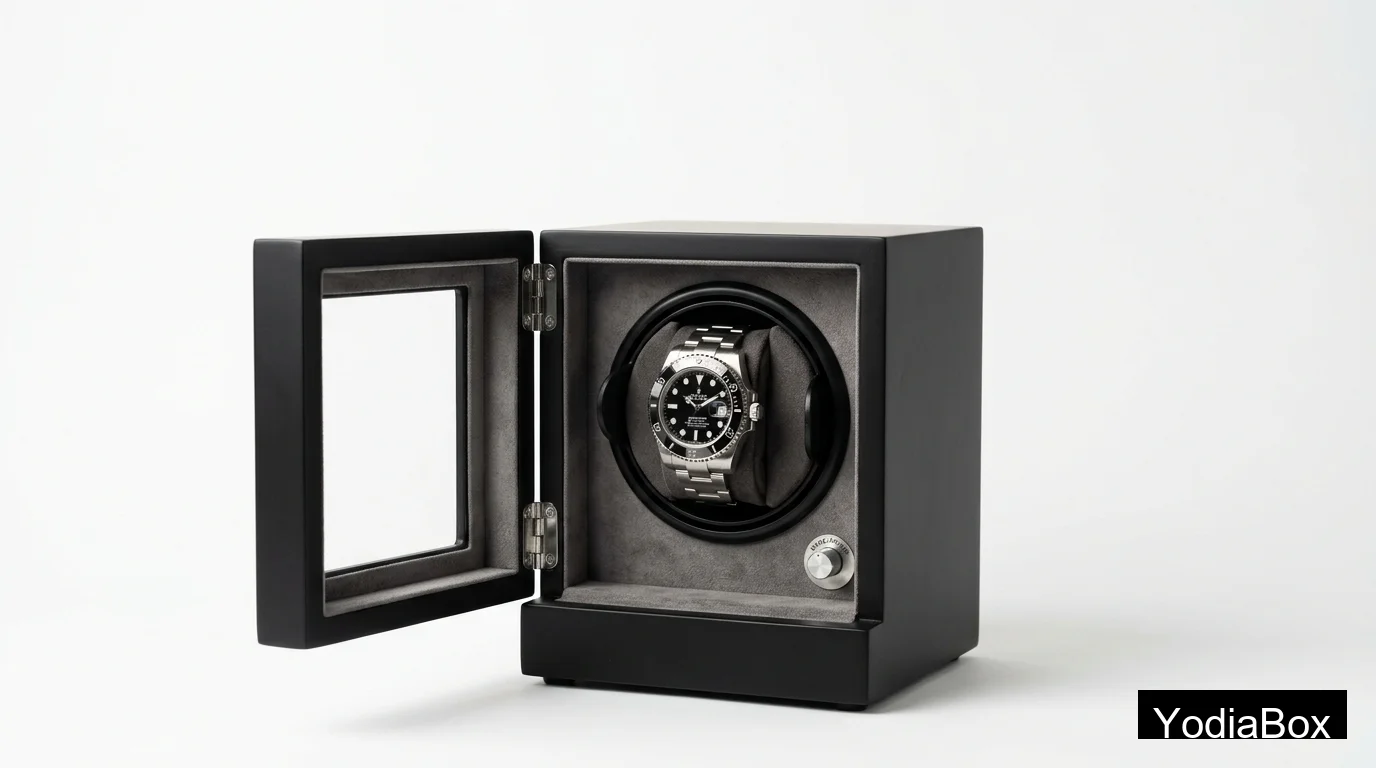
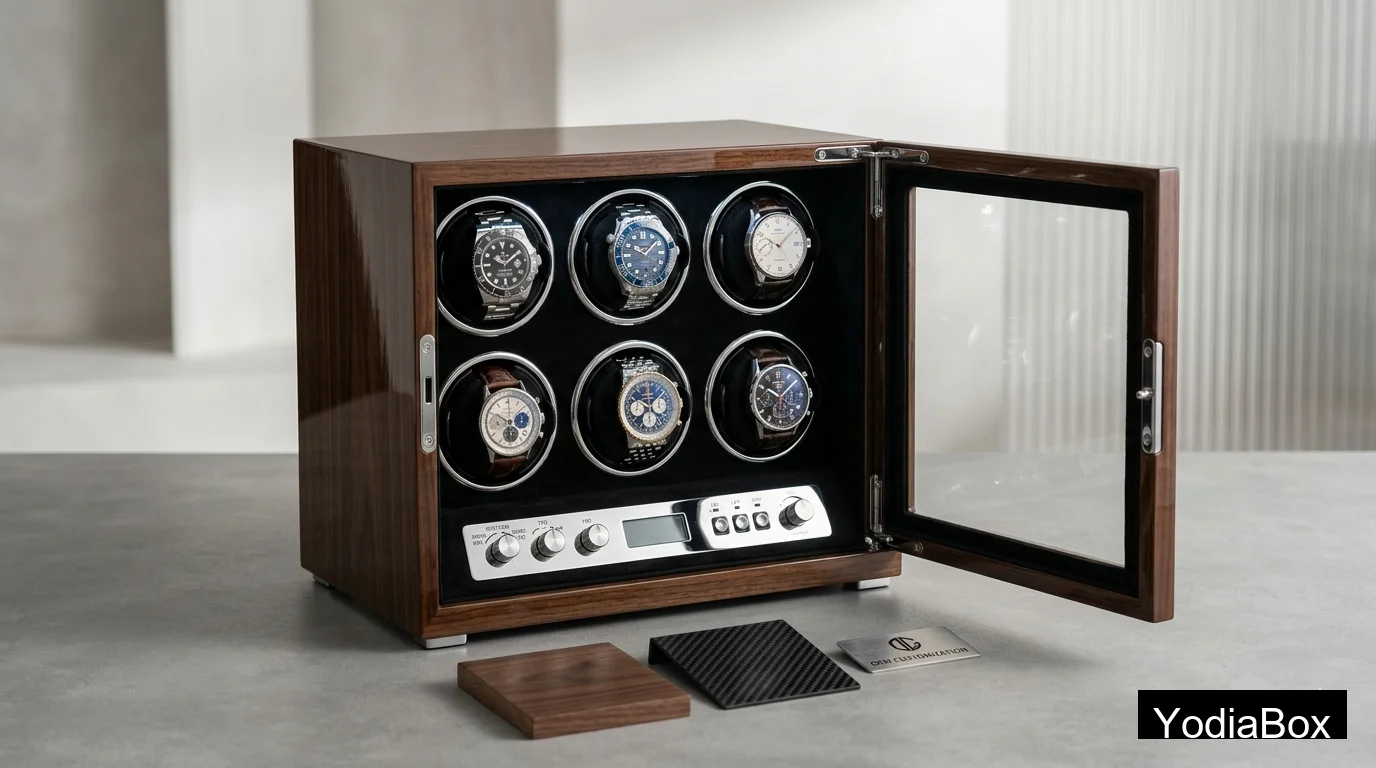
An automatic watch winder box is a powered storage box that rotates an automatic mechanical watch at controlled intervals to keep the movement wound when the watch is not being worn. That sounds simple, but at OEM level it means balancing five things at once:
1. Correct turns per day
2. Direction control
3. Low vibration and low noise
4. Stable watch holding
5. Safe power system and consistent assembly
For product designers, the main decision is whether the winder is being sold as:
– a functional storage device,
– a premium gift box,
– a collector display piece,
– or a bundled accessory with a watch.
Those are not the same product.
A bundled gift-box style unit may target FOB US$18-35 for a single winder at MOQ 300-500 pcs. A collector-grade unit with piano lacquer, Mabuchi-style motor architecture, glass window, and drawer can move to US$55-120 FOB at MOQ 100-300 pcs, depending on electronics and finish yield.
In our factory experience, brands often start by asking for “luxury.” We push them to define three measurable targets first:
– Noise target: under 25-30 dB at 1 meter
– Pillow fit range: suitable for wrist circumference roughly 145-210 mm
– Power mode: 100-240V adapter, USB-C 5V, or 2 x D battery / 4 x AA battery depending on cavity size
If these are not defined early, sampling becomes slow and expensive.
> “My cheap winder is louder than my fridge at night.”
> — common buyer complaint seen across watch forums and Reddit threads
> “The pillow was too big for my 6.5-inch wrist, so the bracelet sat under tension all month.”
> — typical collector feedback in community discussions
Those two complaints explain a large share of returns.
Core features that affect real performance
A watch winder is judged in the first 10 seconds by appearance, but in the first 30 days by mechanics.
1. Rotation program
Most automatic movements do not need constant spinning. A usable program usually includes:
– Clockwise
– Counterclockwise
– Bi-directional
– Cycle mode with rest periods
A practical setting range is 650-1,200 TPD (turns per day), with 650, 900, 1,200 as the most requested presets. Many watches perform well in the 650-800 TPD range, but it depends on the movement. We normally advise brands not to print “fits all watches” on packaging because that claim is too broad.
2. Motor type and noise control
This is where cheap and stable products separate.
A single automatic watch winder box normally uses:
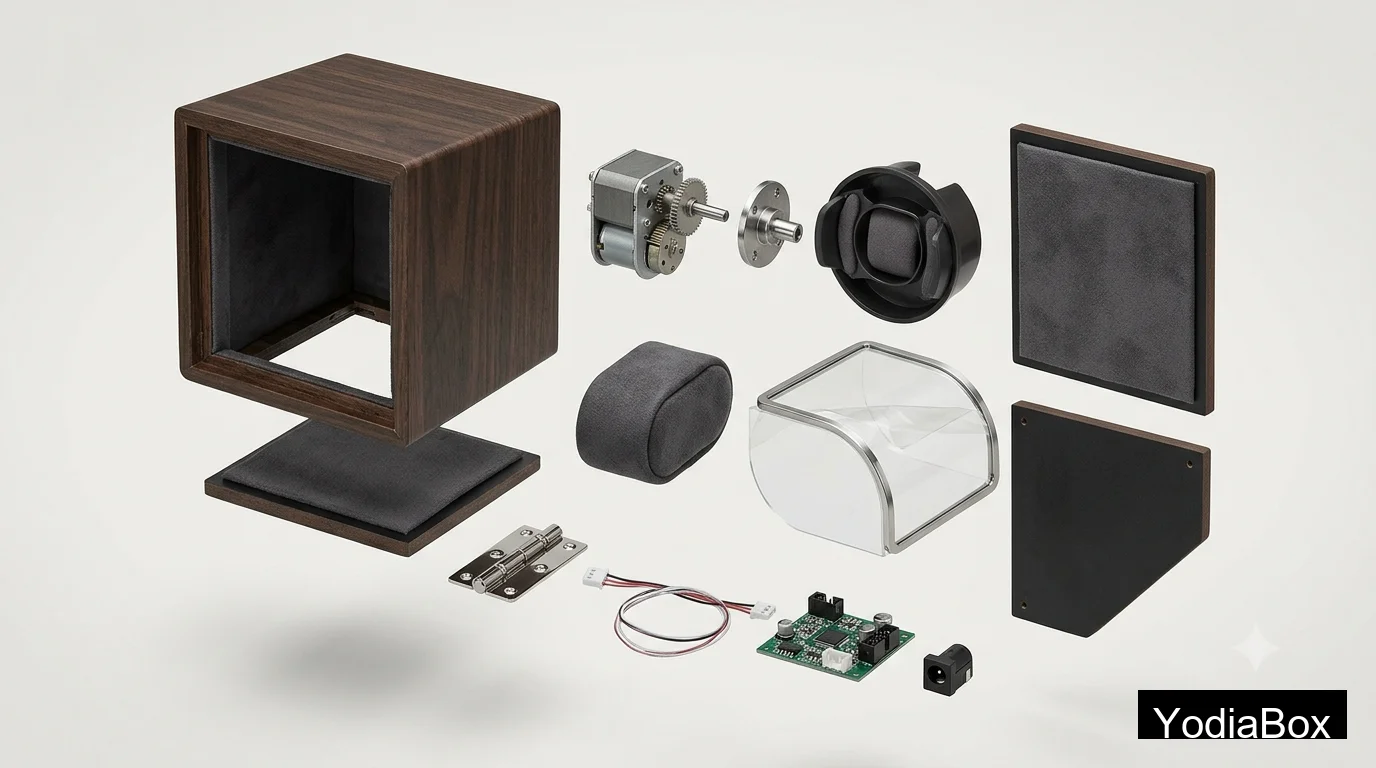
– DC geared motor
– belt or direct gear transmission
– foam isolation pad
– plastic or metal rotor bracket
The lowest sample cost usually comes from generic DC motors, but mass production often shows more variation in:
– startup smoothness
– hum frequency
– heat
– rotor wobble
If the customer wants bedroom use, we usually suggest increasing motor and bracket budget by US$1.80-4.50 per unit rather than spending that money only on thicker paint or nicer logo plating.
3. Pillow structure
Pillow design is one of the most underestimated parts of the box.
Common sizes:
– Single watch pillow width: 70-80 mm
– Compressible circumference range: 160-190 mm
– Small wrist option: 145-170 mm
If the pillow is too hard, the bracelet gets stressed. If too soft, the watch slips during rotation. For heavy steel watches over 180 g, we often use:
– high-density PU foam core
– elastic wrap
– microfiber or suede cover
– side compression tabs
4. Lid and viewing panel
A glass or acrylic window increases gift appeal, but creates new production risks:
– corner breakage
– adhesive overflow
– dust visibility
– panel rattle
For premium units, we prefer 2.0-3.0 mm tempered glass or 2.0 mm acrylic depending on budget and shipping route. Acrylic lowers breakage risk and freight claim rate, but scratches more easily.
5. Power options
Buyers usually choose between these:
– AC adapter
– USB power
– battery power
– dual power system
Dual power is attractive on paper, but adds wiring, switch points, and troubleshooting. If the product will sell online and ship internationally, USB-C input is becoming easier for retail packaging and replacement convenience.
Materials and construction choices
Material choice is not just about appearance. It affects yield, smell, scratch rate, edge quality, and assembly time.
Outer body materials
The most common shell base is MDF because it is stable, easy to machine, and gives a premium weight. Typical thickness:
– 9 mm MDF for compact single units
– 12 mm MDF for double and quad units
– 5-6 mm inner structural panels where needed
Other options include solid wood veneer, ABS shell, or PU-wrapped paperboard, but those suit different price levels.
Surface finish options
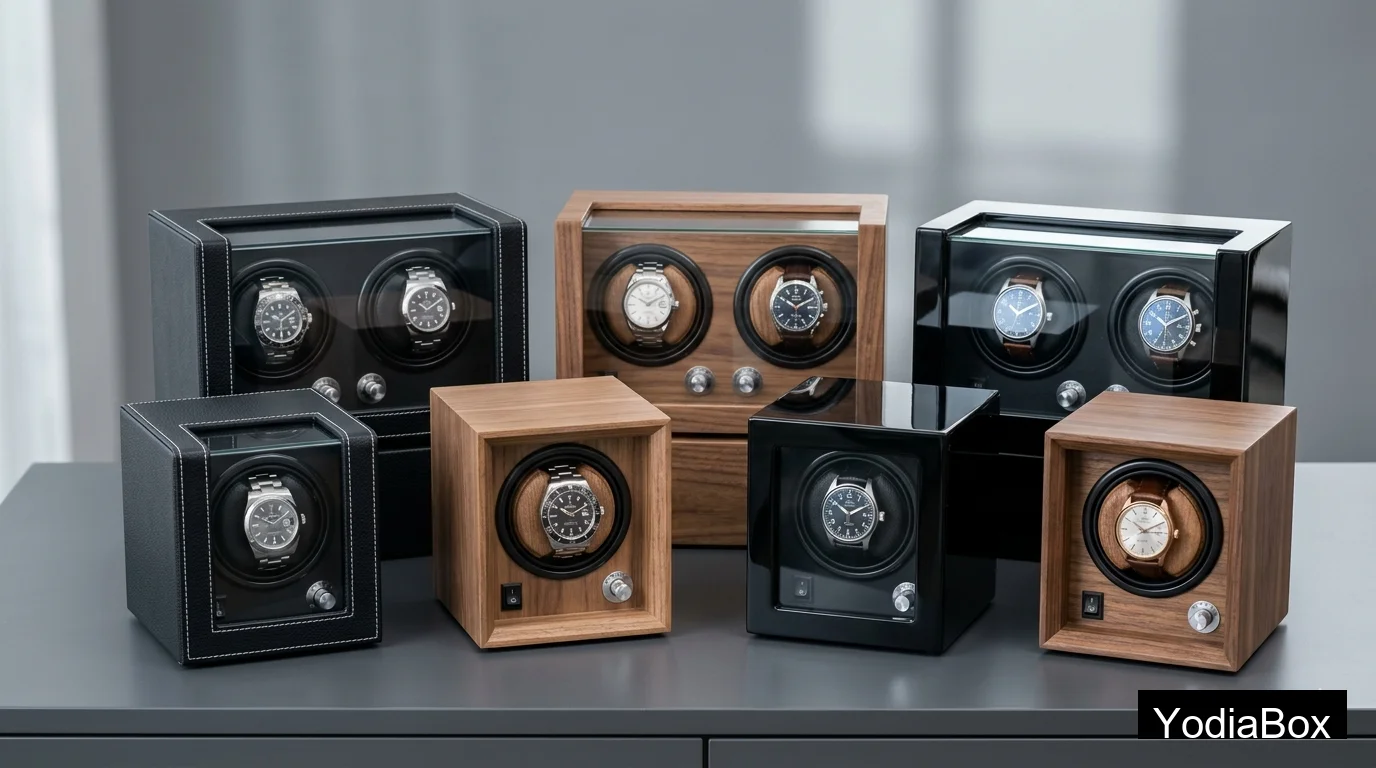
Here is where buyers often over-customize too early. We usually narrow finishes into four practical groups.
| Finish type | Typical look | Cost impact | Best use |
|---|---|---|---|
| PU leather wrap | Soft luxury, broad color range | +US$2-5/unit | Mid-range retail, brand gift sets |
| Piano lacquer | High gloss premium | +US$8-18/unit | Collector display, luxury positioning |
| Wood veneer | Natural grain, classic watch aesthetic | +US$6-14/unit | Heritage-style brands |
| Matte paper + coating | Clean, economical | +US$1-3/unit | Entry OEM, promo programs |
Hook: the finish with the fewest fingerprints in the showroom is often not the finish with the best carton survival.
For leather-style exterior, we frequently use PU in 0.6-0.9 mm thickness over foam and MDF. Real leather is possible, but MOQ and material variation are higher, and the cost increase is usually US$10-25 per unit for small runs.
If you are already sourcing custom packaging or custom jewelry boxes across one collection, matching the watch winder exterior to the wider brand package system helps lower design fragmentation.
Interior materials
Inside the box, the most common linings are:
– microfiber suede
– velvet
– PU leather
– satin for non-contact accent zones
For the watch contact area, microfiber or short-nap suede is usually safer than coarse velvet because it sheds less and presents cleaner under glass.
Typical interior foam density:
– 18-22 kg/m³ for decorative support
– 28-35 kg/m³ for cushion structure
– 40+ kg/m³ where compression retention matters
Hardware and detail parts
The parts customers notice in person:
– hinges
– lid stay
– drawer pull
– switch feel
– logo plate
– adapter jack fit
A weak hinge can ruin the entire product impression. On a box size around 165 x 155 x 145 mm, we usually specify hinge cycle testing at 500-1,000 open/close cycles minimum for development approval.
OEM customization options
This is where an OEM project becomes interesting. Most buyers do not want a generic unit with only a logo. They want a box that matches their watch identity.
Brand appearance customization
Standard options include:
– embossed or debossed logo
– foil stamping in gold, silver, black, rose gold
– laser engraved metal plate
– silk screen on inner lid
– custom color matching by Pantone reference
– gift sleeve or rigid outer carton
For logo setup, our normal MOQ is:
– 300 pcs for standard logo application on existing structure
– 500 pcs for new color + new inner layout
– 800-1,000 pcs for custom mold-heavy plastic parts or new electronics housing
If the buyer also needs matching custom logo work across other watch or jewelry SKUs, we recommend approving one metal tone master first. “Gold” can vary too much between zipper pulls, hinge plating, logo plates, and foil.
Structural customization
Common requests:
– single, double, 4-watch, 6-watch, or 8-watch capacity
– storage drawer for straps or tools
– jewelry compartment under the rotor deck
– removable travel case
– lock and key
– lid window shape changes
– hidden control panel
We always ask one practical question: will the product be sold mostly online, in-store, or as a corporate gift?
That answer changes the engineering:
– Online retail needs stronger drop protection and easier power instructions.
– In-store display needs cleaner viewing angle and lower operating noise.
– Corporate gift needs faster assembly and lower unit cost.
Electronics customization
The most requested controls are:
– on/off
– clockwise/counterclockwise/bidirectional
– timer presets
– LED light
– sleep mode
Be careful with LED lighting. It looks premium in listing photos, but adds heat, wiring, and one more failure point. On entry-to-mid projects, removing LED often improves reliability more than buyers expect.
Packaging customization
A good automatic watch winder box still needs good transit packaging. We commonly use:
– 1 pc in polybag or non-woven bag
– EPE or EVA corner protection
– inner gift box
– 5-layer export carton
Typical outer carton drop risk rises quickly once product weight goes above 2.8 kg gross for lacquered units. If you are also comparing broader jewelry packaging solutions for your line, keep pallet density and carton dimensions aligned where possible.
Typical specs, MOQ, and price ranges
Below is a practical comparison based on common OEM structures we see requested.
| Type | Typical size | MOQ | FOB price range |
|---|---|---|---|
| Single winder | 165 x 155 x 145 mm | 300 pcs | US$18-35 |
| Double winder | 245 x 185 x 165 mm | 200 pcs | US$32-58 |
| 4-watch winder | 335 x 245 x 215 mm | 100 pcs | US$55-120 |
| Single winder + drawer | 165 x 155 x 210 mm | 300 pcs | US$26-45 |
These are not universal prices. Actual cost depends on:
– finish yield
– motor grade
– glass vs acrylic
– adapter certification scope
– packaging level
– order quantity
– inspection standard
Hook: if two suppliers quote the same single-winder price, compare motor source and carton protection first, not just surface finish.
For brands just entering the category, we often suggest starting with one proven body size and customizing:
– exterior wrap
– pillow fit
– logo
– control graphic
– gift box
That keeps development cost under control and usually cuts sampling by 2-4 weeks versus a fully new structure.
If your team needs a broader sourcing benchmark, compare winder programs with your existing wholesale jewelry boxes or work with a jewelry box manufacturer already handling rigid-box tolerances and finishing consistency.
Quality testing and compliance
A watch winder box is part packaging, part consumer electronic item. That means compliance should not be treated casually.
For electrical safety and market access in Europe, relevant concepts include the Low Voltage Directive 2014/35/EU, RoHS Directive 2011/65/EU, and general CE Marking requirements. Which exact directives apply depends on the input voltage, adapter configuration, and final product setup, so we always tell buyers to confirm with their compliance team before mass production.
For inspection, many buyers use AQL sampling based on ISO 2859 Sampling. In our experience, a common shipment standard is:
– Critical: 0
– Major: 2.5
– Minor: 4.0
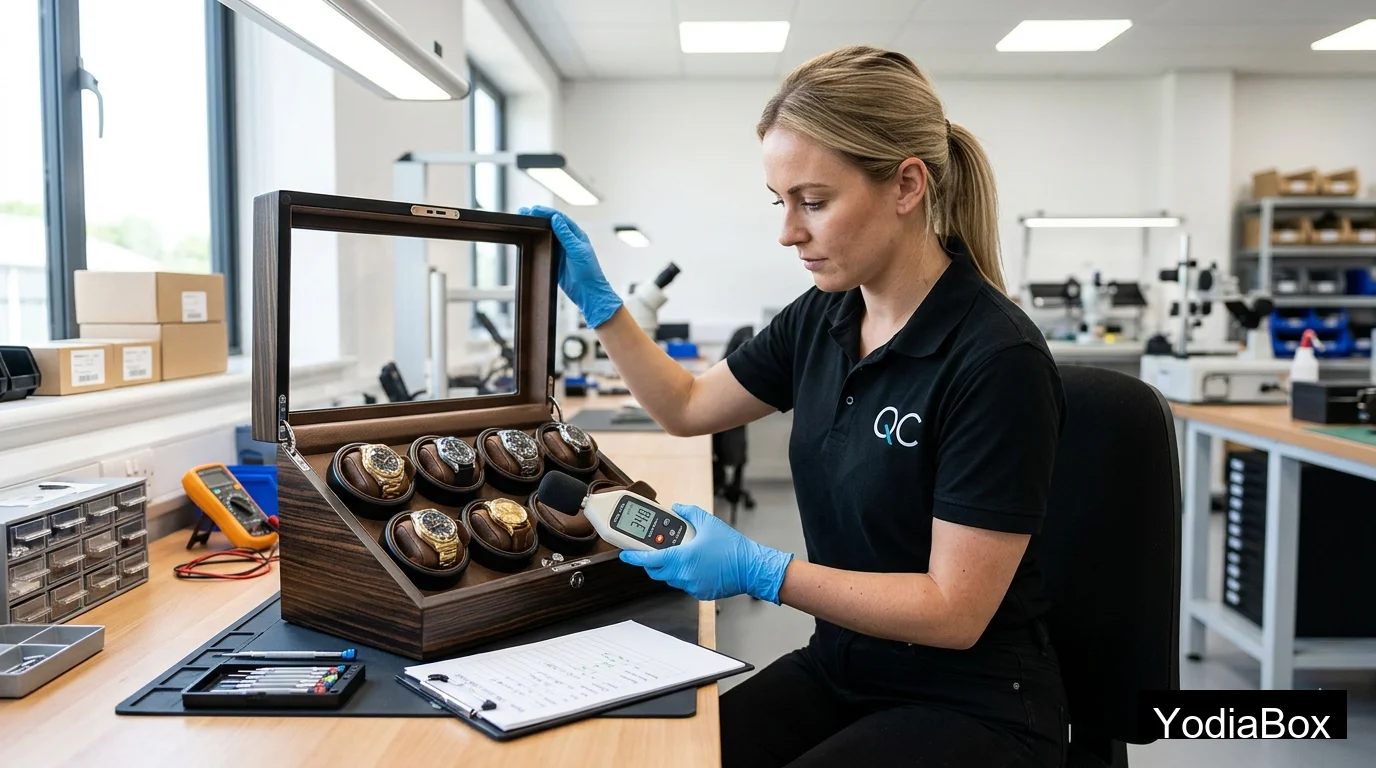
Typical factory QC points for an automatic watch winder box:
– motor noise test
– rotation direction verification
– 2-hour to 8-hour aging run
– switch function
– adapter fit
– lid alignment
– logo position
– lining cleanliness
– drop test on packaged unit
– carton mark check
Engineering tolerances that matter
A few numbers we watch closely:
– lid-to-body gap: 1.2-2.0 mm
– window glue overflow: 0 mm visible from 30 cm
– rotor face wobble: ideally under 1.5 mm
– logo position tolerance: ±1.0 mm
– edge wrap turn-in consistency: ±1.5 mm
> Pro Tip
> When you approve a sample, ask for a golden sample plus a motor spec sheet plus pillow hardness reference. If you only approve appearance, mass production can drift where you cannot see it in photos.
> Common Mistake
> Buyers often choose a pillow based on one sample watch. Then production arrives and half their customers wear smaller wrists. We usually recommend testing with at least 3 case sizes and 2 bracelet types before final approval.
> Engineering Note
> If your winder uses an external adapter, the adapter itself may carry separate compliance obligations from the box electronics. We treat the adapter source as a controlled component, not an afterthought.
Design trade-offs most buyers only discover after sampling
This is the section we wish more clients read before starting.
Gloss vs yield
Piano lacquer looks excellent in renderings. In production, it adds:
– more sanding passes
– longer curing time
– higher scratch sensitivity
– lower yield at corners
On dark high-gloss surfaces, even light dust is visible under retail lighting. If your target price is under US$40 FOB, piano lacquer can consume too much of the budget.
Bigger windows vs safer shipping
A large top window improves display value, but weakens the lid panel and increases breakage risk. We often reduce the window opening by 8-15 mm around the perimeter to keep the frame visually balanced and structurally safer.
More functions vs lower reliability
Every extra control adds risk:
– LED
– touchscreen
– fingerprint lock
– app control
For many mid-range watch brands, a quiet 3-mode mechanical-control unit sells better long term than a feature-heavy box with higher return rates.
Ultra-soft lining vs lint
Some suede-look fabrics feel luxurious in hand but shed fibers into the watch cavity. Under a glass lid, that becomes obvious immediately. We test lining materials by rubbing dark and light cloth over the surface before approval.
Hook: the fabric that wins the showroom touch test may fail the black-watch photography test.
How we usually develop an OEM automatic watch winder box
A straightforward OEM path looks like this:
Step 1: Define the target product
We ask for:
– target retail price
– capacity
– preferred power mode
– watch size range
– brand finish direction
– certification market
– packaging requirement
Step 2: Confirm structure and bill of materials
At this stage we lock:
– shell material
– motor grade
– lining
– pillow dimensions
– hardware color
– adapter type
– packaging method
Step 3: Make prototype or pre-production sample
Typical sample lead time:
– 10-14 days for logo/color changes on existing body
– 18-28 days for structural modification
– 30-45 days for mostly new construction
Step 4: Test with real watches
We strongly prefer buyers to test with:
– light leather-strap watch under 80 g
– standard steel sports watch around 120-180 g
– larger case watch around 42-45 mm
Step 5: Pilot run and final QC plan
Before mass production, we confirm:
– inspection checklist
– packaging drop requirements
– aging test hours
– approved photos for workmanship
For brands asking for low MOQ development, the best route is usually semi-custom rather than fully custom electronics. That is where cost and reliability stay balanced.
FAQ
What turns per day should an automatic watch winder box provide?
Most brands request 650, 900, and 1,200 TPD settings because those cover a wide range of automatic movements. We do not recommend claiming one setting fits every watch. Movement needs vary by caliber, so flexible directional control and rest cycles are safer than constant rotation.
Is a battery-powered or adapter-powered watch winder better?
It depends on how the customer will use it. Adapter-powered units are more stable for home display and reduce power fade. Battery-powered units help with shelf placement and gifting, but usually add ongoing replacement cost and can lose torque as batteries weaken.
What is the usual MOQ for OEM watch winder boxes?
For a standard structure with custom logo and color, MOQ is often 200-300 pcs. If you need a new mold, special electronics housing, or multiple structural changes, MOQ can rise to 500-1,000 pcs. Small trial orders are possible in some semi-custom programs.
Which materials are best for a premium automatic watch winder box?
For premium positioning, we usually see MDF structure, PU leather or piano lacquer exterior, microfiber suede lining, and glass or high-clarity acrylic window. The right choice depends on target FOB. PU leather is more forgiving in mass production than high-gloss lacquer.
How do you reduce watch winder noise in production?
The main levers are motor quality, bracket stability, gear fit, foam isolation, and assembly consistency. We usually get better results by upgrading the motor system and reducing rotor imbalance than by simply adding more interior padding. Sample quietness alone is not enough; consistency matters in batch production.
Video: what to review before approving a watch winder sample
For your product page, we recommend embedding a short factory review video showing:
– startup sound
– direction change
– pillow loading
– lid fit
– packaging drop-prep
Suggested VideoObject fields:
name: Automatic Watch Winder Box Sample Review
description: OEM sample review covering noise, rotation modes, pillow fit, and finish details
uploadDate: 2026-06-18
duration: PT1M30S
Final checklist before you request a quotation
Before asking any supplier to quote an automatic watch winder box, send these 10 points:
1. Capacity: 1 / 2 / 4 / 6 watches
2. Box size target or shelf limit
3. Exterior finish and color
4. Interior material and color
5. Watch pillow fit range
6. Power mode
7. Rotation modes and TPD target
8. Market compliance requirement
9. Packaging level
10. Target MOQ and FOB budget
Last hook: a clear RFQ can remove more cost than a hard negotiation.
If you want, we can turn your concept into a downloadable spec sheet with structure, materials, dimensions, and target BOM ranges so your sourcing and design teams are working from the same document.
CTA: Download spec
References & Sources
1. [[RoHS Directive 2011/65/EU](https://eur-lex.europa.eu/legal-content/EN/TXT/?uri=CELEX:32011L0065)](https://eur-lex.europa.eu/legal-content/EN/TXT/?uri=CELEX:32011L0065)
2. [Low Voltage Directive 2014/35/EU](https://eur-lex.europa.eu/legal-content/EN/TXT/?uri=CELEX:32014L0035)
3. [CE Marking](https://single-market-economy.ec.europa.eu/single-market/ce-marking_en)
4. [ISO 2859 Sampling](https://www.iso.org/standard/16578.html)
Written by: Sarah Jenkins
Senior Content Specialist
Seasoned Industry Editor with 5 years of experience, dedicated to delivering in-depth technical and market reports.
Reviewed by: Dr. Eric Shao
Chief Technical Director
With 12 years of experience in material science and custom manufacturing, ensures the scientific accuracy and technical compliance of all published content.
Recommended Reads
Gift packaging
10 产品
Jewelry display
12 产品
Jewelry Organizer
12 产品
Jewelry pouch
7 产品
Jewelry suitcase
6 产品
Leather jewelry box
13 产品
LED Jewelry box
8 产品
Paper jewelry box
10 产品
Velvet Jewelry box
11 产品
Watch box
7 产品
Wood jewelry box
6 产品
Watch Box Styles Guide: Complete OEM Breakdown for Buyers and Brand Managers
Every season, we quote hundreds of watch box projects — and the same confusion comes [...]
Jun
Silver Bracelet Box: Custom Packaging Solutions for Jewelry Brands
Silver Bracelet Box: Custom Packaging Solutions for Jewelry Brands Custom silver bracelet boxes are specialized, [...]
Box Hoop Earrings Packaging: The Complete B2B Sourcing & Selection Guide
Box Hoop Earrings Packaging: The Complete B2B Sourcing & Selection Guide Choosing the right box [...]
Luxury Watch Box Brands: An OEM Engineer’s Guide to Materials, Construction, and What Actually Matters
Most buyers searching for luxury watch box brands are asking the wrong question. Brand names [...]
Jun
Wooden Watch Box OEM Guide: Wood Species, Joinery, Finishing & Customization for Bulk Buyers
Most buyers come to us with a simple request: "I want a wooden watch box, [...]
Jun
Watch Box Cushion & Pillow Design: An OEM Engineer’s Complete Guide
Every watch box we produce lives or dies on one component most buyers never think [...]
Jun