
Custom Watch Box MOQ, Pricing, and Lead Time FAQ for Wholesale Buyers
If you are sourcing a custom watch box for retail, gifting, or OEM packaging, the first three questions are usually the same: *What is the MOQ? What will it cost? How long will it take?* In our factory, those three numbers depend less on the outer shape and more on five practical variables: box structure, material, logo process, insert style, and packaging standard.
From handling OEM and private-label watch packaging projects, I can say these are also the three numbers procurement teams use to eliminate suppliers fastest. In real quotation work, buyers rarely lose time because of the watch box concept itself; they lose time because the spec is incomplete. When our engineering team receives dimensions, watch head size, strap type, logo method, and destination market at the start, MOQ, pricing, and lead time become much easier to control.
Jump to: MOQ FAQ | Pricing FAQ | Lead-Time FAQ | Customization FAQ | Buyer Checklist FAQ
For buyers comparing quotes, this page gives the ranges we actually see in production. If your team is still benchmarking formats, our guides on Watch Box Price Tiers, Custom Jewelry Box Guide, and Automatic Watch Winder Box features can help narrow the spec before RFQ.
Industry-wide, packaging decisions are also shaped by freight efficiency, retail presentation, and sustainability requirements. For example, corrugated shipping standards are commonly referenced through the Fiber Box Association, while paper sourcing and forest-chain certification are often specified through FSC. For brands selling into the U.S. or EU, packaging claims and material disclosures may also need to align with broader trade and consumer rules published by agencies such as the U.S. Federal Trade Commission and the European Commission.
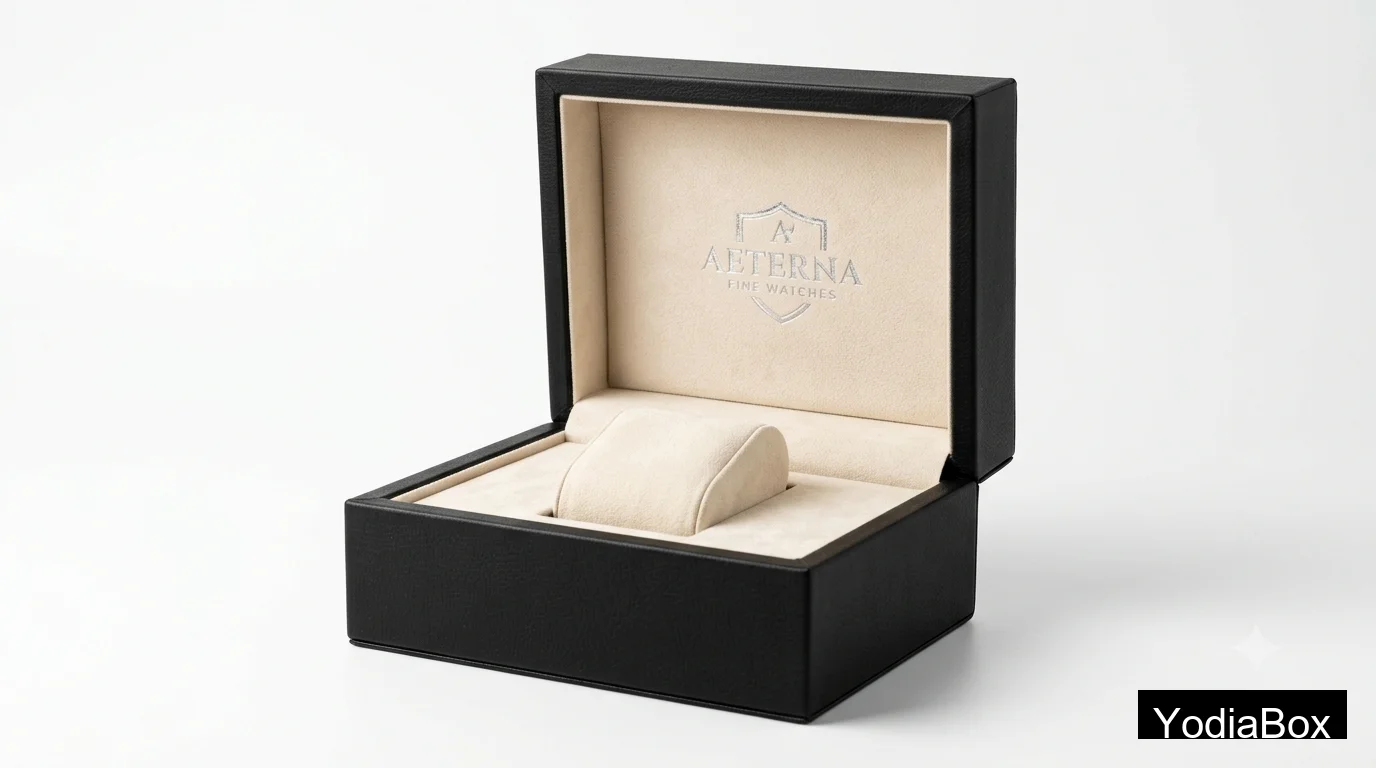
What usually sets MOQ, cost, and lead time
A watch box can look simple on screen and still be expensive in production. We have seen buyers change one detail and push MOQ from 300 units to 1,000 units. The most common triggers are:
– custom mold or uncommon structure
– real wood veneer instead of paper wrap
– metal badge logo instead of foil stamp
– split-color interior with hand-wrapped corners
– drop-test export carton upgrade
– accessory additions like booklet slot, ribbon pull, or LED
If you are buying for a watch launch, a practical starting spec is:
– size: 120 x 120 x 95 mm for a single watch box
– shell: 2 mm greyboard
– wrap: PU or specialty paper
– insert: 45-55 mm wide pillow
– outer carton: K=A export carton
– MOQ: 500 pcs
– sample lead time: 5-7 days
– mass production: 25-35 days
In factory terms, the biggest hidden factor is conversion efficiency. A rigid setup box, hinged box, drawer box, magnetic flap box, or watch presentation case may share similar outer dimensions, but labor minutes per unit can vary significantly. A foil-stamped paper-wrapped rigid box with EVA insert is usually straightforward. A lacquered wood watch box with zinc alloy nameplate, suede tray, and protective sleeve is not.
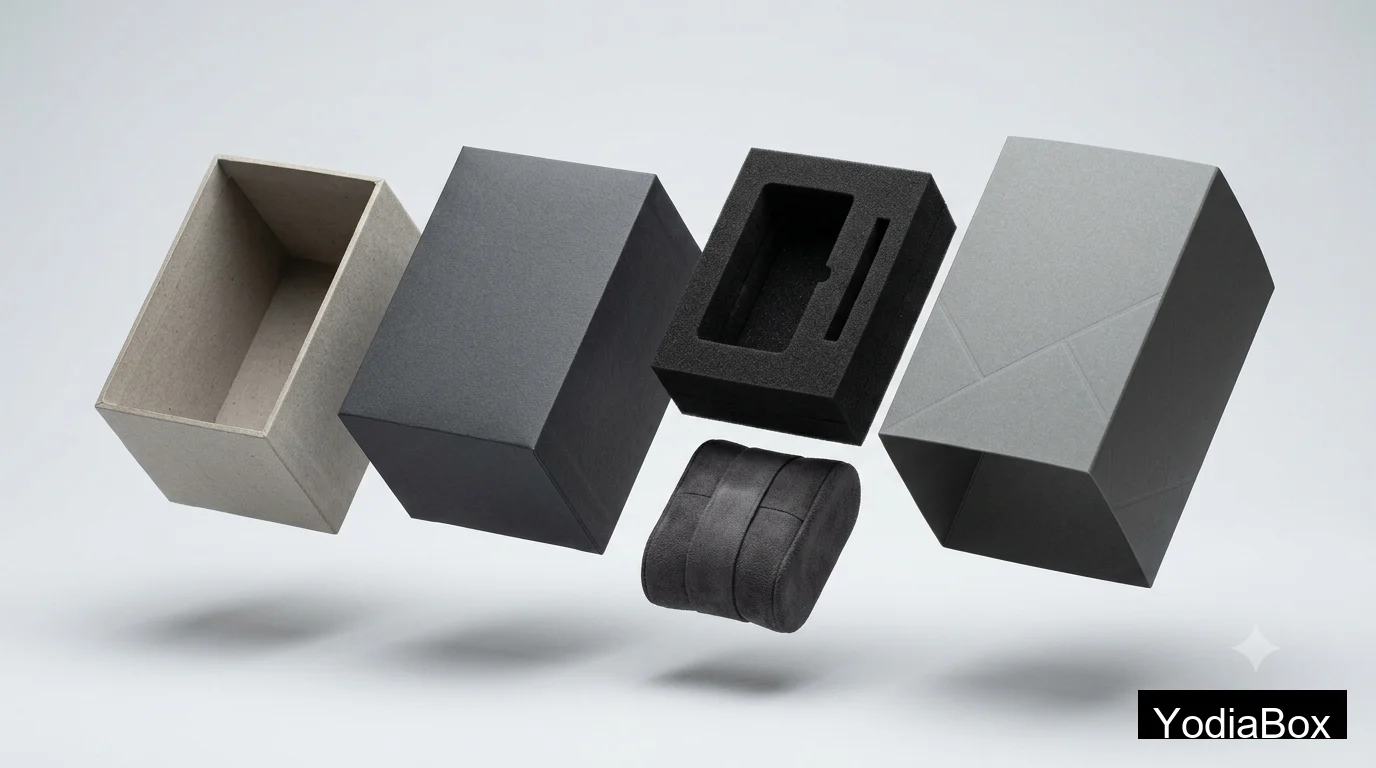
For wholesale buyers, it helps to think in four layers:
1. Primary structure: rigid box, lid-and-base box, hinged gift box, clamshell, drawer box, or winder housing
2. Surface material: art paper, textured paper, PU leather, microfiber, veneer, MDF, or solid wood components
3. Interior fitment: EVA insert, sponge insert, flocked tray, velvet pillow, suede pillow, or molded watch cuff support
4. Shipping protection: polybag, tissue wrap, carton divider, corrugated mailer, and palletized export packaging
If any one of those layers becomes non-standard, MOQ, setup cost, and lead time usually move with it.
Why these variables matter in global sourcing
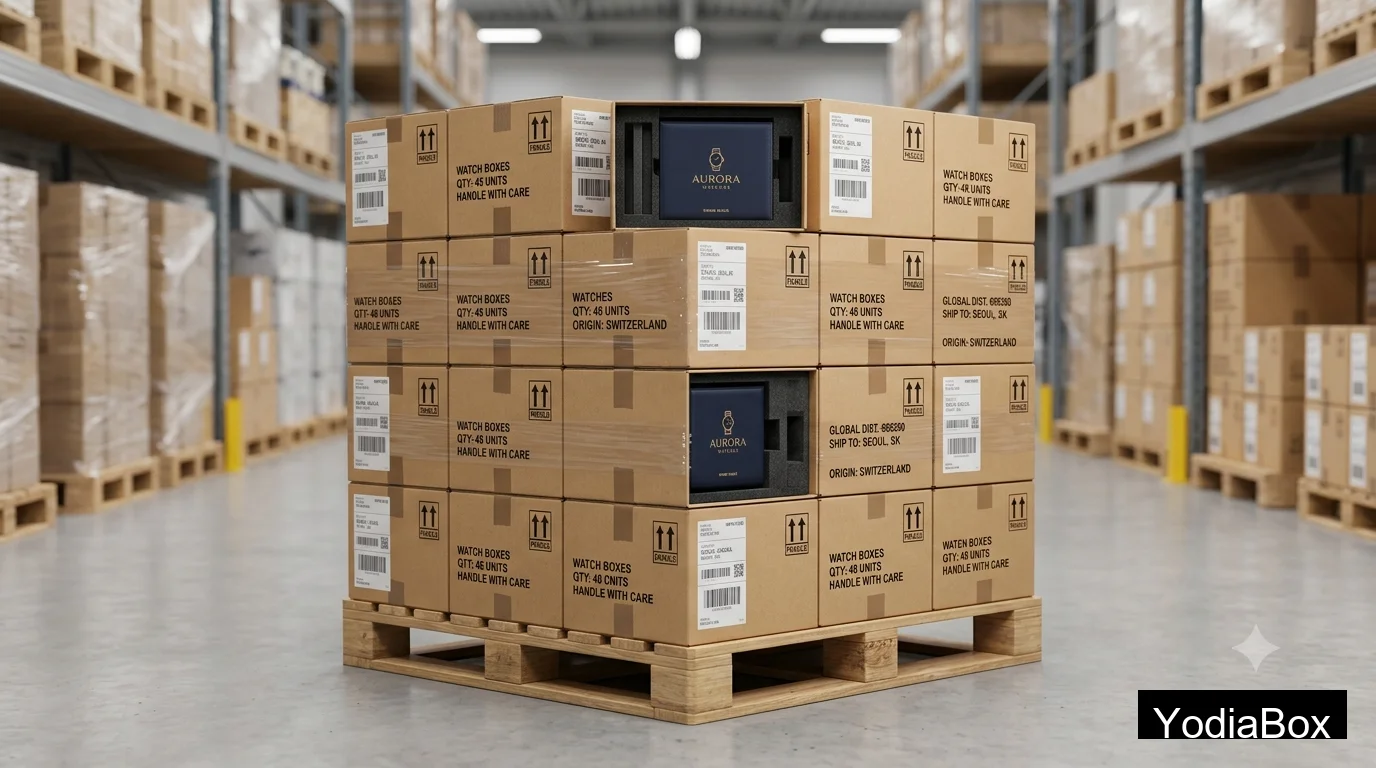
For procurement teams importing by sea or air, the watch box is not only a branding item; it is also a packaging cube-cost item. Larger boxes reduce packing density per master carton and per pallet, which can raise logistics cost even if the unit ex-factory price looks acceptable. According to ISTA, transit packaging performance is closely tied to distribution hazards, and Amazon seller guidance for FBA shipments also emphasizes carton labeling, prep consistency, and route-specific packaging controls through Amazon Seller Central. That is why experienced buyers compare both unit price and ship efficiency before locking a structure.
Buyer callout: the 5 inputs that produce the fastest quote
Fast-Quote Inputs
- outside dimensions in mm
- watch head diameter and strap type
- target quantity by SKU
- logo method and finish
- destination market and delivery deadline
Quick comparison: MOQ by box type
Here is the range we most often quote.
Box type Typical MOQ Common size Notes Single rigid watch box 300-500 pcs 110 x 110 x 90 mm Best entry point for custom branding Premium hinged watch box 500-1000 pcs 125 x 125 x 95 mm More handwork, higher assembly time Watch winder gift box 200-500 pcs 175 x 175 x 190 mm MOQ depends on motor sourcing Multi-watch box for 4-6 pcs 300-800 pcs 320 x 110 x 90 mm Insert layout drives cost and setup
Comparison table: common wholesale watch box specs
Factor Standard retail watch box Premium presentation watch box Watch winder box Typical MOQ 300-500 pcs 500-1000 pcs 200-500 pcs Typical unit price USD 2.20-3.20 USD 4.80-6.80 USD 12.00-38.00 Sample lead time 5-7 days 5-10 days 7-12 days Mass production lead time 20-25 days 30-35 days 35-50 days Common materials 2 mm greyboard, paper wrap, EVA insert PU, specialty paper, suede pillow, metal logo MDF or rigid housing, motor, adapter, premium interior Typical logo process Foil stamping Foil, deboss, metal badge Foil, plate, printed control panel branding Best fit Entry retail packaging, DTC launches Boutique display, gifting, VIP packaging Luxury automatic watches, collectors
> Pro Tip
> If you are testing a new brand, keep your first PO to a single-size rigid box with one-color foil logo. In our experience, that keeps tooling close to zero and makes 300-500 pcs possible.
MOQ FAQ
What is the minimum order quantity for a custom watch box?
For most standard rigid custom watch box projects, our factory sees MOQ at 300 to 500 pieces. That usually applies to:
– paper-wrapped rigid boxes
– standard foam or velvet pillow inserts
– one-position logo
– no custom hardware
MOQ often moves to 500 to 1,000 pcs when you add:
– wooden shell construction
– magnetic book-style structures
– metal plates or zinc alloy logos
– highly customized inserts
– multiple SKUs in one order
If you need very low volume, ask whether the supplier can run your order using an existing die line. That is often how buyers get 200-300 pcs approved.
From our side on the factory floor, I have seen three low-MOQ scenarios work best:
– the buyer accepts an existing structure size
– the logo is foil stamped instead of plated metal
– the insert is adapted from a standard pillow spec rather than fully molded from scratch
Those small decisions often make the difference between an acceptable pilot order and a quote that gets rejected internally.
Can I mix colors or sizes to reach MOQ?
Usually yes, but not always. A common arrangement is:
– 500 pcs total
– split into 2 colors x 250 pcs
– same structure, same dimensions, same insert
If the sizes change, production gets more complicated because board cutting, wrapping layout, and insert tooling may all change. In that case, many factories count MOQ per size, not per total order.
In actual production planning, color split is much easier than size split. If black and green wraps go onto the same 120 x 120 x 95 mm rigid shell and use the same pillow insert, the run can often stay efficient. But if one SKU is for a 36 mm ladies’ watch and another is for a 44 mm men’s chronograph with thicker strap curvature, insert compression changes and QC standards change too.
Why do some suppliers quote 1,000 pcs minimum for a simple box?
Most of the time, it is not the box itself. It is the supplier’s internal efficiency threshold. Small runs create waste in:
– paper cutting
– logo setup
– glue line prep
– labor scheduling
– carton allocation
Some factories are set up for large gift box volume, so 1,000 pcs is their minimum profitable batch. Others, especially OEM packaging specialists, can handle 300-500 pcs more comfortably.
Another reason is material purchasing. A supplier may need to buy full sheets, full rolls, or full cartons of hardware. Even if your watch packaging looks simple, the supplier may be protecting margin against:
– low-yield textured paper
– minimum purchase quantities from insert vendors
– outsourced metal plate production
– export carton minimums
– offcut waste on unusual box dimensions
> Common Mistake
> Buyers sometimes compare a 300 pcs quote from one supplier with a 1,000 pcs quote from another without checking whether both include the same insert, logo method, and export packaging. MOQ only makes sense when the specification is identical.
What MOQ is realistic for DTC brands, boutiques, and distributors?
A practical way to decide MOQ is by channel:
– DTC startup brand: usually start with 300-500 pcs
– Boutique retail program: often 500-1000 pcs
– Distributor or chain rollout: often 1000+ pcs
– Collector or luxury presentation line: may accept higher MOQ for premium finish consistency
In our experience, the right MOQ is not just what the supplier accepts. It is what your sell-through can absorb within one packaging cycle without leaving you with obsolete inventory when branding or watch references change.
MOQ decision framework: how buyers should choose a starting quantity
Use this simple framework before issuing the RFQ:
Buyer scenario Recommended MOQ target Why New brand with 1-2 watch SKUs 300-500 pcs Limits inventory risk and preserves cash Growing DTC brand with stable branding 500 pcs Better unit economics without overcommitting Multi-channel retail launch 500-1000 pcs Supports store allocation and replenishment Premium seasonal gifting program 500-1000 pcs Reduces risk of finish inconsistency across batches Distributor / chain buy 1000+ pcs Better material utilization and freight planning
A helpful procurement rule is to match MOQ to one packaging cycle, not one optimistic sales forecast. If your team expects to revise the logo, sleeve, legal text, barcode system, or watch assortment within 3-6 months, a lower initial MOQ is usually safer.
External benchmark: why MOQ varies by packaging type
Rigid boxes are generally more labor-intensive than folding cartons because they use thicker board, manual wrapping, and fitted inserts. Industry packaging organizations such as FBA and testing bodies like ISTA help explain why shipping performance and structural format matter in final packaging selection, especially for export channels. Buyers comparing rigid boxes to simpler cartons should not expect the same MOQ logic.
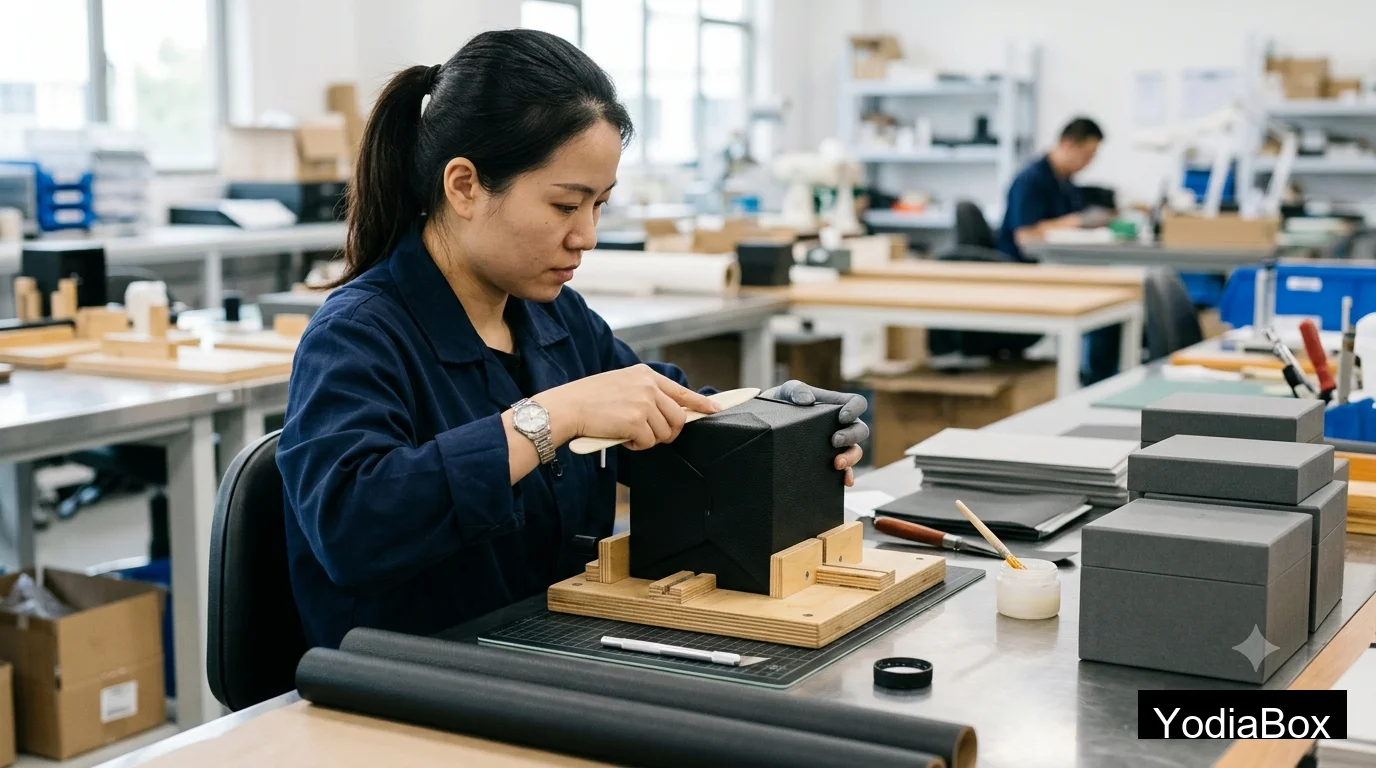
Pricing FAQ
How much does a custom watch box cost wholesale?
For a standard single-watch rigid box, the most common wholesale range is USD 2.20 to USD 6.80 per piece at 500 pcs. The spread is wide because material and finish matter more than buyers expect.
Typical cost bands:
– USD 2.20-3.20: paper wrap, EVA insert, basic foil logo
– USD 3.20-4.80: PU wrap, suede insert, stronger hinge or neck support
– USD 4.80-6.80: premium texture paper, detailed interior, metal logo plate
– USD 12.00+: wood or watch winder presentation box
If you want a fuller breakdown, see our Watch Box Price Tiers article.
For context, buyers evaluating a quote should also ask whether the price includes:
– inner pillow or cuff insert
– individual polybag or protective sleeve
– barcode label application
– export master carton
– spare parts for hinges or adapters in winder projects
– carton marks for Amazon FBA, distributor, or boutique retail routing
A nominally lower quote can become more expensive after those details are added back in.
What affects the unit price most?
The biggest drivers in our factory are:
1. Material
– specialty paper can cost 20-60% more than standard paper
– PU usually adds USD 0.30-0.90/pc
– wood veneer can add USD 1.50-4.00/pc
2. Insert type
– EVA + velvet: lower cost
– molded suede pillow: mid cost
– leatherette wrapped support with hidden notch: higher cost
3. Logo process
– foil stamp: usually lowest cost
– screen print: good for flat graphics
– metal badge: often adds USD 0.40-1.20/pc
4. Structure
– lift-off lid is simpler
– hinged lid needs more hand assembly
– magnetic flap designs need magnet placement and QC
5. Packaging standard
– polybag + master carton is basic
– white sleeve, tissue, barcode label, and drop protection all add cost
From an engineer’s view, the price driver that buyers most often underestimate is the interior. We regularly see a quotation change more from the insert than from the outer wrap. A watch with a metal bracelet, butterfly clasp, or thick leather strap may need a wider or firmer pillow, deeper cavity, or support notch to avoid pressure marks. That adds labor and material quickly, especially when the presentation quality target is high.
Typical material and construction specs buyers ask for
For better RFQ accuracy, these are common material specs in wholesale watch packaging:
– greyboard thickness: 1.5 mm, 2.0 mm, or 2.5 mm
– EVA density range: varies by insert feel and compression target
– pillow width: usually 45-55 mm
– single box outside dimension: often 110 x 110 x 90 mm to 125 x 125 x 95 mm
– master carton gross weight target: usually under 15 kg
– outer carton standard: K=A export carton
If the watch is oversized, skeleton, or paired with accessories like a warranty card, manual, bracelet tool, or polishing cloth, internal dimensions often need to increase beyond the standard single-watch range.
Structured cost table: common adders buyers should expect
Cost driver Typical impact Notes for buyers Upgrade from paper wrap to PU USD 0.30-0.90/pc Often chosen for better wipe-clean surface and luxury feel Upgrade from standard paper to specialty paper 20-60% material premium Depends on texture, imported stock, yield, and lamination Metal logo badge USD 0.40-1.20/pc Can also increase setup time and MOQ Veneer / wood look finish USD 1.50-4.00/pc Usually paired with more manual work Insert redesign USD 80-300 setup Often tied to custom cavity or fixture needs Sample development USD 50-150 Frequently refundable after bulk order confirmation
Are setup fees or tooling charges normal?
Yes, depending on the project. Common charges include:
– sample fee: USD 50-150
– custom insert mold or fixture: USD 80-300
– metal logo mold: USD 100-250
– new structure mockup: USD 100+
Many factories refund some or all sample fees after mass order confirmation. Ask that upfront.
A practical buying rule we use internally is this: if the box requires a new fixture, unusual hardware alignment, or a completely new insert cavity, assume there will be either a direct setup fee or an indirect MOQ increase. Factories recover development cost one way or the other.
> Engineering Note
> Box dimensions must match the actual watch head, strap fold, and pillow compression. A pillow that looks fine at 50 mm width may become too tight once the strap thickness reaches 4.5-5.0 mm. We usually ask buyers for watch diameter, lug-to-lug length, strap material, and folded circumference before finalizing insert size.
How should buyers compare quotes fairly?
Use the same decision framework for every supplier. Ask these questions:
Comparison point Supplier A Supplier B Why it matters MOQ based on same dimensions? Prevents false MOQ comparison Same logo method? Foil vs metal badge can shift cost heavily Same insert material? EVA, velvet, suede, and molded pillows price differently Same export packaging? Carton standard affects final delivered condition Sample fee refundable? Impacts development budget Lead time from artwork or sample approval? Different starting points change schedule reality Includes barcode / sleeve / polybag? Avoids hidden add-ons Existing die line or new tooling? Impacts MOQ and setup cost
This is one of the simplest ways to keep procurement, branding, and operations aligned during supplier review.
Buyer decision path: lowest price vs best total cost
A useful sourcing model is to compare suppliers on landed total cost, not ex-factory unit price only. Review:
– unit price
– sample/setup fees
– carton efficiency
– defect/rework risk
– lead-time reliability
– compliance documentation
– freight cube impact
– inventory risk from high MOQ
This matters because a box quoted at USD 2.80/pc may be a worse buy than one quoted at USD 3.10/pc if the cheaper version requires more oversized cartons, lacks sleeve protection, or fails fit testing and causes a delayed launch.
External pricing context: why paper, board, and transport matter
Packaging costs are also influenced by raw material and logistics markets. Pulp and paper pricing is widely tracked by organizations such as Fastmarkets and industry reporting from Statista and World Bank commodity data. While these sources do not quote custom watch box pricing directly, they help explain why paper-based packaging and freight-sensitive packaging projects can fluctuate even when the design stays the same.
Quick comparison: price and lead time by spec level
Spec level Typical MOQ Unit price range Production lead time Best for Standard rigid box 300-500 pcs USD 2.20-3.20 20-25 days Entry retail packaging Mid-range branded box 500 pcs USD 3.20-4.80 25-30 days DTC watch brands Premium presentation box 500-1000 pcs USD 4.80-6.80 30-35 days Gift sets and boutiques Watch winder box 200-500 pcs USD 12.00-38.00 35-50 days Luxury automatic watches
Lead-Time FAQ
What is the usual lead time for a custom watch box order?
A normal schedule for a wholesale custom watch box order is:
– artwork check: 1-2 days
– pre-production sample: 5-7 days
– sample approval and revisions: 3-7 days
– mass production: 20-35 days
– export packing: 2-3 days
So from approved artwork to ship-ready goods, a realistic total is 25-45 days.
In my experience, the most reliable lead-time planning starts by separating *sample lead time* from *bulk lead time*. Buyers often say they need the order in 30 days, but if 10 of those days are spent adjusting logo placement, wrap texture, or pillow fit, the actual factory build window becomes too compressed. That is where quality issues start.
What makes lead time longer?
The most common delays are:
– waiting for buyer-approved logo artwork
– material color not available in stock
– custom hardware sourcing
– insert fit revision after sample
– holiday season congestion before Q4 shipping
If you have a hard launch date, we suggest booking with at least 6-8 weeks buffer before vessel cutoff.
Other common schedule risks include:
– supplier queueing during peak gift packaging season
– rework caused by last-minute Pantone changes
– slower drying or curing time on certain laminated or wrapped materials
– longer incoming time for magnets, hinges, motors, adapters, or metal plates
– export documentation timing if your shipment consolidates with other SKUs
Can you do urgent orders in 15 days?
Sometimes, but only under narrow conditions:
– existing structure
– standard paper or PU in stock
– no metal badge
– no major sample revision
– order around 300 pcs
For anything premium, 15 days is risky. We would rather say no than promise a date that causes quality problems later.
For brands also considering motion packaging, our Watch Winder Box Single design guide explains why watch winder projects typically need longer lead time than static boxes.
What is a safe production timeline for a new watch launch?
For new product launches, our practical recommendation is:
– finalize structure and dimensions: week 1
– make and review sample: week 2
– revise sample if needed: week 3
– approve production sample and deposit: week 4
– mass production and packing: weeks 5-8
That is why a 6-8 weeks planning window is usually safer than trying to compress everything into one month. If you are launching before holiday retail or a crowdfunding fulfillment wave, adding more buffer is even better.
Factory case example: where lead time usually slips
On one watch packaging project, the outer box spec looked simple: black textured paper, silver foil logo, and suede pillow. The delay came from the insert. The buyer’s first sample used a pillow that looked good visually but over-compressed the leather strap and pushed the watch head too high. We adjusted the pillow width and cavity depth, then re-sampled. The box itself did not create the delay; fit testing did. That is why we always treat watch dimensions and strap fold as engineering data, not decoration details.
Lead-time checklist for launch planning
Safe Launch Timing Checklist
- Lock artwork before sampling starts.
- Confirm material stock or special-order lead time.
- Approve the physical insert fit with the real watch.
- Confirm whether lead time starts from PO, deposit, or sample approval.
- Add ocean/air transit buffer and customs clearance time.
External timing factors buyers should not ignore
For international buyers, factory lead time is only one part of delivery timing. Port congestion, peak-season vessel space, and customs clearance can all affect final arrival. For general trade and logistics context, buyers often monitor UNCTAD, World Shipping Council, and destination customs guidance such as U.S. Customs and Border Protection. These sources are useful when your internal deadline is a retail in-store date rather than only an ex-factory ship date.
Customization FAQ
What customization options are most practical for wholesale buyers?
The safest custom options for first orders are:
– foil logo in gold, silver, black, or white
– textured paper or PU wrap
– velvet or suede pillow insert
– printed sleeve or outer carton label
– simple color customization using Pantone reference
These give strong brand identity without causing too much production risk.
For first-time OEM buyers, I usually recommend building branding in layers:
1. start with logo and color
2. then refine insert feel and unboxing sequence
3. only after that add hardware, special structures, or mixed materials
That sequence gives you a better balance between brand impact and production reliability.
Can you match my brand colors exactly?
Usually we can get close, but exact match depends on surface and process. Pantone on coated paper, uncoated paper, PU, and velvet will not look identical. We normally ask buyers to approve a physical sample, not just a digital mockup.
This is especially important for luxury watches, fashion watches, and gifting programs where the watch box needs to align with retail display, shopping bag, warranty card, and point-of-sale materials. A physical sample is the only dependable way to evaluate texture, tone, foil contrast, and perceived premium level together.
Do you offer sustainable materials?
Yes, but “eco” needs to be defined clearly. Common options include:
– FSC paper wraps if required by your sourcing program
– recycled greyboard
– reduced-plastic packing format
– water-based glue where suitable
If your compliance team asks for standards, start with the ISO Standards Catalogue for applicable packaging and quality management references. For anti-tarnish storage discussions, the basic oxidation concept is explained in Wikipedia: Tarnish.
From a sourcing standpoint, sustainable packaging requests usually work best when the buyer specifies which requirement matters most:
– recycled content
– certified paper source
– plastic reduction
– shipping efficiency
– gift-ready appearance without extra overpacking
Otherwise, “eco-friendly watch box” can mean different things to different suppliers.
For broader sustainability frameworks, brands may also review FSC, PEFC, and packaging waste guidance from the European Commission. If you need formal environmental management references from suppliers, ISO 14001 is one of the most commonly cited standards.
Can watch boxes be designed for jewelry crossover collections?
Yes. We often see brands launch a watch plus bracelet or watch plus ring gift set. If you are combining categories, our custom jewelry boxes and wood jewelry box pages show structures that can be adapted into watch packaging.
This crossover category often needs:
– dual-compartment inserts
– removable tray designs
– necklace card or bracelet slot combinations
– watch pillow plus ring roll layouts
– larger boutique gift box dimensions than a standard single-watch box
Which logo and finish options are best for different brand positions?
A simple framework is:
– Entry retail / startup: one-color foil stamp on paper wrap
– Fashion / lifestyle: textured paper or PU with foil or screen print
– Premium boutique: deboss + foil, suede interior, refined edge wrapping
– Luxury presentation: metal badge, veneer, lacquer, layered unboxing accessories
In our factory experience, foil stamping remains the best first-order option for most brands because it gives a premium look with lower setup complexity than plated hardware or multi-process decoration.
Decision framework: choose customization by business stage
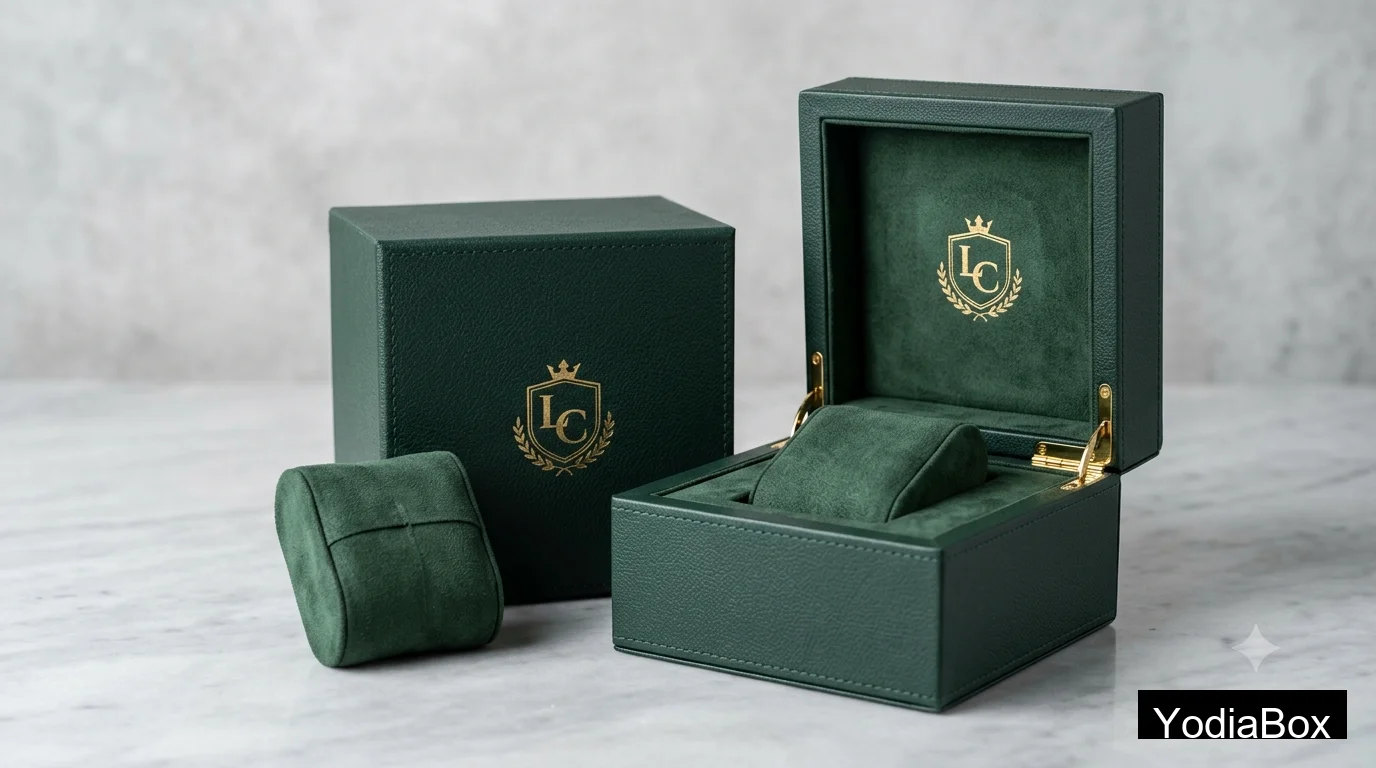
Business stage Best customization choice Risk level Why it works Pilot order Foil logo + stock structure Low Fast approval and lower MOQ Early brand-building Textured paper or PU + upgraded pillow Low-Mid Better perceived value without major tooling Retail gift set Hinged structure + sleeve + premium interior Mid Stronger unboxing for boutique and gifting Collector line Veneer, badge, hardware, layered interior High Best reserved for stable demand and higher margin SKUs
Buyer Checklist FAQ
What should I send in an RFQ to get an accurate quote fast?
Send these 8 items:
1. box style reference photo
2. outside dimensions in mm
3. watch size and strap type
4. quantity, for example 500 / 1000 / 3000 pcs
5. outer material choice
6. insert material choice
7. logo method and position
8. destination market and required deadline
If you can also share target price, we can usually tell within one round whether the spec is realistic.
For even faster and more accurate quoting, add these details if available:
– watch head diameter
– lug-to-lug length
– strap thickness
– bracelet or leather strap
– gift set accessories included
– individual packing requirement
– shipping method, such as air or sea
– required compliance or retailer carton limits
The more complete the RFQ, the less likely you are to get a misleading low quote that changes later.
Should I approve a physical sample before mass production?
Yes, especially if:
– your watch case is over 42 mm
– the strap is stiff leather or metal bracelet
– your box uses magnets or hinges
– color matching matters for retail display
A photo approval is fine for basic artwork, but not for fit and feel.
In our own process, physical sample approval is where most risk gets removed. That is where buyers can check:
– watch fit and pillow tension
– lid closing pressure
– logo alignment
– color consistency
– wrap edge finish
– overall unboxing feel for retail or gifting
Do I need drop-test or compliance requirements for watch packaging?
That depends on your channel. Boutique delivery, e-commerce, distributor pallet shipping, and airport duty-free all need different packing standards. We advise buyers to specify:
– inner pack quantity
– master carton size limit
– carton gross weight target, usually under 15 kg
– barcode label format
– transit protection standard
For design inspiration and category context, broad jewelry references like Britannica: Jewelry can help merchandising teams align packaging style with product positioning.
If your distribution route includes parcel shipping, testing references from ISTA are worth reviewing. If your cartons use corrugated board and you need common terminology or performance context, the Fiber Box Association is also useful. Buyers shipping into Amazon channels should check current prep and labeling rules in Amazon Seller Central.
How do I choose the right watch box spec for my buying stage?
A simple buyer decision path is:
Buying stage Recommended box spec Why Market test / pilot launch Standard rigid box, foil logo, EVA or velvet insert, 300-500 pcs Lowest risk and lowest setup complexity Growing DTC brand PU or textured paper wrap, suede pillow, 500 pcs Better brand perception with controlled cost Boutique retail / gifting Hinged box, premium interior, 500-1000 pcs Better display value and premium feel Luxury automatic line Winder or presentation box, premium hardware, 200-500 pcs Matches high-value product positioning
This framework is useful when internal teams disagree. Marketing may want a luxury watch case finish, procurement may need lower MOQ, and operations may need shorter lead time. Matching the box type to the buying stage usually resolves that conflict faster than debating appearance alone.
What are the top buying criteria when comparing suppliers?
For wholesale buyers, the best shortlist usually comes from these criteria:
1. ability to meet your actual MOQ
2. quote clarity on insert, logo, and export packing
3. proven sample accuracy
4. realistic lead time, not just fast promises
5. experience with watch packaging rather than general gift boxes
6. willingness to advise on fit, strap compression, and carton protection
7. consistency between sample and bulk production
A supplier who gives a slightly higher but better-structured quote is often the safer choice than one who offers the lowest first number.
Supplier scorecard: a clearer decision tool for procurement teams
Use this weighted scorecard when you need a more defensible supplier decision:
Criteria Weight Supplier A Supplier B Supplier C MOQ fit 15% Unit price 15% Quote completeness 15% Sample accuracy 20% Lead-time reliability 15% Watch-fit engineering support 10% Export packaging competence 10%
This is especially useful when procurement, product, and brand teams are evaluating different priorities.
RFQ checklist box
RFQ Checklist
- reference image or dieline
- outside dimensions in mm
- watch head size and strap style
- insert material and pillow width target
- logo method and artwork file
- order quantity by SKU
- packing requirements and carton limit
- destination market and in-house deadline
Final advice for procurement teams
If you want the best result on a first order, simplify the variables. We usually recommend:
– one structure
– one insert type
– one logo process
– 500 pcs starting quantity
– target landed box cost established before sampling
That approach avoids most first-run failures. If you want us to quote efficiently, send your dimensions, quantity, artwork, and deadline through our Contact page or learn more About YodiaBox. We can usually tell you within 24 hours whether your custom watch box brief fits a standard production route or needs a premium build.
If I had to give one factory-side recommendation to wholesale buyers, it would be this: do not overdesign the first order. A rigid gift box with correct watch fit, stable export packing, and clean foil branding usually performs better than a more complex concept that stretches your MOQ, budget, and delivery window at the same time.
Recommended first-order configurations by buyer type
Buyer type Best first-order spec Typical MOQ Typical price range Why we recommend it Startup watch brand Rigid box, paper wrap, EVA or velvet insert, foil logo 300-500 pcs USD 2.20-3.20 Lowest development risk Growing DTC label Rigid or hinged box, textured paper or PU, suede pillow 500 pcs USD 3.20-4.80 Better unboxing with manageable cost Boutique / gifting buyer Hinged presentation box, premium interior, upgraded sleeve 500-1000 pcs USD 4.80-6.80 Stronger gift perception Luxury automatic watch brand Winder or wood-style presentation box 200-500 pcs USD 12.00-38.00 Better alignment with high-value SKU
Bottom-line buying recommendation
If you are still deciding, this is the clearest path:
– choose standard rigid box + foil logo if your priority is low MOQ and faster launch
– choose PU or textured paper + suede pillow if your priority is stronger retail presentation
– choose hinged premium box only when your margin can support more labor and longer lead time
– choose watch winder box only when the product value and customer expectation justify the added complexity
For most first-time wholesale buyers, the best decision is not the most elaborate box. It is the most repeatable spec that protects the watch, supports the brand, and can be reordered without surprises.
References & Sources
1. ISO Standards Catalogue
2. Wikipedia: Tarnish
3. Britannica: Jewelry
4. FSC
5. PEFC
6. ISO 14001 Environmental Management
7. European Commission: Packaging Waste
8. Fiber Box Association
9. ISTA
10. Amazon Seller Central
11. UNCTAD
12. World Shipping Council
13. U.S. Customs and Border Protection
14. U.S. Federal Trade Commission
15. Fastmarkets
16. Statista
17. World Bank Commodity Markets
Written by: Sarah Jenkins
Senior Content Specialist
Seasoned Industry Editor with 5 years of experience, dedicated to delivering in-depth technical and market reports.
Reviewed by: Dr. Eric Shao
Chief Technical Director
With 12 years of experience in material science and custom manufacturing, ensures the scientific accuracy and technical compliance of all published content.
Recommended Reads
Gift packaging
10 产品
Jewelry display
12 产品
Jewelry Organizer
12 产品
Jewelry pouch
7 产品
Jewelry suitcase
6 产品
Leather jewelry box
13 产品
LED Jewelry box
8 产品
Paper jewelry box
10 产品
Velvet Jewelry box
11 产品
Watch box
7 产品
Wood jewelry box
6 产品
Watch Winder Box Single: Design Standards, Target Users, and OEM Production Considerations
If you are developing a watch winder box single SKU, the hard part is usually [...]
Jun
Watch Box Price Tiers: A Factory Engineer’s OEM Pricing Guide
Every week, buyers send us inquiry emails that start the same way: "Can you give [...]
Jun
Watch Box Cushion & Pillow Design: An OEM Engineer’s Complete Guide
Every watch box we produce lives or dies on one component most buyers never think [...]
Jun
Custom Watch Box MOQ, Pricing, and Lead Time FAQ for Wholesale Buyers
If you are sourcing a custom watch box for retail, gifting, or OEM packaging, the [...]
Jun
Automatic Watch Winder Box: Features, Materials, and OEM Customization Options
If you are developing an automatic watch winder box for your brand, the hard part [...]
Jun
Watch Box OEM/ODM Buyer Guide: Materials, Customization, MOQ, Pricing & Supplier Selection
A good watch box protects the product, supports brand positioning, and reduces returns before the [...]
Jun