
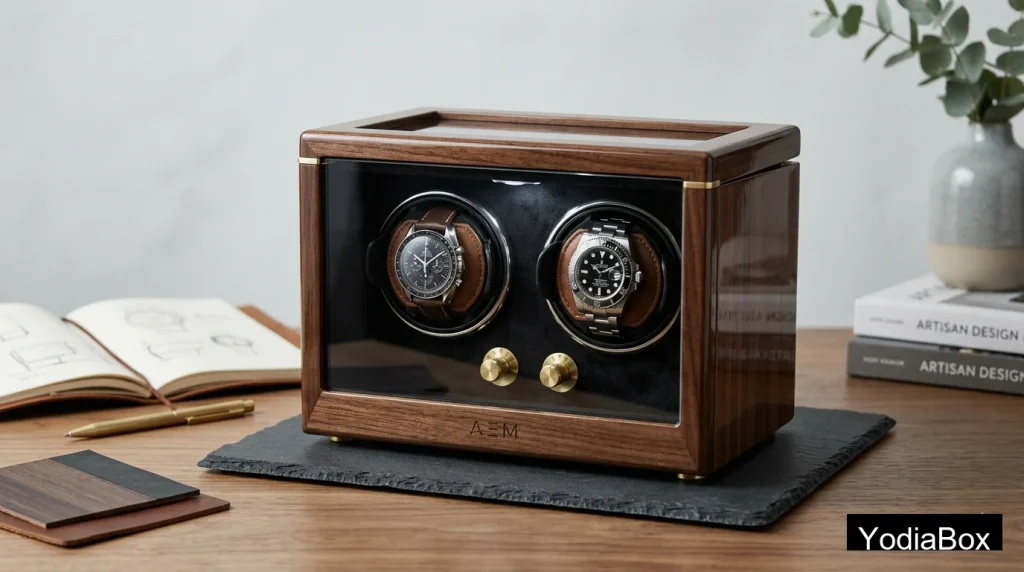
Watch Winder Box: The Complete OEM Buyer’s Guide to Automatic Watch Winder Manufacturing
If you are sourcing a watch winder box for your brand, the short answer is this: a workable OEM program usually starts at 100-300 pcs per SKU, lands around US$28-145/unit depending on motor count, finish, and electronics, and needs 35-60 days for sampling plus bulk production. In our factory experience, most buyer problems do not come from the outer box. They come from motor noise above 25 dB, incorrect turns-per-day programming, poor-fit watch pillows for 6.0-7.5 inch wrists, and failed safety paperwork for AC-powered units under the EU’s Low Voltage Directive 2014/35/EU and CE Marking requirements.
That is why OEM buyers should evaluate a watch winder box as both a packaging product and a small electromechanical product. A nice lacquer shell means very little if the rotor stalls after 6 months, the adapter runs hot at 48°C, or the customer’s 44 mm diver slips on an undersized cushion.
What separates a good supplier from a risky one? Usually five things: motor stability, pillow fit range, finish consistency, compliance documents, and final inspection discipline. We will break down each one with the numbers buyers actually use in RFQs.
Quick Navigation
– [What an OEM buyer should specify first](#what-an-oem-buyer-should-specify-first)
– [Core watch winder box configurations and price ranges](#core-watch-winder-box-configurations-and-price-ranges)
– [Materials, structure, and manufacturing trade-offs](#materials-structure-and-manufacturing-trade-offs)
– [Electronics, compliance, and testing requirements](#electronics-compliance-and-testing-requirements)
– [Packaging, logistics, and MOQ planning](#packaging-logistics-and-moq-planning)
– [How we quote and sample a custom watch winder box](#how-we-quote-and-sample-a-custom-watch-winder-box)
– [FAQ](#faq)
– [Get a quote](#get-a-quote)
What an OEM buyer should specify first
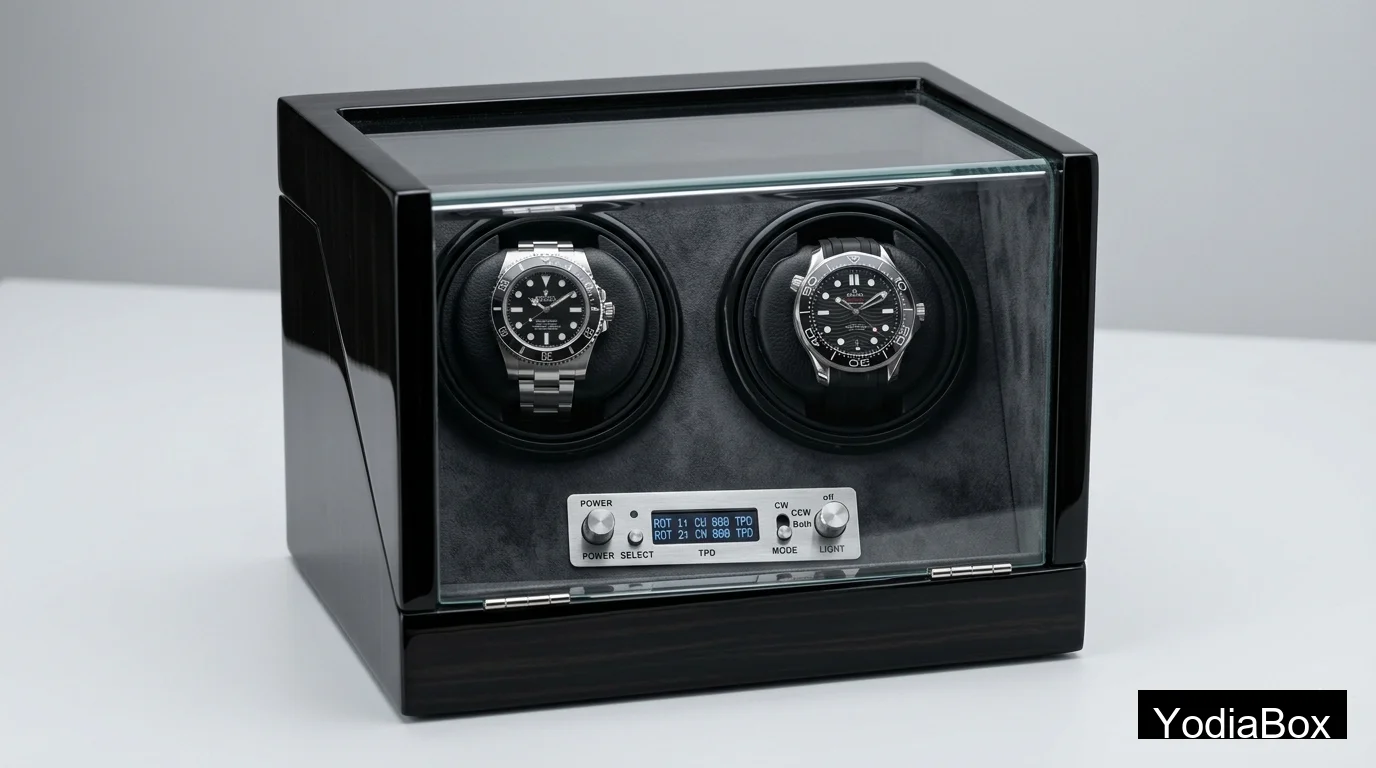
When buyers send us only a reference photo and ask for “same style,” the project slows down immediately. A watch winder box needs a tighter spec sheet than a standard static watch box.
At minimum, we recommend confirming these 10 points before sampling:
1. Capacity: 1-watch, 2-watch, 4-watch, 6-watch, or 9-watch
2. Watch size range: case diameter 36-50 mm, lug-to-lug height, and bracelet flexibility
3. Pillow circumference: usually 170 mm, 180 mm, or 190 mm
4. Motor program: clockwise, counterclockwise, bi-directional
5. TPD range: common presets are 650, 900, 1200, and 1500 turns/day
6. Power type: 100-240V adapter, USB-C 5V, or D-cell battery backup
7. Outer finish: PU leather, MDF piano lacquer, walnut veneer, carbon fiber paper, or solid wood
8. Interior lining: short plush, microfiber, velvet, suede PU
9. Branding method: foil stamp, metal plate, screen print, embossed logo
10. Target retail and landing cost: for example US$39 FOB target for entry level or US$95 FOB for premium
Here is the first buying hook: if your end customer wears mostly slim dress watches, do not approve the same pillow size used for sports watches. We have seen return rates climb above 4% because a 38 mm dress watch on a loose bracelet slowly rotates off-center, even though the motor works fine.
For buyers already selling standard watch packaging, our Watch Box Buyer Guide is useful because many structural principles overlap. The difference is that a winder adds electrical risk, motor tolerances, and vibration control.
Core watch winder box configurations and price ranges
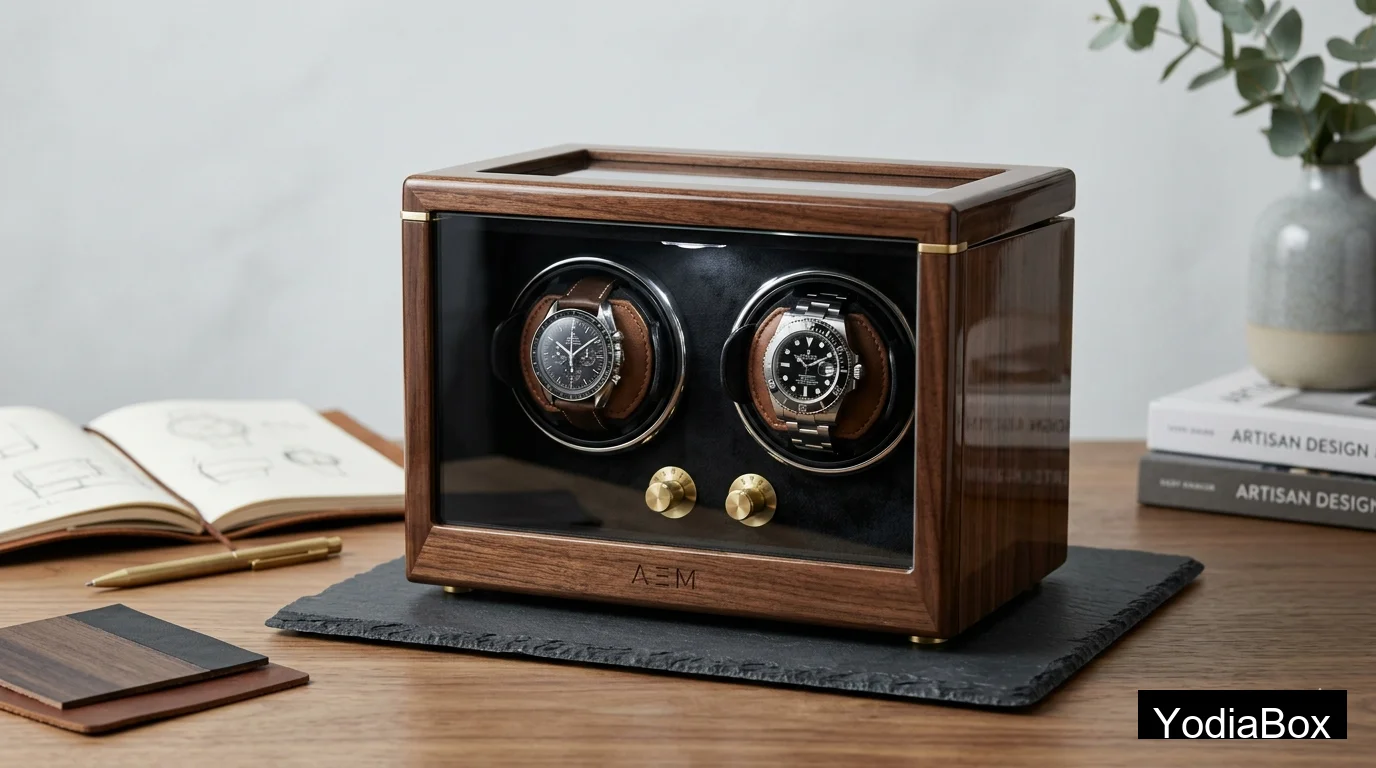
The biggest cost drivers are motor quantity, shell material, and control system. A 2-watch model with basic Mabuchi-style motor architecture, MDF shell, PU wrap, and standard adapter can cost less than half of a 4-watch piano lacquer model with independent controls.
Common OEM configurations
| Configuration | Typical outer size | MOQ | FOB price range |
|---|---|---|---|
| 1-watch winder | 140 x 180 x 160 mm | 200 pcs | US$28-45 |
| 2-watch winder | 220 x 190 x 210 mm | 100 pcs | US$42-78 |
| 4-watch winder | 320 x 260 x 240 mm | 100 pcs | US$78-145 |
| 6-watch winder with storage | 360 x 280 x 300 mm | 50-100 pcs | US$118-210 |
These are normal OEM ranges for mid-volume orders, not luxury retail prices. If you ask for real walnut veneer, beveled glass, copper-color hardware, 3-color gift box printing, and silent upgraded motors under 15 dB at 1 meter, the price moves fast.
Another hook buyers miss: a 4-watch winder does not simply cost twice a 2-watch winder. The shell gets larger, the hinge load changes, carton drop risk goes up, and foam protection must improve. That is why freight damage claims rise sharply on units above 4.5 kg gross weight.
Which format sells best?
In our experience:
– 1-watch: good for entry gift market and online testing
– 2-watch: best balance for DTC brands; widest demand
– 4-watch: strong for premium watch collectors
– 6-watch with drawer storage: better for showroom display than mass e-commerce
If you are new to this category, start with 2-watch, MOQ 100 pcs, target net weight around 2.2-2.8 kg, and master carton under 14 kg for easier courier handling.
Materials, structure, and manufacturing trade-offs
A watch winder box is sold on appearance, but it survives on structure. We usually build around an MDF core from 9-12 mm, because MDF gives stable dimensions for hinge mounting and motor cavity routing. Solid wood looks premium but can warp with humidity swings, especially if exported from 65% RH environments into dry winter markets.
Common shell options
– PU leather over MDF
– Lowest tooling cost
– Fastest sampling, usually 7-10 days
– Good for FOB targets below US$55 on 2-watch units
– High-gloss piano lacquer on MDF
– Premium look
– Requires more sanding and polishing
– Reject rate can reach 8-12% if dust control is poor
– Wood veneer
– Better natural look than printed paper
– Grain matching matters on lid and side panels
– Adds labor and veneer cracking risk
– Carbon fiber pattern paper
– Popular for modern styling
– Lower cost than real carbon fiber
– Edge wrapping quality must be checked carefully
Interior fit matters more than many buyers expect
The inside cushion and cup assembly decide whether the watch sits straight and rotates smoothly. We normally test with watches from 80 g to 250 g. Light watches can bounce if the torque pulse is too abrupt. Heavy watches can slip if the pillow compresses too much after repeated use.
A practical pillow spec for most brands is:
– compressed circumference: 165-175 mm
– uncompressed circumference: 185-195 mm
– foam density: 25-35 kg/m³
– fabric thickness: 0.8-1.5 mm
If your customer base includes large bracelets, ask for two pillow sizes in one SKU. It adds around US$0.80-1.60/unit, but reduces complaints.
> Pro Tip
> For a 2-watch winder box, ask your supplier to test with at least one 40 mm dress watch under 100 g and one 44 mm steel sports watch over 180 g before sample approval. A unit that works only with one weight class is not production-ready.
For brands also sourcing static display packaging, our Wholesale Watch Boxes page shows common material directions buyers often adapt into winder programs.
Electronics, compliance, and testing requirements
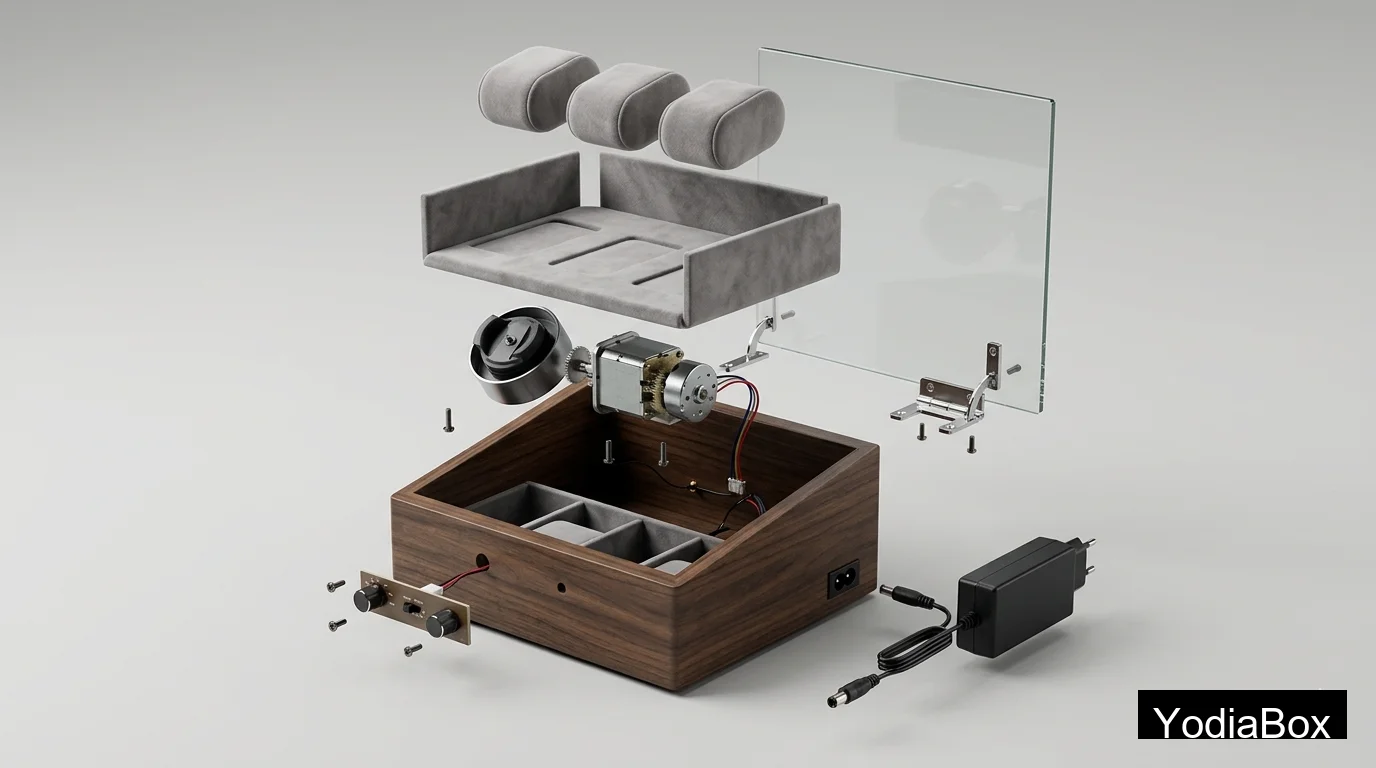
This is where many packaging-focused suppliers get exposed. A watch winder box sold into the EU or other regulated markets is not just a decorative case. It is an electrical item, and that means paperwork and component discipline matter.
If the product uses AC adapter input or falls under relevant electrical scope, buyers should review compliance for the Low Voltage Directive 2014/35/EU, CE Marking, and materials restrictions such as the RoHS Directive 2011/65/EU. If your model includes paints, coatings, or decorative components for broad consumer contact, it is also smart to review whether additional material safety checks are needed based on market and age-use positioning.
What we test in factory
Our normal pre-shipment checks for watch winder box projects include:
– Input power verification: 100-240V adapter rating
– No-load and loaded motor running test: usually 2-4 hours
– Noise check: target <20 dB at 30 cm for premium, <25 dB acceptable for mid-range
– Surface inspection under 600-1000 lux
– Lid open/close cycle test: often 300-500 cycles
– Drop test on packaged unit: 76 cm for mail-order style pack, depending on carton design
– High/low temperature observation: typically -10°C to 45°C storage simulation for packaging integrity
– AQL inspection planning based on ISO 2859 Sampling
One thing we tell buyers directly: “silent motor” is a sales phrase, not a measurable engineering spec. If you want consistency, define it numerically. For example:
– at 30 cm distance
– ambient noise below 18 dB
– measured operating noise not above 22 dB
– test duration 20 minutes
– watch load 150 g simulated weight
Without that, two factories can both claim “silent” and ship very different products.
> Engineering Note
> Motor failure is often blamed on the motor itself, but in our experience the real cause is usually misalignment between the motor shaft, cup mount, and pillow pressure. A 1.5-2.0 mm assembly offset can create intermittent drag and shorten life much faster than the motor spec sheet suggests.
Control systems: simple or independent?
There are two mainstream OEM routes:
1. Shared control board
– lower cost
– same program for all positions
– suitable for 1-watch and 2-watch models
2. Independent control per rotor
– more flexible for collectors with different watch calibers
– better premium positioning
– higher wiring and QA complexity
If your brand sells to enthusiasts, independent programs justify a higher retail price. If you sell giftable lifestyle products, a simple 3-mode switch + adapter is usually enough.
Packaging, logistics, and MOQ planning
A watch winder box is fragile in three ways: finish scratching, glass breakage, and internal motor shock. Outer beauty means nothing if the customer opens the lid and finds the rotor detached.
Retail pack and master carton planning
For a 2-watch unit around 220 x 190 x 210 mm, a normal pack-out could be:
– 1 pc per polybag or dust bag
– EPE or EVA corner protection
– 1 inner foam set, 20-30 mm thickness
– 1 printed gift box, about 255 x 225 x 245 mm
– 2 pcs per master carton
– master carton roughly 470 x 270 x 510 mm
– gross weight 6.0-7.5 kg
That spec keeps the package manageable for cross-border parcel and wholesale distribution.
Common shipping mistakes
The biggest freight problem we see is buyers approving a beautiful gift box without enough buffer zone around the product. A glossy lacquer corner can chip from one hard impact if the foam thickness is reduced from 25 mm to 10 mm just to save carton size.
| Packaging choice | Main advantage | Main risk | Typical cost effect |
|---|---|---|---|
| EPE foam + gift box | Low cost, fast | Lower premium feel | +US$1.20-2.50 |
| EVA insert + rigid box | Better protection, cleaner fit | Higher tooling cost | +US$3.50-6.00 |
| Mail-order tested outer carton | Fewer transit claims | Larger CBM | +US$0.80-1.80 |
| Velvet dust bag added | Better unboxing | No real drop protection | +US$0.40-0.90 |
> Common Mistake
> Buyers often ask us to reduce carton size by 10-15% after sample approval. On static packaging this may be manageable. On a watch winder box, that reduction often cuts shock protection below safe levels and increases damage claims, especially on glass-lid models.
If you are comparing presentation formats beyond winders, our Custom Jewelry Box and Complete LED Jewelry Box Guide are useful references for insert engineering, finish control, and gift-box standards that often carry over into this category.
How we quote and sample a custom watch winder box
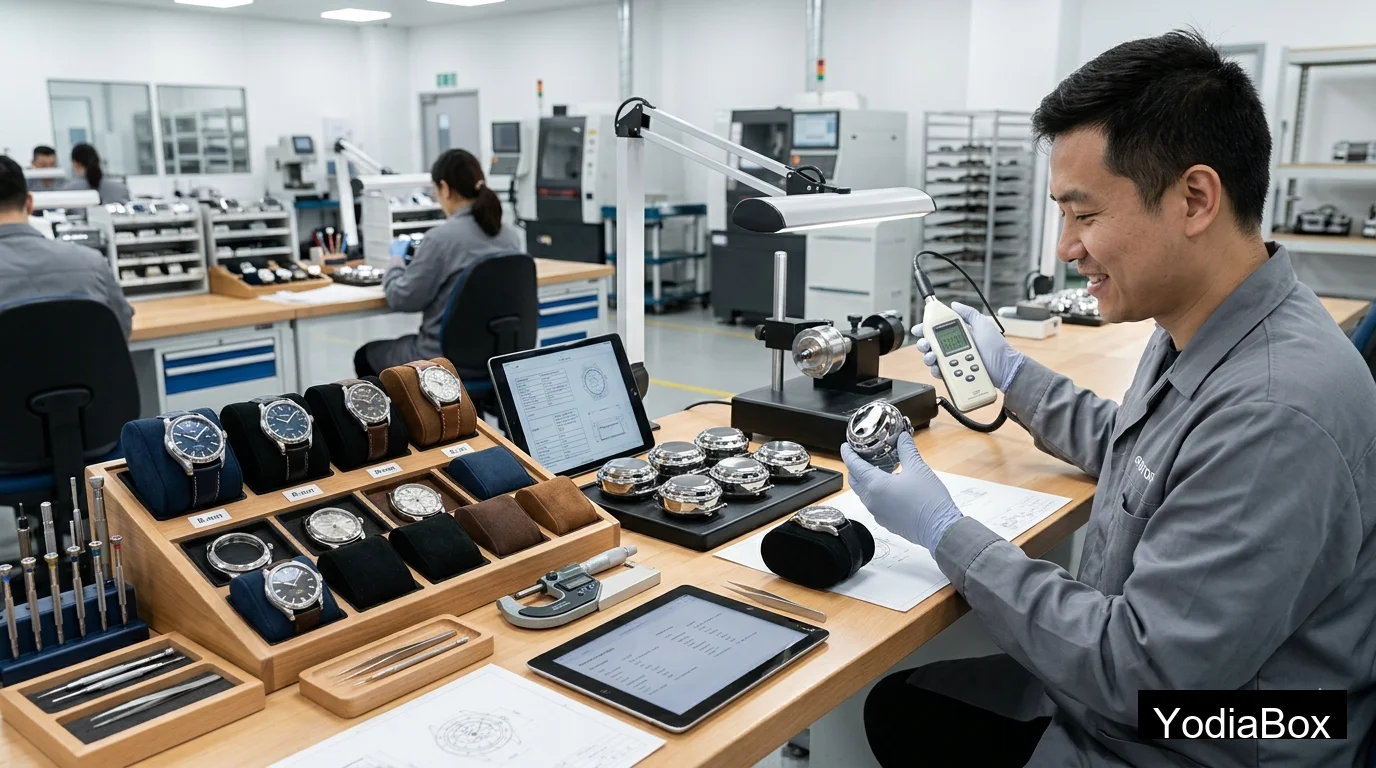
A serious quote depends on more than style reference. We usually need the following from buyers:
– target market: EU, US, Middle East, Japan, etc.
– capacity: 1/2/4/6 watches
– target ex-factory or FOB price
– finish direction: leather, veneer, lacquer
– logo method and size
– watch size range and bracelet circumference
– plug type: EU/US/UK/AU
– expected order quantity: 100, 300, 500, or 1000 pcs
– packaging requirement: retail gift box only or e-commerce tested pack
Typical OEM development timeline
For a custom watch winder box, a realistic schedule is:
– artwork and spec confirmation: 2-5 days
– material sourcing: 3-7 days
– prototype sample: 10-18 days
– sample revision if needed: 5-10 days
– bulk production: 30-45 days
– final inspection and booking: 3-7 days
So from approved drawing to ready cargo, many projects need 45-60 days. Around Chinese New Year or peak Q4 shipping, it can be longer.
What affects MOQ?
MOQ usually depends on the least flexible component:
– custom shell color or lacquer: 100-200 pcs
– custom logo plate: 100 pcs
– custom adapter/plug carton print: 300-500 pcs
– custom control PCB: often 300 pcs+
– custom gift box print: 300 pcs if offset printed
If a buyer wants to test the market at 50 pcs, we normally suggest using an existing shell with a custom logo and standard adapter. Full customization at very low quantity rarely gives a stable landed cost.
Hook for small brands: if your retail target is under US$99, do not overbuild the first order. Start with proven structure, one outer finish, one pillow spec, one adapter pack, and one control board. Complexity is what kills margin in early runs.
What separates a reliable factory from a trading-only source
Not every supplier advertising watch winder box manufacturing actually controls the key production steps. Some only source the wood shell and outsource the electronics separately. That can work, but then responsibility becomes blurry when something fails.
In our experience, buyers should ask who handles:
– shell fabrication
– painting or wrapping
– electronics assembly
– motor sourcing
– aging test
– final QC
– export pack-out
You do not need every process in one building, but you do need one accountable party. That is the real issue.
Questions we think buyers should ask on the first call:
– What is your normal AQL level for this category?
– What percentage of bulk units are power-tested?
– What is your standard motor warranty period: 6 months, 12 months, or 24 months?
– Can you provide RoHS material declarations if requested?
– What is your measured noise standard and test distance?
– Have you shipped similar SKUs to EU customers with CE documentation?
For background on how we approach custom development and factory communication, you can review About YodiaBox. And if you already have a target spec sheet, the fastest next step is to Contact YodiaBox with your watch size range, target price, and quantity.
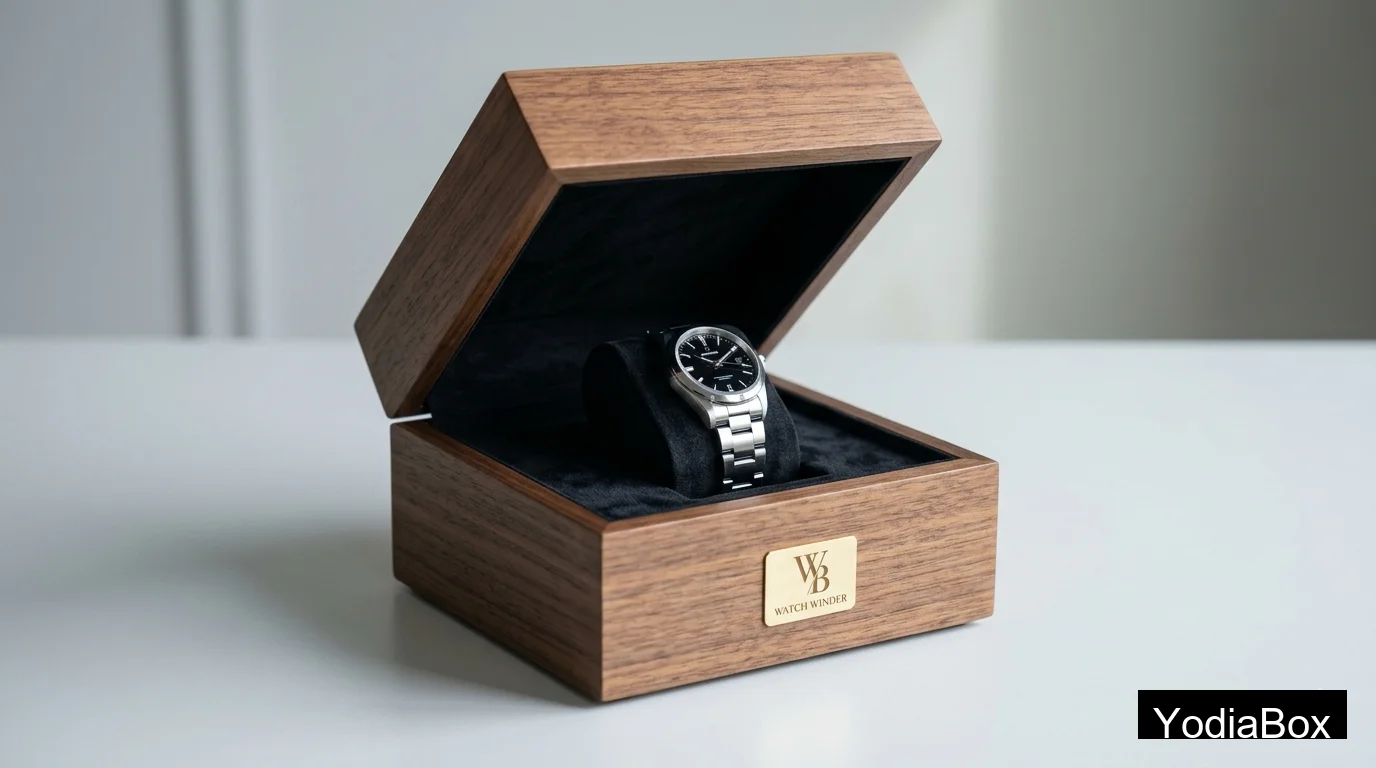
Video and content assets buyers should request
Even if you do not need consumer video, ask your supplier for at least one 30-60 second test video showing:
– lid opening and closing
– all rotor positions running
– control mode switching
– noise impression at close range
– watch loading and pillow removal
– adapter connection
A photo can hide vibration. A short video usually cannot.
For your own product page, we recommend exporting image assets in WebP format for faster loading, with unique alt text for each angle. That matters for content performance and buyer trust, especially when selling premium accessories online.
FAQ
Is it a good idea to use a watch winder?
It depends on the watch and the user. For automatic watches worn in rotation, a watch winder can be useful because it keeps the movement running and avoids frequent resetting of time, date, or moonphase. But it should use the correct TPD setting, usually 650-1200, and should not overrun the watch continuously without need.
Does Rolex recommend a watch winder?
Rolex does not generally require a watch winder for normal ownership. A Rolex automatic can be hand-wound and worn as usual. Some owners use winders for convenience, especially with multiple watches, but the key is proper programming and stable fit. For OEM buyers, that means your watch winder box should offer controlled rotation, not just nonstop motion.
How long should you leave a watch on a watch winder?
Usually, buyers should design for programmed cycles rather than nonstop spinning. Many winders run in intervals to reach a target like 650, 900, or 1200 TPD over 24 hours. End users may leave the watch in the winder daily, but the machine should rest between cycles. Continuous constant rotation is usually unnecessary and can be a poor selling point.
Is a watch better to keep in a box or watch winder?
For quartz watches or automatics not worn often, a regular box is often enough. For automatic watches that the owner wants ready to wear, a watch winder is more convenient. We usually explain it this way: a watch box is for storage and protection; a watch winder box is for storage plus controlled motion. The better choice depends on the user’s habits.
Get a quote
If you are buying a watch winder box for OEM or private label, send us these 6 items and we can usually quote faster and more accurately:
1. target capacity: 1/2/4/6 watches
2. target quantity: 100 / 300 / 500 / 1000 pcs
3. target FOB or landed price
4. finish reference: leather, lacquer, veneer, carbon pattern
5. watch size and wrist circumference range
6. sales market and plug type
We can also help you compare a powered winder against a standard collector box if you are still deciding which direction fits your market better. If you want pricing, sampling advice, or packaging recommendations, use our Contact page and send your reference images, dimensions, and expected order quantity.
References & Sources
1. [Low Voltage Directive 2014/35/EU](https://eur-lex.europa.eu/legal-content/EN/TXT/?uri=CELEX:32014L0035)
2. [CE Marking](https://single-market-economy.ec.europa.eu/single-market/ce-marking_en)
3. [[RoHS Directive 2011/65/EU](https://eur-lex.europa.eu/legal-content/EN/TXT/?uri=CELEX:32011L0065)](https://eur-lex.europa.eu/legal-content/EN/TXT/?uri=CELEX:32011L0065)
4. [ISO 2859 Sampling](https://www.iso.org/standard/16578.html)
 English
Written by: Sarah Jenkins
Senior Content Specialist
Seasoned Industry Editor with 5 years of experience, dedicated to delivering in-depth technical and market reports.
Reviewed by: Dr. Eric Shao
Chief Technical Director
With 12 years of experience in material science and custom manufacturing, ensures the scientific accuracy and technical compliance of all published content.