
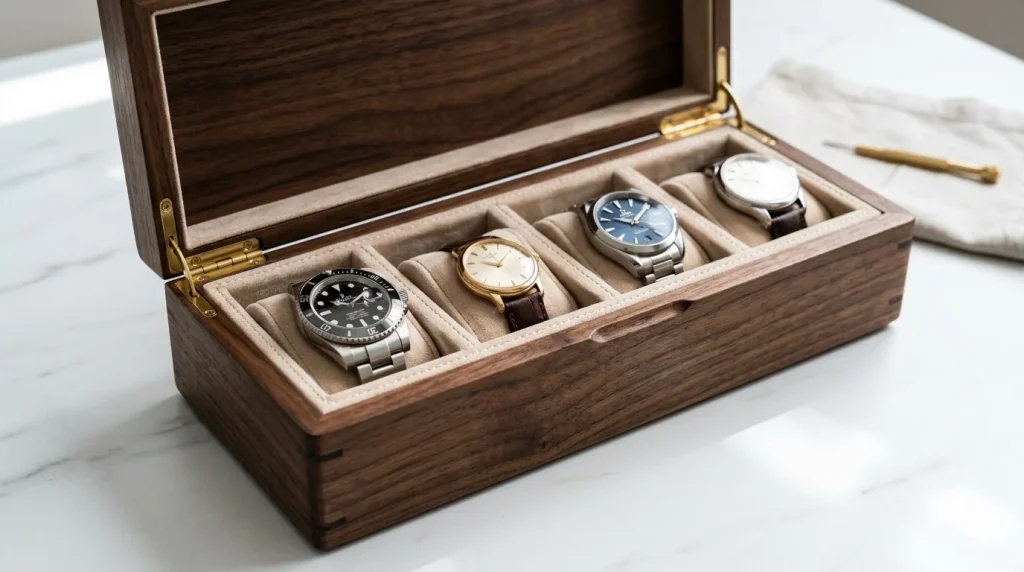
Wooden Watch Box OEM Guide: Wood Species, Joinery, Finishing & Customization for Bulk Buyers
Most buyers come to us with a simple request: “I want a wooden watch box, walnut if possible.” What they don’t realize is that “wooden watch box” covers maybe 40 different production decisions before we cut a single board. The wood species is just the start.
For a broader perspective, see our watch box buying guide.
This guide walks through everything a serious OEM buyer needs to know — from timber selection and joinery to moisture resistance, finishes, laser engraving, and how to read a price quote without getting burned. We’ve built hundreds of thousands of these boxes in our workshop. Here’s what actually matters.
—
Wood Species Comparison: What We Actually See in Production
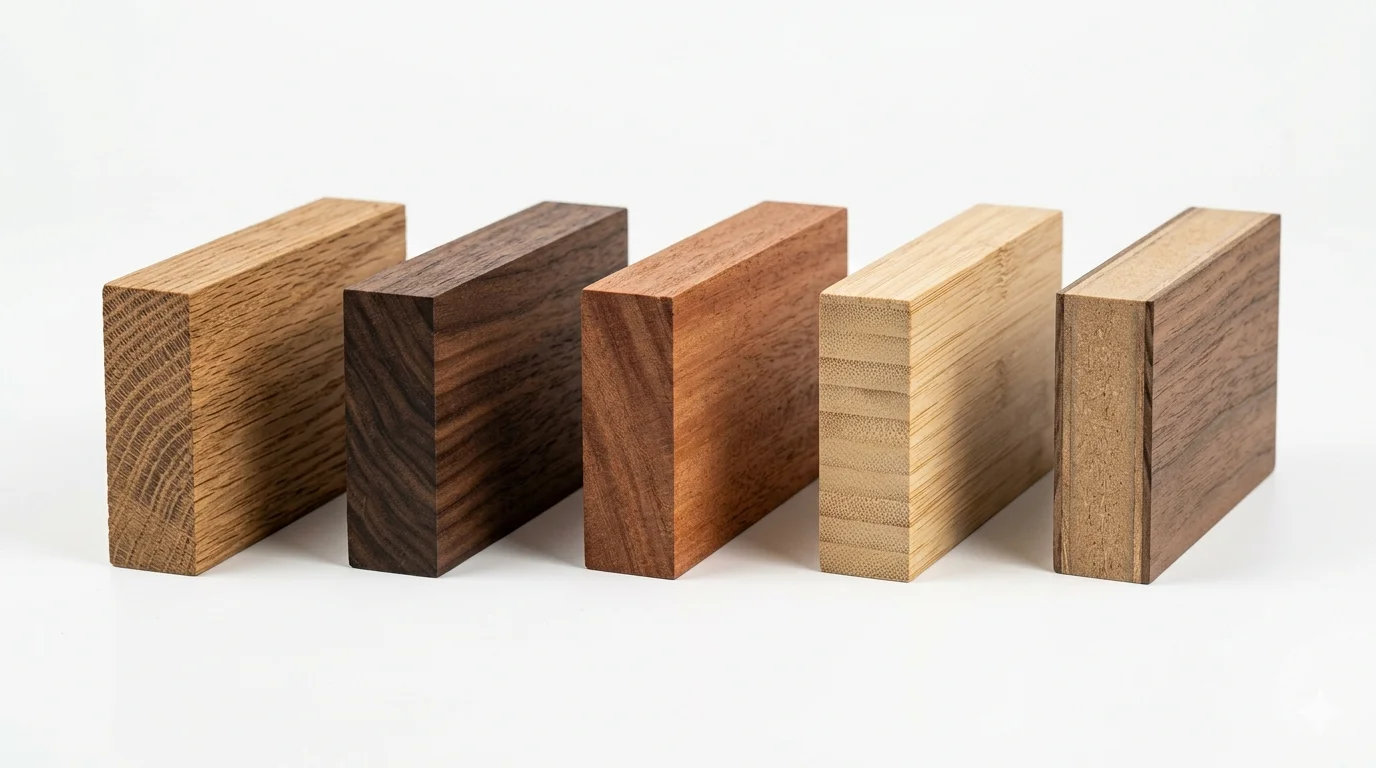
[FS-Bait] The five most common wood species for watch boxes — oak, walnut, mahogany, bamboo, and MDF veneer — differ not just in appearance but in machinability, warping risk, and finished cost per unit. Selecting the wrong species for your humidity zone or logo technique can increase reject rates by 15–30%.
Walk into our factory and you’ll see stacks of blanks waiting for the mill. The species you choose affects everything downstream: how long we can run a blade before resharpening, how tight a dovetail we can cut, how the stain takes. Here’s the honest breakdown.
Oak
Oak is dense, open-grained, and a strong choice for buyers who want visible texture. Janka hardness sits around 1,290 lbf — that means it resists denting well, which matters for hinge areas that take repeated stress. The open grain does create one practical headache: pore-filling before finishing adds a process step and cost. Buyers who want a glass-smooth surface on oak should expect either a grain filler coat or a sealer-heavy lacquer schedule.
What we’ve found in practice: oak moves seasonally. In humid shipping environments (think Southeast Asian ports in monsoon season), a poorly dried oak blank will show a hairline at the joint line within 6 months. We specify moisture content ≤ 10% before milling for oak destined for Europe or North America.
Walnut
The benchmark species for premium watch packaging. American black walnut (Juglans nigra) machines beautifully — tight grain, low warping tendency at proper MC, and a natural chocolate-brown color that photographs well for catalog shots without heavy staining. It’s also the most forgiving for laser engraving: the contrast between burned and unburned walnut is sharp and consistent.
The catch is cost. Walnut blank cost runs roughly 2.2–2.8× oak on a per-unit basis. For luxury brands ordering 500+ units, it’s usually justified. For a startup doing 200 units, the math gets harder.
Mahogany
We mostly work with plantation mahogany (Khaya species, African mahogany) rather than genuine Honduran mahogany, which carries CITES considerations that complicate export paperwork. Khaya is lighter than walnut, cuts cleanly, and takes red-toned stains in a way that mimics the classic “jewelry box” aesthetic perfectly.
This doesn’t apply when your customer is in a market sensitive to sustainability certifications. Khaya sourcing documentation requirements from FSC add lead time and cost. Budget an extra 2–3 weeks if FSC chain-of-custody paperwork is required.
Bamboo
Technically a grass, not a timber. We include it here because demand has tripled in our workshop over the past four years, driven by sustainability positioning. Bamboo composite panels machine like MDF — consistent, no grain direction surprises — but deliver a surface hardness (around 1,380 lbf Janka equivalent for strand-woven bamboo) that outperforms most hardwoods.
One thing that surprises most buyers: bamboo watch boxes are typically *more* dimensionally stable than oak or mahogany in humidity swings. The composite lamination structure resists moisture-driven expansion better than solid timber.
MDF with Veneer
Let’s be direct: MDF core with real wood veneer is not “wooden” in the traditional sense, but it’s the dominant substrate for watch boxes in the $8–$18 ex-factory price range. Why? Dimensional stability is near-perfect. MDF doesn’t move with humidity. The veneer gives you the visual character of any wood species at a fraction of the cost of solid timber.
A common mistake is assuming MDF veneer boxes are inferior. For retail environments with aggressive HVAC cycling (think department stores), an MDF-core box will outlast a solid oak box for joint integrity. The limitation is edge exposure — if the veneer edge is visible and takes impact, it chips where solid wood would dent.
Wood Species Janka Hardness (lbf) Humidity Risk Laser Engrave Quality Relative Cost Index Best Use Case White Oak 1,290 Medium Good 1.0× Mid-market, rustic aesthetic American Walnut 1,010 Low-Medium Excellent 2.2–2.8× Premium/luxury brands African Mahogany (Khaya) 830 Low Very Good 1.6–2.0× Classic jewelry aesthetic Strand-Woven Bamboo ~1,380 Very Low Good 1.3–1.7× Sustainability-positioned brands MDF + Veneer N/A Very Low Fair (veneer only) 0.7–1.0× Retail, high-volume, price-sensitive
—
Joinery Techniques: Where Boxes Fail or Last 20 Years
The joint is where a watch box either becomes an heirloom or a disappointment. We’ve seen boxes come apart after 18 months not because the wood was wrong but because the joinery specification was wrong for that wood.
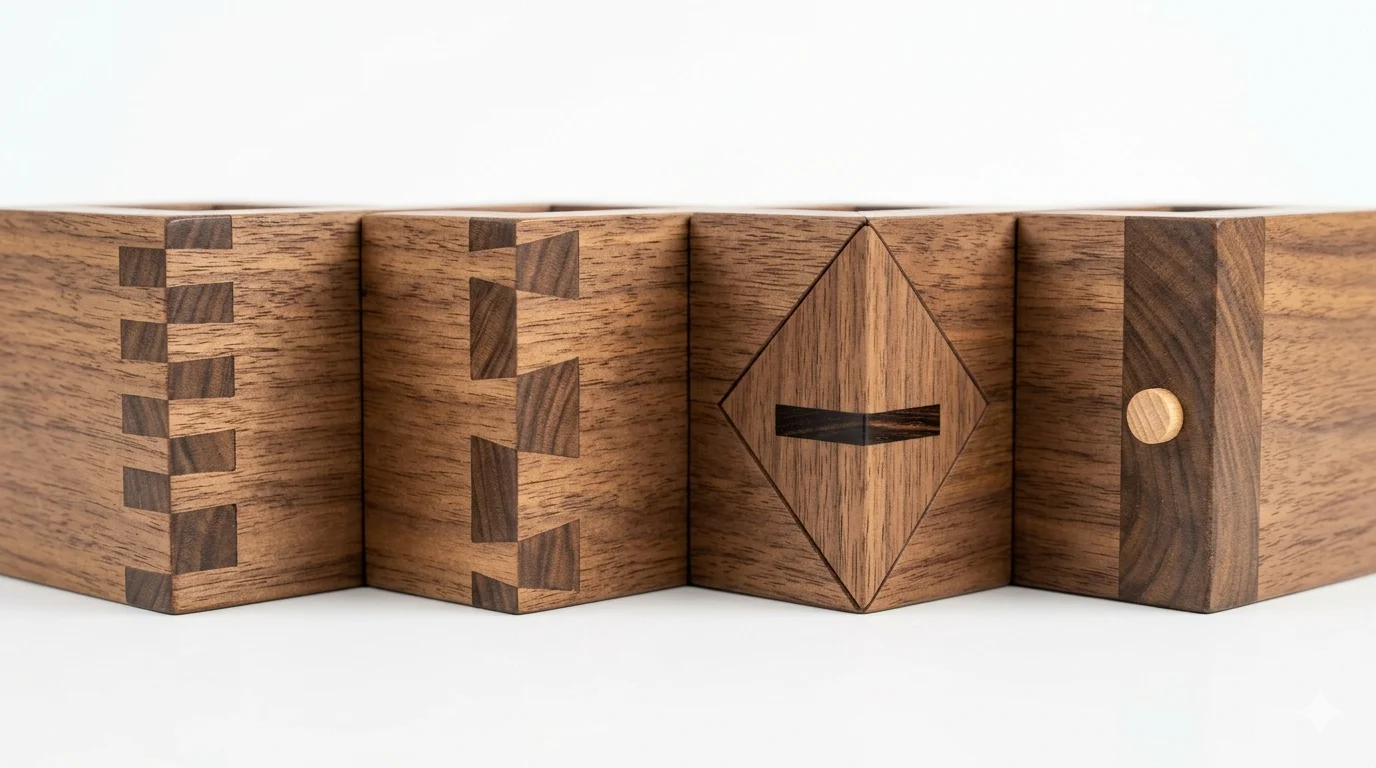
[FS-Bait] Watch box joinery options — butt joints with dowels, finger joints, dovetails, mitered splines, and rabbet construction — vary in shear strength from roughly 40 N to 380 N per joint depending on technique and adhesive. Matching joinery to wood species and hinge load is the single biggest quality variable in OEM production.
Butt Joint + Dowel
The entry-level construction. Quick to machine, low tooling cost, adequate for lightweight boxes (under 800g finished weight). The weakness is that a butt joint relies almost entirely on the adhesive bond and the dowel for shear resistance. Under repeated lid cycling — a watch box gets opened maybe 500–1,000 times in its working life — the glue line at a butt joint sees peel stress that a finger joint handles naturally.
Use it when: MOQ is high (1,000+), price is the primary driver, and the box will live in low-humidity, stable environments.
Finger Joint (Box Joint)
Our most common construction for the $15–$35 price tier. The interlocking fingers increase glue surface area by 3–5× compared to a butt joint. Formula for glue surface area increase:
SA increase = (2n + 1) × finger_depth / board_thickness
As detailed in the wooden watch box craftsmanship.
Where n = number of fingers. A 6-finger joint on a 15mm board at 12mm depth gives a surface area ratio of approximately 5.4× the butt joint baseline. That translates directly to joint strength.
Finger joints also look good on exposed corners — many buyers specifically request them as a visible design element rather than hiding them with veneer.
Dovetail Joint
The premium construction. Dovetails are mechanically interlocked — the joint can’t pull apart under tension without breaking the wood itself. For watch boxes, we typically use half-blind dovetails so the joint is invisible on the front face but visible from the side.
Engineering Note: Dovetails require tighter moisture content control during production. If a dovetail is cut at 12% MC and the wood dries to 7% in a heated warehouse, the pins shrink and you get visible gaps. We specify ≤ 8% MC for dovetailed hardwood boxes going to North American or European markets.
Mitered Spline
A 45° miter with internal splines (biscuits or thin timber inserts) gives you the clean look of a miter with significantly more strength. This is our go-to for high-end display boxes where visible grain wrap around corners is important. The grain flows continuously around the corner, which looks stunning on walnut.
The tradeoff: miter joints are the least forgiving to humidity movement. The splines help, but we don’t recommend mitered construction for clients shipping to Southeast Asia, Middle East, or any market with wide seasonal humidity swings without an interior lacquer seal.
—
Finishing Options: Protection First, Aesthetics Second
A finish isn’t decoration — it’s a moisture barrier. This is the framing that changes how buyers think about the finishing specification.
Lacquer (NC and PU)
Nitrocellulose (NC) lacquer is fast, cheap, and gives a classic furniture look. Polyurethane (PU) lacquer builds a harder film and is our recommendation for watch boxes that will be handled daily. PU lacquer at 2-seal + 2-topcoat achieves a film build of approximately 80–120 μm, which is sufficient to slow moisture transmission to a rate that won’t cause joint movement.
RoHS compliance matters here: some NC lacquer formulations still contain restricted substances. For any box going to the EU, we verify our finish schedule against the RoHS Directive 2011/65/EU component list.
Oil and Wax (Natural Finish)
Penetrating oils (tung, Danish, hardwax-oil) don’t build a surface film — they sink into the wood fibers. The result is a matte, tactile surface that feels like wood rather than a coated surface. Buyers with premium positioning often prefer this.
This doesn’t apply when the box will be displayed in retail environments with customer handling. An oil-finished box shows fingerprints and water rings. We add a matte topcoat over the oil on retail-specification boxes to solve this without losing the natural feel.
Piano Gloss / High Polish
Multiple coats of PU or polyester lacquer, sanded between coats, finished with buffing compound. The process adds 2–3 production days and significant labor cost, but the result is a mirror-like surface that photographs exceptionally well.
Pro Tip: If your marketing budget depends on product photography, piano gloss is worth the cost. A $4–6 upcharge per unit pays for itself in one decent catalog shoot. But be honest with your customers about care — piano gloss scratches easily and shows dust.
Staining
Buyers often request specific stain colors to match brand identity. Stain performance varies by species: open-grained woods (oak, ash) take stain unevenly if not grain-filled first. Walnut and mahogany take stain predictably. We typically send stain samples on the actual production species before approval — what looks correct on walnut will look different on oak.
—
Humidity Resistance and Durability Specifications
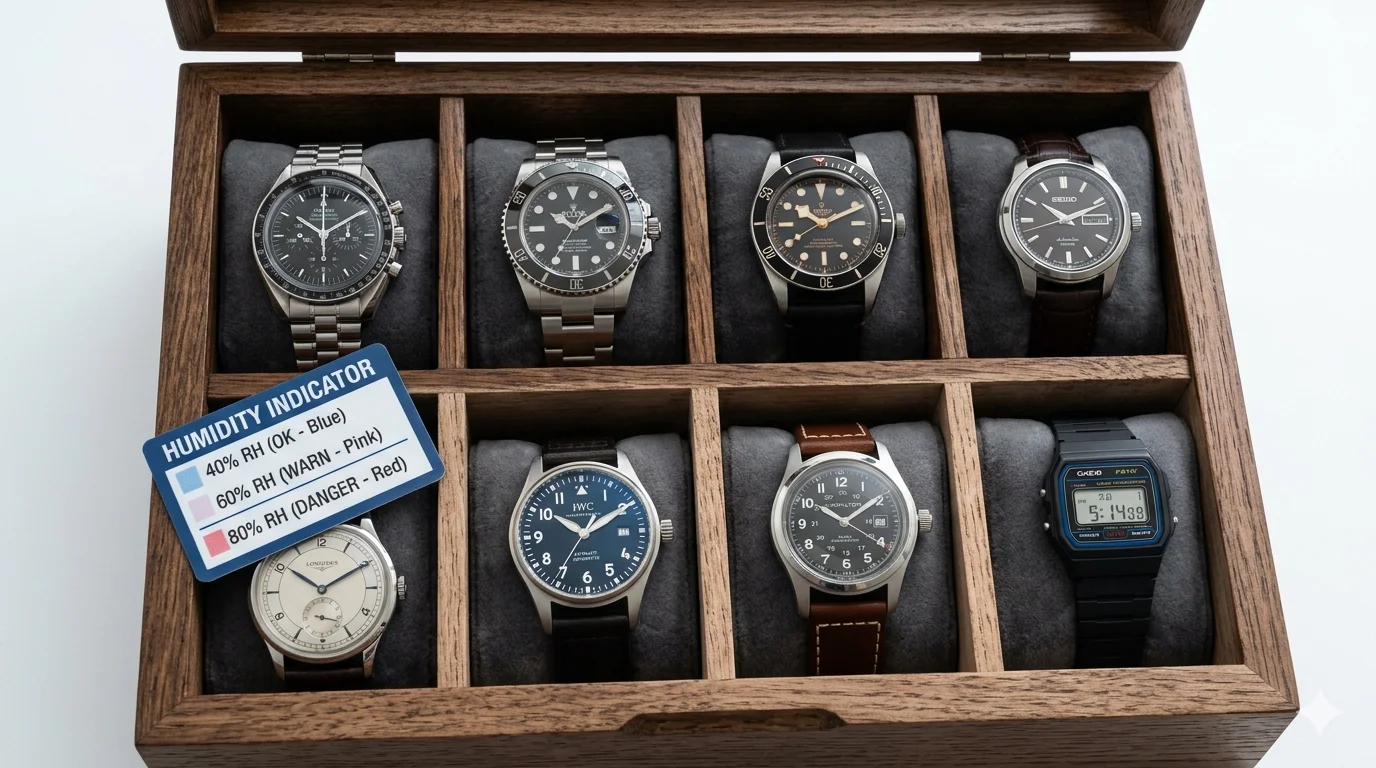
Wooden watch boxes fail in the field for two reasons: joint failure from humidity cycling, and interior liner degradation. Wood gets most of the blame; the liner is often the real culprit.
The formula we use for estimating equilibrium moisture content (EMC) at destination:
EMC (%) ≈ 30 × (relative_humidity / 100) × (1 / (1 + K × relative_humidity))
Where K ≈ 0.791 for most hardwoods. At 65% RH (typical European office), EMC ≈ 12%. At 85% RH (tropical), EMC ≈ 18%. A box cut to 8% MC will absorb moisture until it reaches EMC — the question is whether the joints and finish can tolerate the dimensional change.
Common Mistake: Specifying a solid timber box for a client in Singapore or Miami without interior lacquer sealing. The interior surfaces of a watch box are almost never finished, and the bare wood inside absorbs humidity far faster than the exterior. We seal interior surfaces with a barrier coat on all boxes destined for humid climates. Add this to your specification.
For shipping durability, we test to ISTA 3A procedures — vibration, drop, and climate exposure — for any order where retail shelf presentation is critical. This isn’t a standard test most factories offer by default; ask for it explicitly.
This ties directly into our handcrafted wood watch storage.
—
Pricing by Wood Grade and Construction Tier
Price ranges shift constantly with commodity markets, but the *relationships* between tiers stay consistent. Here’s how we think about it at our factory:
Construction Tier Wood Spec Joinery Finish Approx. Ex-Factory Range (USD) MOQ Entry MDF + Oak Veneer Butt/Dowel NC Lacquer $6–$10 500 Standard Solid Oak or Bamboo Finger Joint PU Lacquer $12–$18 300 Premium Solid Walnut or Mahogany Finger Joint or Dovetail PU or Oil Finish $22–$38 200 Luxury Solid Walnut + Inlay Dovetail or Mitered Spline Piano Gloss or Hardwax Oil $45–$80+ 100
This doesn’t apply when you’re including electronics (LED lighting, watch winder motors, or battery systems). Electrical components add separate regulatory requirements including CE marking under Directive 2014/35/EU and UN 38.3 battery safety testing for any lithium cell included in the package.
—
Customization: Laser Engraving, Inlay, and Brand Application
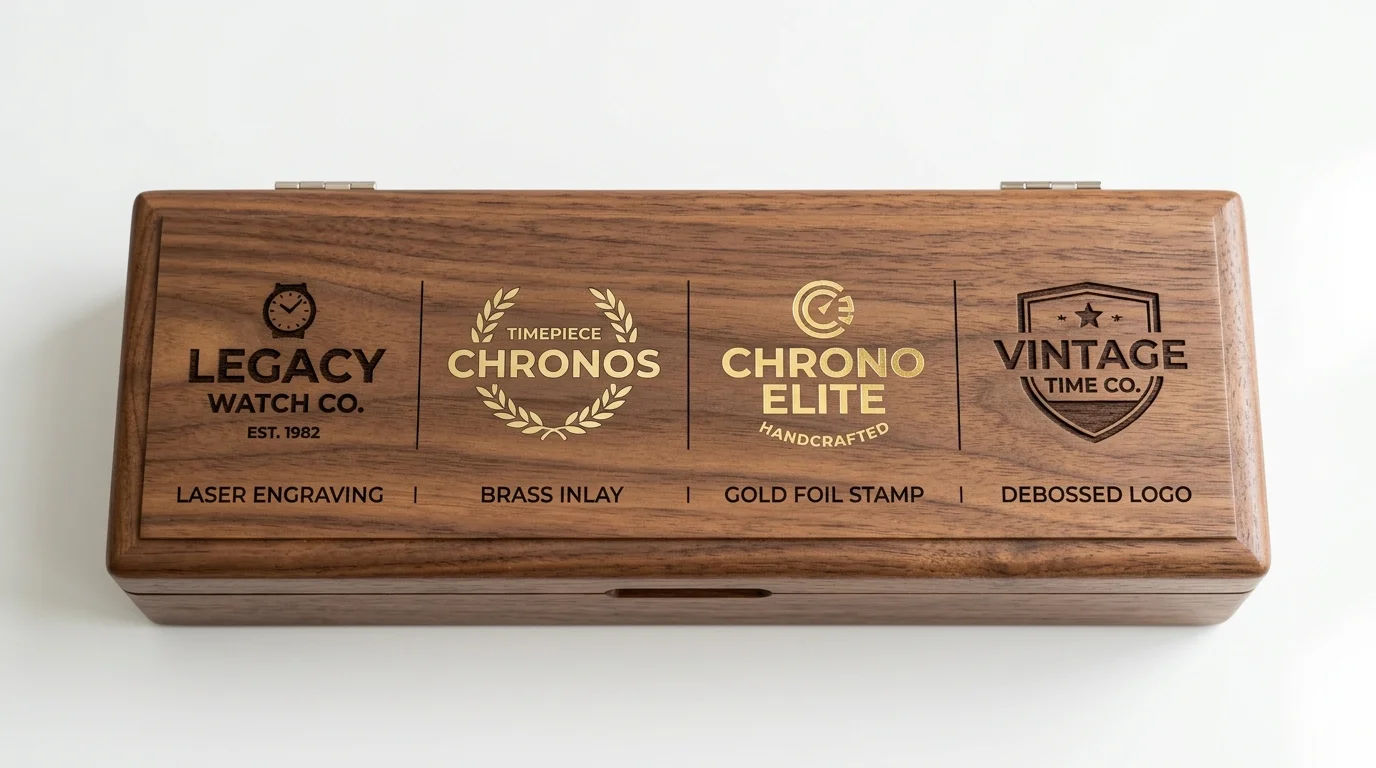
Laser Engraving
Our CO₂ laser achieves engrave depths of 0.3–1.2mm on wood surfaces. Walnut gives the best contrast — the natural dark pigment in the char reads cleanly against the honey-brown base. Bamboo engraves consistently but with lower contrast. MDF veneer requires careful power calibration; too deep and you burn through the veneer into the MDF substrate.
Standard logo placement: lid center, lid corner, or interior front rail. We provide a die-line template at order; artwork must be submitted as vector (AI, EPS, or SVG) at production scale.
For repeat orders, the laser file setup cost is a one-time charge. After that, adding your logo costs essentially nothing per unit.
Brass and Shell Inlay
Metal inlay — typically brass sheet cut to logo shape, pressed and glued into a routed cavity — is available on premium tier boxes. The process requires 0.3mm positional tolerance between the router path and the inlay piece. We use CNC routing for this; hand-routing is not consistent enough at production scale.
Pro Tip: Brass inlay on walnut is one of the best-looking results we produce. The warm metal against dark wood reads as genuinely luxurious. Budget approximately $3–8 additional per unit depending on inlay complexity, plus a one-time tooling cost for the router path file.
Foil Stamping vs. Laser
Foil stamping gives you metallic color options (gold, silver, rose gold, holographic) that laser can’t achieve. The tradeoff: foil requires a brass die ($80–200 one-time), and placement must be on a flat, finished surface. Curved or textured areas don’t stamp cleanly.
Short answer: laser for clean, high-resolution logos with no minimum order implication; foil for metallic brand marks where the gold/silver finish is part of the brand identity.
—
OEM Buyer Decision Matrix
Use this matrix to match your project requirements to the right specification path. Score each criterion 1–3 (1 = low priority, 3 = high priority) for your project, then read across.
Decision Criteria If Score = 1 (Low Priority) If Score = 3 (High Priority) Unit Cost Solid hardwood (walnut/mahogany) acceptable MDF veneer + NC lacquer Humidity Destination MDF core, standard finish Solid bamboo or sealed solid hardwood, interior barrier coat Logo Prominence Foil stamp or deboss Laser engrave (walnut preferred) or brass inlay Joint Longevity Butt joint + dowel acceptable Finger joint minimum; dovetail for premium Sustainability Claim Any species with FSC paper available Bamboo or FSC-certified hardwood with documentation Lead Time Standard 35–45 day production MDF construction (faster machining, shorter dry time) Order Volume 100–200 units 500+ units (enables tooling amortization for inlay/special joinery)
—
Frequently Asked Questions
Q: What’s the minimum order quantity for solid walnut boxes with laser engraving?
In our workshop, 150 units is the practical floor for solid walnut with laser. Below that, wood procurement and setup costs make per-unit pricing unworkable for most buyers. MDF veneer can go to 300 units at better pricing.
Q: Can I mix wood species in one order — say, half walnut and half oak?
Yes, but it changes how we schedule production. Mixed-species orders are treated as two separate production runs sharing shipping. Expect a 10–15 day lead time addition and a small per-species setup charge.
Q: How do I specify interior lining for a watch box?
Interior lining (velvet, suede microfiber, foam insert) is specified separately from the wood construction. The standard option is a die-cut foam insert with microfiber wrap. If you have a specific Pantone color for the interior, send it early — fabric minimums can be a constraint on unusual colors.
Q: What certifications do you provide for wooden watch boxes going to the EU?
For non-electronic wooden boxes, the primary documentation is a REACH substance declaration (confirming no SVHC above 0.1% w/w) and an FSC chain-of-custody certificate if specified. We provide both on request. CE marking applies only if the box includes electrical components.
Q: Does laser engraving add significantly to lead time?
No. Laser engraving is the last step before quality inspection and typically adds 1–2 days to a production run, not 1–2 weeks. The file setup and approval process takes longer than the actual engraving.
Q: What happens to my samples if I order 5 samples but the production run is 200 units — are they the same construction?
They should be. A common mistake by buyers is approving samples that were hand-finished or made from a different blank grade than production will use. Ask explicitly: “Are these samples cut from the same timber grade and finished on the same line as production?” If the answer is vague, that’s a red flag.
—
References & Sources
1. Forest Stewardship Council (FSC) Chain of Custody Standard — Forest Stewardship Council International
2. RoHS Directive 2011/65/EU — Restriction of Hazardous Substances — European Parliament and of the Council
3. Low Voltage Directive 2014/35/EU (CE Marking) — European Parliament and of the Council
4. UN Manual of Tests and Criteria — UN 38.3 Battery Safety — United Nations Economic Commission for Europe
5. ISTA Test Procedure 3A — Packaged Products for Parcel Delivery — International Safe Transit Association
6. REACH Regulation (EC) No 1907/2006 — Understanding REACH — European Chemicals Agency
7. CE Marking — European Single Market Guidance — European Commission
8. Wood Handbook: Wood as an Engineering Material — Chapter 4, Moisture Relations — USDA Forest Products Laboratory
 English
Written by: Sarah Jenkins
Senior Content Specialist
Seasoned Industry Editor with 5 years of experience, dedicated to delivering in-depth technical and market reports.
Reviewed by: Dr. Eric Shao
Chief Technical Director
With 12 years of experience in material science and custom manufacturing, ensures the scientific accuracy and technical compliance of all published content.