
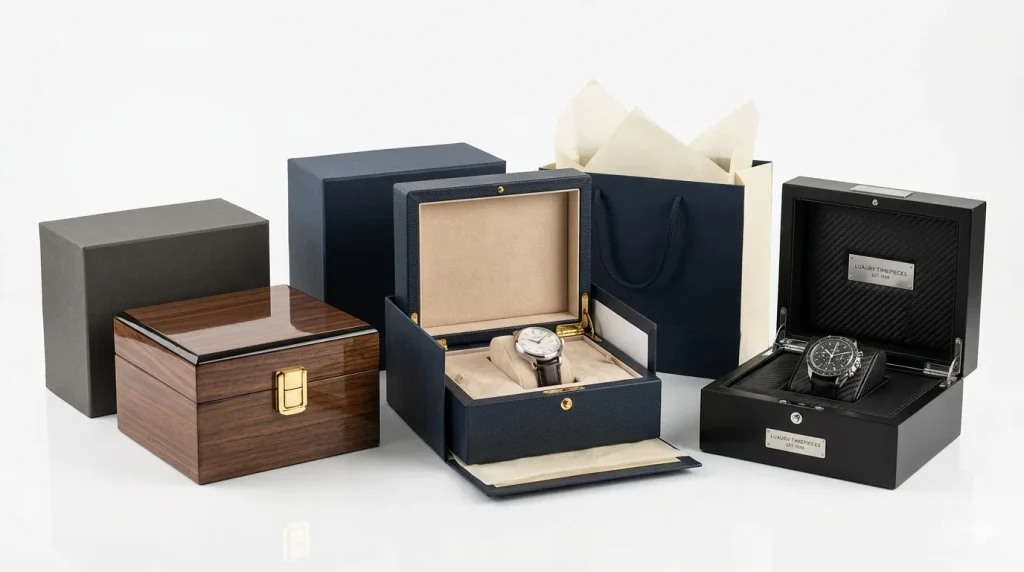
Luxury Watch Box Brands: An OEM Engineer’s Guide to Materials, Construction, and What Actually Matters
Most buyers searching for luxury watch box brands are asking the wrong question. Brand names matter far less than the engineering underneath the lid. In our workshop, we’ve built boxes for clients who slapped prestigious logos on mediocre foam inserts, and we’ve built anonymous white-label pieces that could sit comfortably next to a Rolex boutique display. The box doesn’t know whose name is on the outside. The materials do the talking.
For a broader perspective, see our complete watch box guide.
This guide breaks down what actually separates a $12 watch box from a $180 one—not marketing copy, but measurable construction differences any OEM buyer can evaluate before placing a 500-unit MOQ.
—
What Makes a Watch Box “Luxury”: The Engineering Baseline
The word “luxury” gets applied to anything with a piano-black finish and a ribbon pull. That’s not useful. What we’ve found in practice is that genuine luxury-tier watch packaging clears four engineering thresholds before any surface treatment even comes into discussion.
Structural rigidity. The substrate—usually MDF, plywood, or solid wood—needs to resist racking under load. A 12mm MDF board with proper corner joinery won’t flex when a 300g automatic watch slides during transit. A 6mm chipboard box will. The formula is simple: rigidity scales with substrate thickness and joint quality, not with the leather stretched over it.
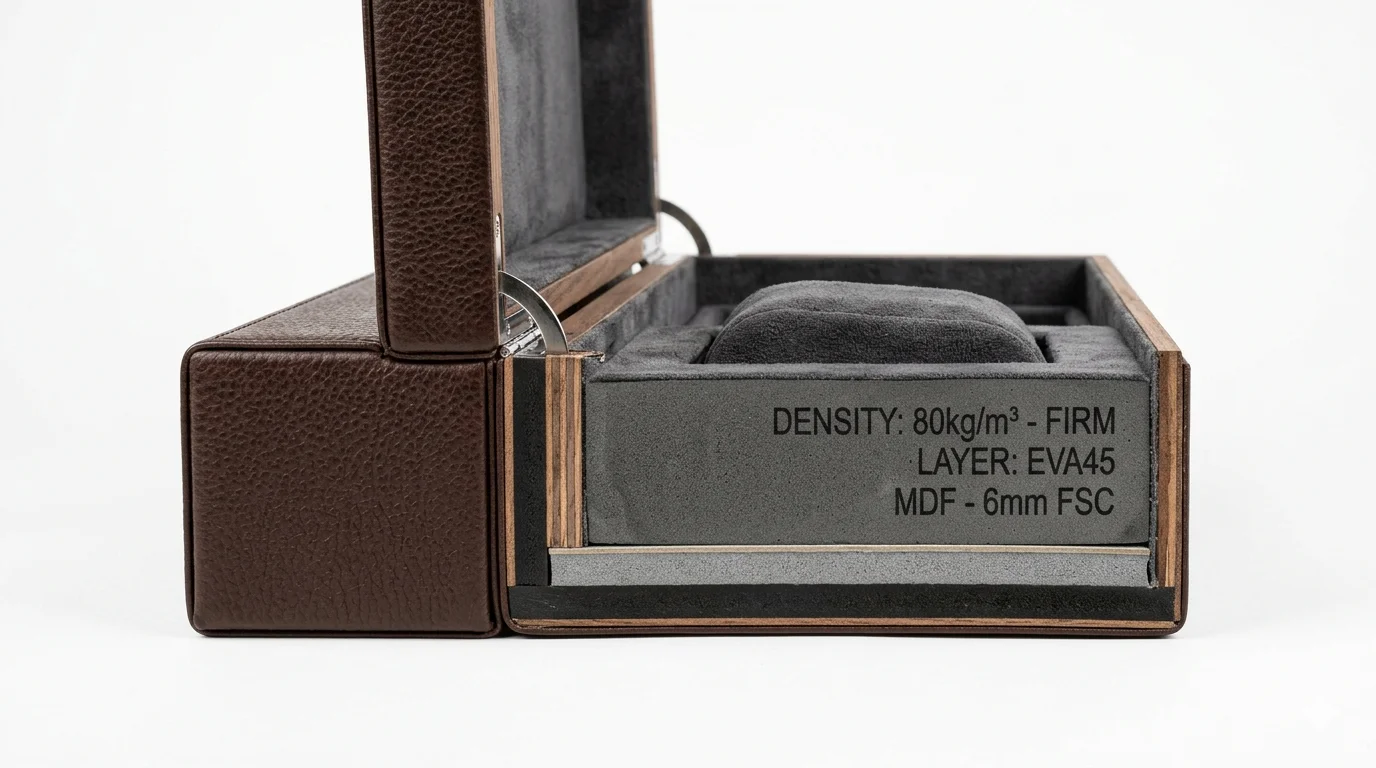
Climate control for the interior. Watches are precision instruments. Humidity cycling—common during ocean freight—causes lubricants to migrate and metal components to micro-corrode. A properly designed luxury watch box uses a closed-cell foam insert (typically polyurethane at 45–55 kg/m³ density) rather than open-cell polyester. Open-cell foam absorbs and releases moisture. Closed-cell does not.
Surface durability. The exterior finish should survive the ISTA 3A drop-and-vibration sequence without delaminating. We test this internally before any client shipment. Bonded leather over 1.0mm substrate will crack at fold edges within 18 months of normal retail handling. Full-grain leather over 1.2mm substrate won’t.
Mechanical precision. Hinges, magnetic closures, and locking mechanisms should operate at consistent torque across 10,000 cycles. One thing that surprises most buyers: a hinge that feels perfect at room temperature can bind or loosen at 40°C because the metal expands at a different rate than the wood substrate. This isn’t a defect—it’s a material pairing problem that needs to be engineered out at the prototype stage.
> Engineering Note: Density is the single most predictive variable for foam insert longevity. Measure it. 45 kg/m³ minimum for watch cushions holding pieces above 150g. Below that, the cushion compresses permanently within 6 months of display use.
—
Premium Leather Options: What the Surface Actually Tells You
Surface material is where most buyers start, and where most get misled. Here’s how the materials actually stack up.
Full-Grain vs. Top-Grain vs. Bonded Leather
Leather Type Source Layer Thickness Range Pore Structure Expected Surface Life Full-grain Outermost hide layer 1.0–1.4mm Open, natural 15–25 years with use Top-grain Sanded outer layer 0.8–1.2mm Partially closed 7–12 years with use Corrected-grain Sanded + embossed 0.7–1.0mm Artificial texture 4–8 years Bonded / PU leather Fiber scraps + polyurethane 0.4–0.8mm None 2–5 years PU synthetic 100% polyurethane film 0.5–1.2mm None 3–6 years
A common mistake is treating “genuine leather” as a quality signal. By ISO 17234-1 leather testing standards, “genuine” simply means leather is present somewhere in the material—it says nothing about grade, thickness, or placement. We’ve seen boxes marketed as “genuine leather” where the leather content is a 0.3mm backing layer under a PU film topcoat.
For OEM clients targeting true luxury positioning, the only defensible specification is full-grain or top-grain with a minimum 1.0mm callout thickness, hand-stitched at corners rather than heat-bonded.
Alcantara: The Underused Option
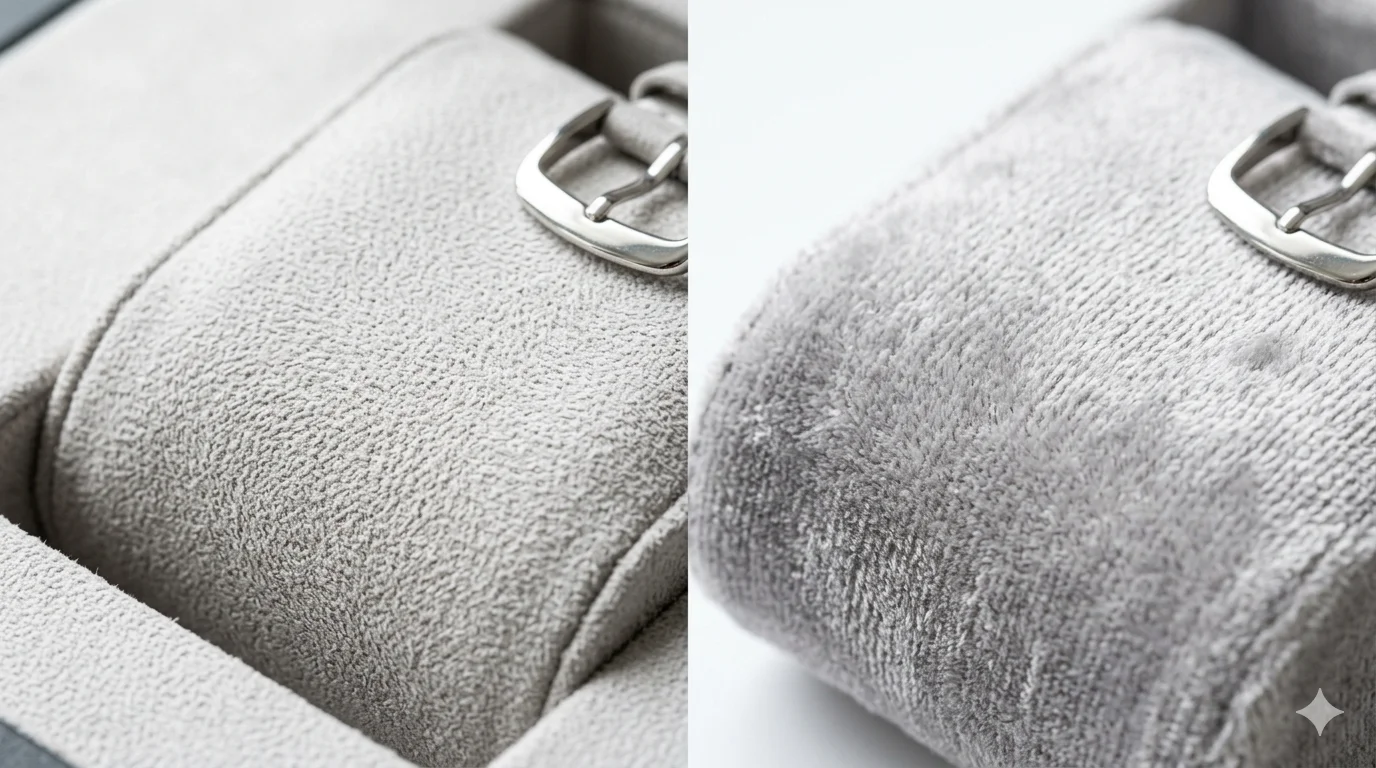
Alcantara—the branded microsuede produced by Alcantara S.p.A.—is genuinely underspecified in watch box interiors. It’s a 68% polyester / 32% polyurethane nonwoven that gives a velvet-soft hand feel, resists abrasion better than natural suede, and doesn’t generate the micro-fiber shedding that can contaminate watch crystals.
What we’ve found in practice: Alcantara adds approximately €0.40–0.80/unit to material cost at 1,000-unit volumes, but dramatically reduces the rate of crystal micro-scratches reported by end consumers. For clients selling automatic watches above €500 retail, this is a no-brainer tradeoff.
This doesn’t apply when your buyer pool is high-turnover gifting (under €150 retail watches) where the visual texture matters more than the technical performance—in that segment, high-pile velvet reads as more luxurious to the consumer even though Alcantara outperforms it technically.
> Pro Tip: Ask your supplier for an Alcantara certification tag. Genuine Alcantara material carries a serial-numbered certificate of authenticity. Any supplier claiming Alcantara without this documentation is selling a domestic microsuede imitation, which performs significantly worse in abrasion testing.
—
Exotic Woods and Carbon Fiber: High-Impact Substrates
As detailed in the luxury watch box brands reviewed.
Solid Wood Construction
Solid wood watch boxes—walnut, ebony, maple burl, cherry—are the benchmark for the ultra-premium segment. The engineering reality is that solid wood moves. Humidity changes cause expansion and contraction across the grain, and a box that fits perfectly at 45% RH in our workshop may develop lid gap at 20% RH on a retail shelf in Arizona.
The solution is quarter-sawn construction for panels, with floating panel joinery that accommodates seasonal movement without stressing the glue lines. This isn’t optional—it’s physics. A glued-up solid panel fighting seasonal movement will crack within two to three years.
Dimensional calculation for movement allowance:
Estimated seasonal movement = Panel width (mm) × Moisture content change (%) × Radial shrinkage coefficient
For walnut, radial shrinkage coefficient ≈ 0.00274. A 200mm wide walnut panel experiencing a 4% MC swing moves approximately 200 × 4 × 0.00274 = 2.19mm. That’s enough to bind a close-tolerance lid if not designed for it.
Carbon Fiber Composite
Carbon fiber watch boxes occupy a specific niche: ultra-light (shipping cost matters on international DDP orders), visually dramatic, and genuinely strong. The challenge is that automotive-grade carbon fiber panels—2×2 twill weave at 0.5mm–1.0mm plies—require professional bonding to wood or aluminum substrates to achieve usable box geometry.
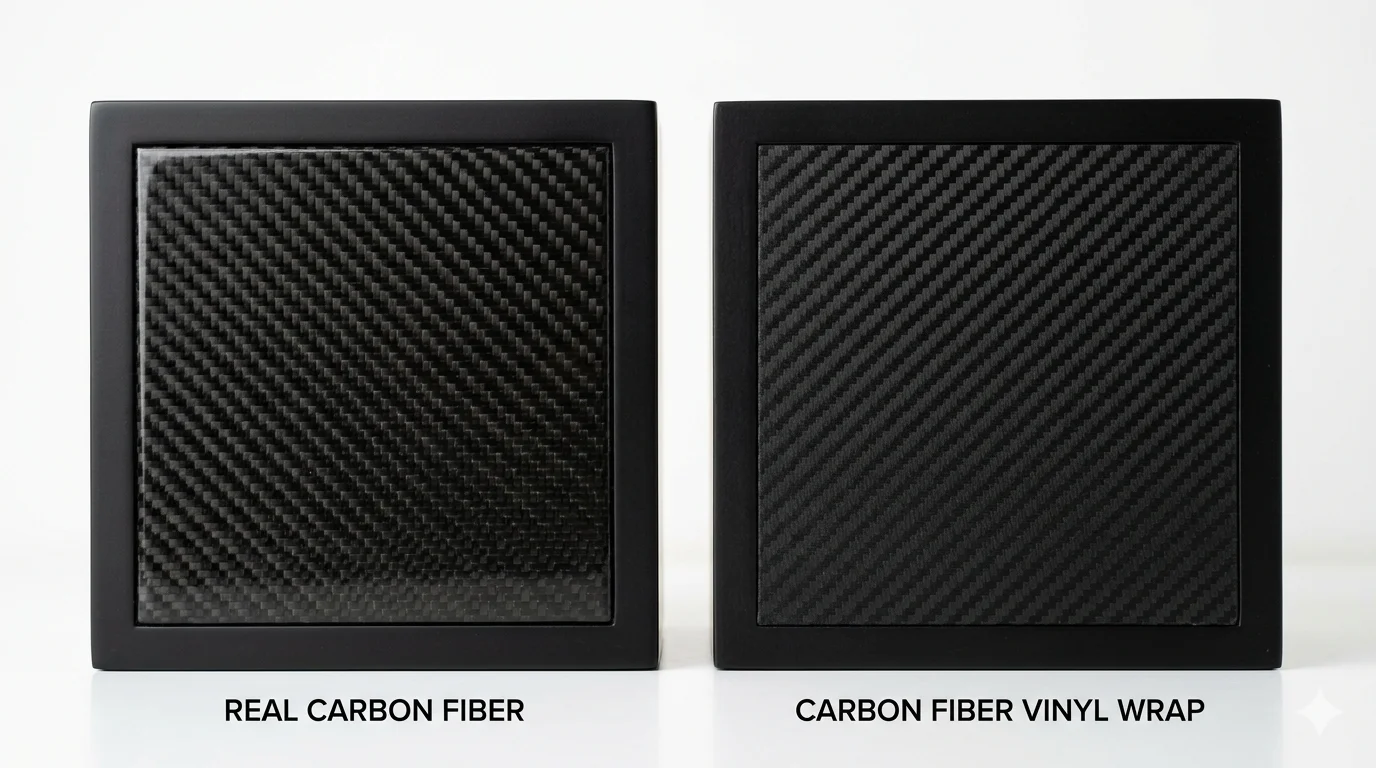
What we’ve found in practice: most “carbon fiber” watch boxes in the mid-market are carbon fiber vinyl wrap over MDF. Real carbon fiber composite construction costs 3–5× more. You can distinguish them: real CF panels are cold to the touch, have no visible seam edges, and produce a sharp metallic sound when tapped. Vinyl wrap over MDF sounds dull and has a slight give at the surface.
> Common Mistake: Specifying “carbon fiber finish” without clarifying “real composite vs. vinyl wrap” in the OEM contract. We’ve seen orders go wrong on this repeatedly. Make the spec explicit, with a material verification protocol in the QC clause.
—
Museum-Grade Display Engineering: The Interior Systems
The watch itself matters more than the box around it. Which means interior engineering—how the watch sits, rotates, and is presented—is where luxury watch box brands actually differentiate.
Cushion Engineering
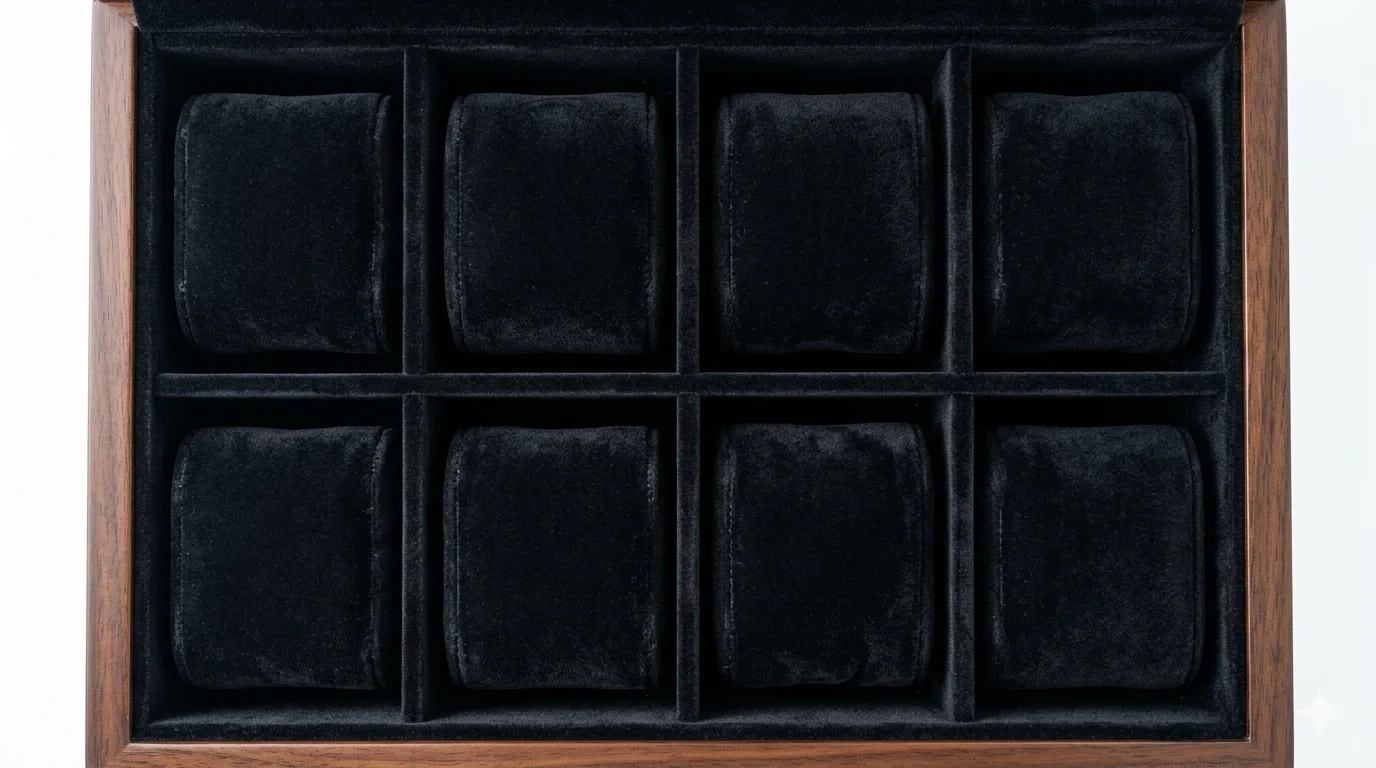
Watch cushions are not decoration. They’re the primary mechanical support for a piece worth anywhere from €500 to €50,000. The engineering parameters:
Cushion diameter to case diameter ratio: Ideally 0.85:1. A cushion too narrow lets the watch rock axially; too wide compresses the bracelet inward. For a 40mm case diameter watch, target a 34mm cushion crown diameter.
Shore hardness: We specify 15–25 Shore A for foam cores under Alcantara or velvet. Below 15 Shore A, the watch sinks and the crown contacts the base under its own weight. Above 25 Shore A, the cushion doesn’t conform to the case back profile and creates point-loading stress on ceramic or sapphire case backs.
Rotation systems: For skeleton watches or display-back timepieces, rotating cushion mechanisms with 360° or 180° indexed stops add approximately $3–8/unit at tooling amortized over 2,000 units. These use a ratcheting PTFE bearing in the cushion base. This is worth specifying for any client selling display-back automatic watches—it’s the feature customers immediately interact with.
[FS-Bait] A luxury watch box interior requires a foam cushion of 45–55 kg/m³ density at 15–25 Shore A hardness, with a cushion-to-case diameter ratio of approximately 0.85:1. These three parameters together prevent crown damage, case back stress, and axial rocking during storage and display.
Multi-Watch Storage: Layout Engineering
Multi-watch boxes (6, 8, 12-slot configurations) introduce a structural problem most buyers don’t anticipate: inter-watch vibration coupling. If two watches are cushioned on a shared MDF panel with no isolation layer, vibration from handling transmits through the substrate. For vintage watches with fragile balance wheels, this is a genuine concern.
Our solution in production: a 3mm closed-cell EVA layer bonded beneath the MDF panel acts as a vibration break. It adds under $0.50/unit at volume but is a specification point worth raising with any supplier targeting the collector market.
—
This ties directly into our high end watch box features.
Compliance and Standards: What OEM Buyers Must Know
Luxury positioning doesn’t exempt you from compliance. In fact, it raises the stakes—a recalled luxury product damages brand equity far more than a recalled mass-market one.
Relevant Standards for Watch Box OEM
Standard Jurisdiction What It Covers Mandatory? CE (LVD 2014/35/EU) EU Electrical components (if box includes winder/lighting) Yes, if powered RoHS Directive 2011/65/EU EU Restricted hazardous substances in materials Yes, for EU market REACH Regulation EC 1907/2006 EU Chemical substances in articles Yes, for EU market FCC Part 15 USA Radio frequency emissions (if watch winder included) Yes, if wireless UN 38.3 International Lithium battery transport (if battery-powered winder) Yes, if Li-ion ISTA 3A Shipping Transit shock and vibration simulation Recommended ISO 2859-1 QC Sampling procedures for inspection by attributes Recommended
> Engineering Note: REACH compliance is where we see the most gaps in mid-tier OEM orders. Certain dye lots used in velvet and leather finishing contain restricted azo dyes. Request a material safety data sheet (MSDS) and a REACH SVHC declaration for any textile or leather component before production begins.
A common mistake is treating CE marking as a blanket quality certification. It isn’t. CE is a self-declaration of conformity to specific directives—for a passive watch box with no electrical components, no CE marking is required or applicable. Suppliers who put CE marks on passive boxes are either misinformed or misrepresenting compliance.
—
FAQ: Luxury Watch Box OEM Sourcing
Q: What’s the realistic MOQ for a fully custom luxury watch box?
It depends on construction complexity. For leather-wrapped MDF with custom foam insert: typically 300–500 units. For solid wood with CNC-routed interior: 200–300 units due to higher per-unit setup cost. Carbon fiber composite: 500+ units minimum because of tooling amortization.
Q: How do I verify leather quality before production?
Request a physical sample, not photos. Test the fold edge by bending 180° around a 5mm mandrel—quality top-grain leather won’t crack. Check thickness with a caliper. Smell matters too: genuine leather has a characteristic tanning odor that PU synthetic doesn’t replicate.
Q: Can the same box design work for both display and shipping?
Short answer: usually not, without compromise. Display-optimized boxes use open-front or glass-panel designs that are structurally weaker in transit. Shipping-optimized boxes prioritize corner protection and closure retention. We typically recommend designing the primary box for display/retail and specifying a separate outer shipping carton to ISTA 3A transit standards.
Q: What’s the lead time for a fully custom luxury watch box from design to production sample?
In our workshop, prototype lead time is 15–25 days for leather/MDF construction, 30–45 days for solid wood, and 45–60 days for carbon fiber composite. These assume finalized design files and approved materials. Revisions add time—budget two rounds.
Q: How do I spec a watch winder inside a luxury box?
This opens a separate compliance discussion. Once you add a motor and power supply, the box becomes an electrical product under CE LVD 2014/35/EU and potentially FCC Part 15 for the US market. If battery-powered, UN 38.3 applies for air freight. Factor testing costs into your project budget from day one.
Q: Is Alcantara worth the premium over velvet for watch interiors?
For watches above €500 retail value: yes, unambiguously. For lower price points: it depends on your target consumer. Alcantara outperforms velvet on abrasion resistance and doesn’t shed fibers. But it doesn’t have the same visual “luxury” depth that high-pile velvet projects in photos, which matters in e-commerce.
—
Sourcing Checklist: Before You Sign the OEM Contract
What we’ve found in practice is that most quality failures are entirely predictable from the specification document—or the lack of one. Before signing any OEM production contract for luxury watch boxes, verify these points in writing:
– Substrate material and minimum thickness (specify: “12mm MDF” or “10mm Baltic birch plywood,” not just “wood”)
– Leather grade, thickness, and stitching method at corners
– Foam density (kg/m³) and Shore hardness for all cushion components
– Hinge cycle life rating and material specification
– Magnetic closure pull force (typically 400–800g for a single watch box lid)
– Interior material fiber shedding test protocol
– REACH SVHC declaration for all textile and leather components
– Agreed sampling plan referencing ISO 2859-1 AQL level
– Transit testing protocol (ISTA 3A or equivalent)
This doesn’t apply when ordering purely decorative or disposable packaging—for gifting boxes intended for single-use presentation, many of these specs are overkill. But for any piece that’s part of the product experience itself, every line of this checklist protects both you and your end customer.
—
References & Sources
1. ISTA 3A: Packaged-Products for Parcel Delivery System Shipment — International Safe Transit Association (ISTA)
2. ISO 17234-1: Leather — Chemical Tests for Colour Fastness — International Organization for Standardization
3. ISO 2859-1: Sampling Procedures for Inspection by Attributes — International Organization for Standardization
4. CE Low Voltage Directive 2014/35/EU — Official Journal of the European Union
5. RoHS Directive 2011/65/EU: Restriction of Hazardous Substances — Official Journal of the European Union
6. REACH Regulation EC 1907/2006: Understanding REACH — European Chemicals Agency (ECHA)
7. FCC Equipment Authorization — Part 15 — US Federal Communications Commission
8. UN 38.3: Transport of Dangerous Goods — Lithium Battery Testing — United Nations Economic Commission for Europe (UNECE)
9. Alcantara Material Certification and Authentication — Alcantara S.p.A.
 English
Written by: Sarah Jenkins
Senior Content Specialist
Seasoned Industry Editor with 5 years of experience, dedicated to delivering in-depth technical and market reports.
Reviewed by: Dr. Eric Shao
Chief Technical Director
With 12 years of experience in material science and custom manufacturing, ensures the scientific accuracy and technical compliance of all published content.