
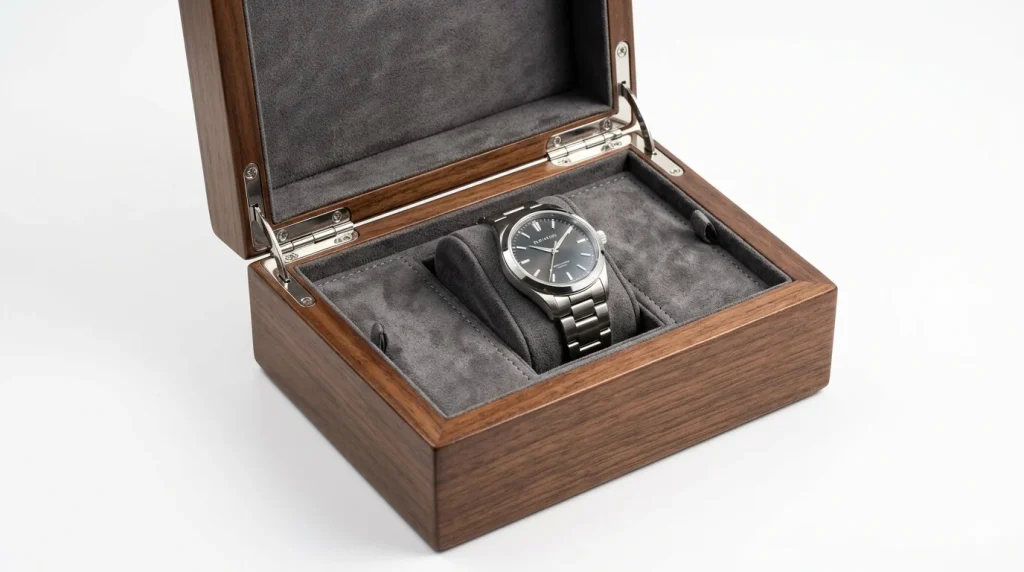
Watch Box Price Tiers: A Factory Engineer’s OEM Pricing Guide
Every week, buyers send us inquiry emails that start the same way: “Can you give me a price for watch boxes?” And every week, we send back the same question: “What material, what quantity, and how much customization?” Because without those three numbers, quoting a watch box is like asking how much a car costs — the answer spans from $200 to $200,000 depending on what you actually want.
For a broader perspective, see our watch box guide.
This guide breaks down watch box pricing the way we explain it internally — by material grade, MOQ bracket, and customization depth. No vague ranges. Real cost drivers.
—
What Actually Drives Watch Box Cost
Before we get to numbers, understand the cost structure. A watch box price has four buckets:
Materials (typically 40–55% of unit cost), labor (20–30%), packaging/insert (10–15%), and overhead + margin (15–20%).
The ratio shifts with volume. At 500 units, labor overhead per unit is high. At 10,000 units, material cost dominates. This is why the same box at 500 pcs vs. 5,000 pcs can have a 35–40% price difference — not because we’re charging a “small order premium” (though there is one), but because fixed setup costs amortize across more units.
Engineering Note: The formula we use for rough unit cost estimation is:
> Unit Cost ≈ (Material Cost per Unit) + (Setup Cost ÷ MOQ) + (Labor Rate × Cycle Time) + Overhead
For a standard leatherette single-watch box: material ≈ $1.80–$2.40, setup amortized at 1,000 pcs ≈ $0.30–$0.60, labor ≈ $0.80–$1.20, overhead ≈ $0.60–$0.90. Total: $3.50–$5.10 ex-works before customization.
One thing that surprises most buyers — customization doesn’t scale down the way materials do. A debossed logo costs roughly the same die setup whether you order 500 or 5,000 units. The per-unit impact just shrinks as volume grows.
—
Price Tier 1: Entry-Level Watch Boxes ($2.50–$6.00/unit)
This tier covers the bread-and-butter of retail watch packaging — high volume, standardized construction, minimal customization.
Typical specs:
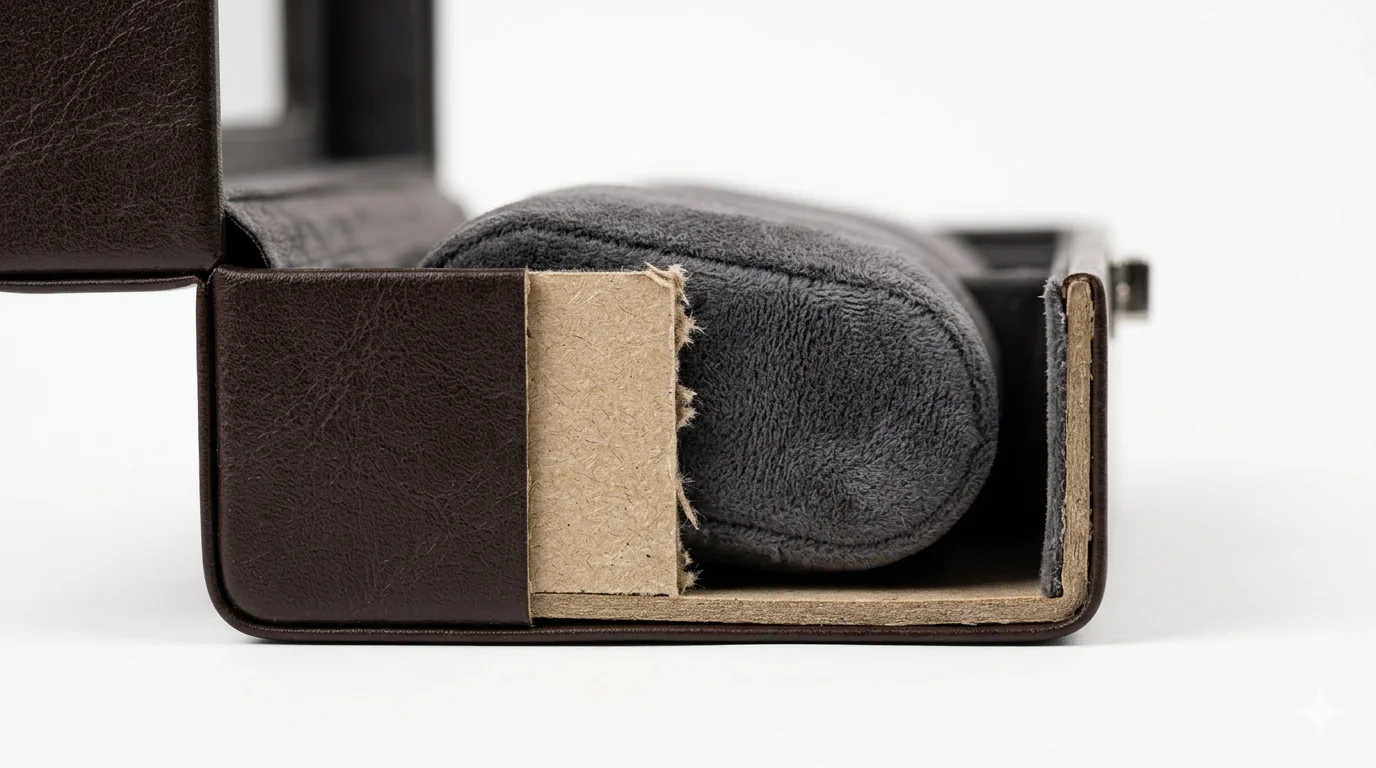
– Outer shell: PU leatherette or paper-wrapped MDF
– Inner lining: compressed foam wrapped in microfiber or non-woven fabric
– Closure: magnetic snap or simple latch
– Pillow: cylindrical EVA foam, fixed height
– MOQ: 500–1,000 units
At 1,000 units with a single-color foil-stamp logo, you’re typically looking at $3.20–$4.80/unit ex-works. Add a printed outer sleeve and it moves to $4.00–$5.50/unit.
Common Mistake: Buyers assume “leatherette” is a single material. It’s not. There’s 0.6mm PVC leatherette (cheap, cracks in 6–12 months), 0.8mm PU leatherette (standard), and 1.0mm+ bonded leather (premium feel, much more durable). Specify the thickness and backing — or you’ll receive whatever clears the line fastest.
Configuration500 pcs1,000 pcs3,000 pcs
Plain PU, no logo$4.80–$5.40$3.80–$4.40$2.90–$3.50
PU + foil stamp logo$5.60–$6.20$4.50–$5.10$3.40–$4.00
PU + printed sleeve$6.20–$7.00$5.00–$5.80$3.80–$4.50
Paper wrap MDF + sleeve$4.20–$5.00$3.40–$4.10$2.60–$3.20
*All prices ex-works, standard single-watch box approximately 90×90×70mm, no LED*
This tier works well for fashion watch brands, retail chain programs, and promotional gifting. It doesn’t apply when your customer expects a luxury unboxing experience — a $3.50 box under a $500 watch sends the wrong signal regardless of how nice the watch is.
—
Price Tier 2: Mid-Range Watch Boxes ($6.00–$14.00/unit)
This is where most serious watch brands operate. Better materials, more construction options, and meaningful customization become economically viable.
What changes at this tier:
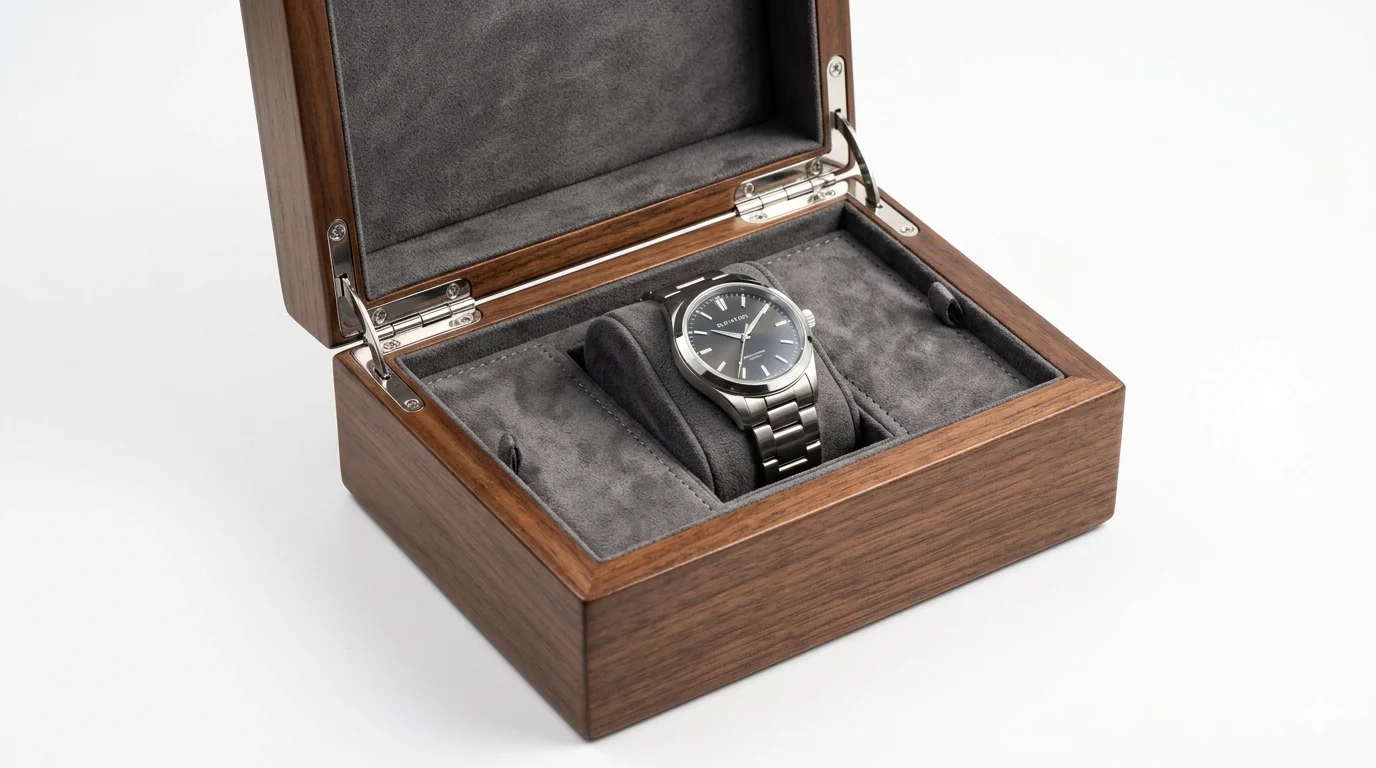
– Outer shell upgrades to genuine bonded leather, Saffiano-pattern PU, or high-grain synthetic leather
– Inner lining shifts to cut velvet or suede microfiber (not glued-edge, properly stitched)
– Closures include piano-hinge mechanisms, magnetic clasp with magnetic insert, or two-point latch
– Pillow height becomes adjustable (interchangeable pillows for different strap widths)
– Full-color printing on insert cards is standard
MOQ at this tier typically runs 300–500 units for stocked components, 500–1,000 units for fully custom builds.
Pro Tip: The hinge mechanism is the single most failure-prone component in mid-range boxes. We’ve seen buyers specify a beautiful Saffiano leather outer and then accept a $0.12 piano hinge. After 200 open/close cycles, it starts to creak and eventually cracks the leather at the fold line. Specify a hinge with a minimum 2,000-cycle test rating — ask for the test report, not just a claim.
At 1,000 units with bonded leather, velvet lining, magnetic closure, and embossed logo:
As detailed in the watch box price comparison.
> Estimated unit cost: $8.50–$11.50 ex-works
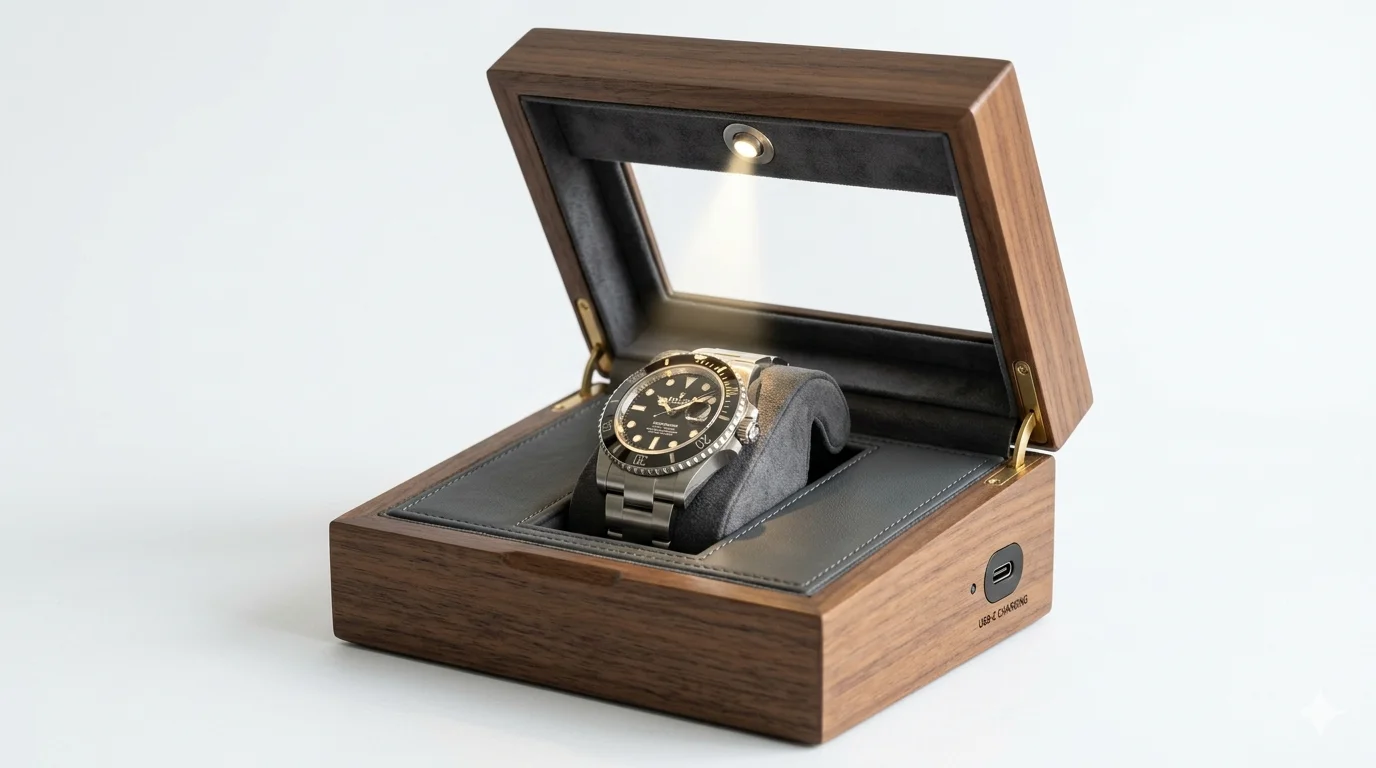
Add an LED spotlight pillow and that rises by $1.80–$3.20/unit depending on battery type.
Feature UpgradeAdded Cost/Unit (at 1,000 pcs)
Bonded leather vs. standard PU+$0.60–$1.20
Cut velvet vs. microfiber lining+$0.40–$0.80
Piano hinge (rated 2,000 cycles)+$0.30–$0.55
Adjustable pillow system+$0.50–$0.90
LED spotlight (coin cell)+$1.80–$2.40
LED spotlight (rechargeable)+$2.80–$3.80
Embossed logo (setup + per-unit)+$0.35–$0.65
—
Price Tier 3: Premium & Luxury Watch Boxes ($14.00–$45.00+/unit)
Short answer: this tier is about materials you can feel blindfolded and mechanisms that feel mechanical — not just functional.
Genuine full-grain leather at this level isn’t a marketing term. It has a grain pattern that’s non-uniform (because it’s real), a vegetable-tanned smell, and edge-burnishing visible under magnification. The construction changes too — MDF substrate gets replaced with poplar ply or aluminum extrusion frames in the highest tier. Hinges are solid brass or stainless steel with soft-close dampers.
What we see in our workshop at this tier:
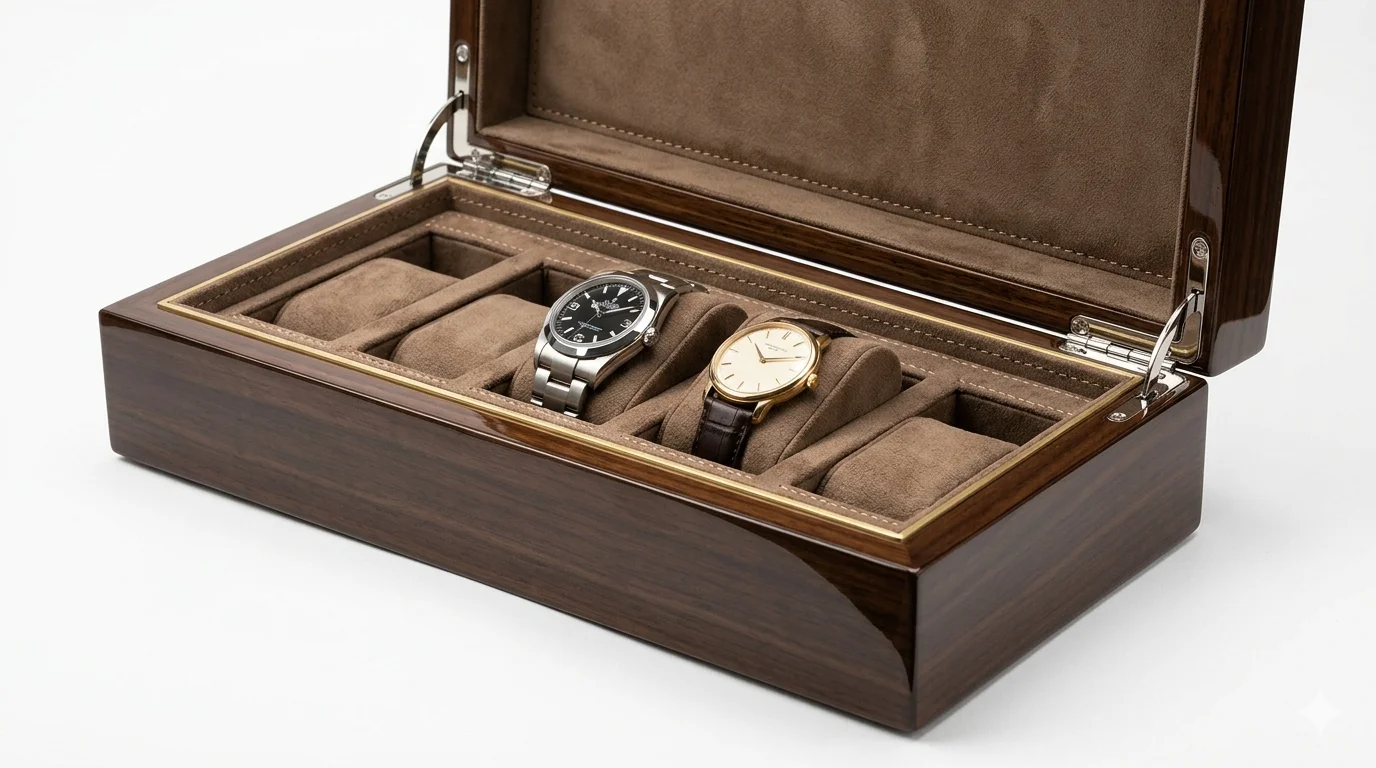
– Shell: Full-grain leather (1.2–1.8mm), carbon fiber veneer, lacquered wood (piano finish)
– Lining: Silk, Japanese suede, hand-stitched Alcantara
– Closure: Soft-close magnetic, push-button latch with chrome hardware, key-lock mechanism
– Inserts: CNC-machined foam with fabric wrap, or injection-molded ABS with velvet flocking
– Electronics: App-controlled LED, USB-C rechargeable, automatic open/close motor (top 1% of orders)
– MOQ: 100–300 units (because setup cost is high and amortized differently)
Engineering Note: At this tier, RoHS Directive 2011/65/EU compliance for any electrical components isn’t optional — it’s required for EU market entry. We test LED driver boards and battery management circuits against RoHS substance limits before production sign-off. If your supplier isn’t asking about RoHS at this price point, that’s a red flag.
This tier also sees the most variation in pricing — a $14 box and a $45 box can both be “premium.” The difference is construction depth, not surface appearance. A lacquer-finish wood box looks expensive from 3 feet away; an aluminum-frame box with hand-stitched interior feels expensive at 3 inches away.
This doesn’t apply to most retail or mid-market programs — the ROI only makes sense when your watch retails above $800–$1,200, or when the box itself has secondary use value (storage, display) that justifies the cost to the end customer.
—
MOQ Structure and Volume Pricing
The relationship between MOQ and price isn’t linear — it drops in steps, not a smooth curve. Here’s why: our production line schedules in batches. A batch of 500 and a batch of 800 have nearly identical setup costs. At 1,000, we cross a threshold where we can run a dedicated shift without line changeovers. At 5,000, we can pre-cut materials in bulk and reduce material waste by 8–12%.
Volume BracketTypical Price IndexSetup Cost AmortizationLead Time
100–299 units100% (baseline)High (spread over few units)25–35 days
300–499 units85–90%Medium-high20–30 days
500–999 units75–82%Medium18–25 days
1,000–2,999 units65–72%Low-medium15–22 days
3,000–4,999 units58–65%Low14–20 days
5,000+ units50–58%Very low12–18 days
*Index is relative to the 100-unit price for equivalent specs. Actual prices vary by material tier.*
Common Mistake: Buyers try to hit the next price break by splitting one SKU order into two colorways to reach the MOQ together. This actually *increases* per-unit cost because each colorway requires separate setup, separate material cutting, and separate QC runs. Two colors at 500 each costs more than one color at 1,000 — often by 8–15%.
—
Customization Cost Breakdown
Customization is where most buyers underestimate the quote. A “custom box” means different things: it could mean adding your logo (cheap), changing the interior color (moderate), or redesigning the box shape entirely (expensive).
Here’s how we categorize it:
Level 1 — Brand application: Logo foil stamp, emboss, or print on an existing box design.
– Setup: $80–$180 (die or plate)
– Per-unit add: $0.15–$0.40
Level 2 — Color and material selection: Choosing from our standard material palette (12–18 leatherette colors, 8–10 velvet colors) for an existing construction.
– Setup: $0–$60 (material sampling fee)
– Per-unit add: $0.00–$0.30 (some materials carry a small premium)
Level 3 — Dimension modification: Changing box size to fit an oversized watch or specific display requirement.
– Setup: $200–$600 (new die cutting templates, new pillow molds)
– Per-unit add: $0.20–$0.80 (new material ratios)
This ties directly into our affordable watch box options.
Level 4 — Full custom design: New structural design, custom hardware, proprietary closure mechanism.
– Setup: $800–$3,500 (design, sampling, tooling)
– Per-unit add: $0.50–$3.00+
– This doesn’t apply unless you have a volume commitment of 2,000+ units to justify tooling investment.
Pro Tip: If you’re testing a new program at 300–500 units, use Level 1–2 customization on an existing construction. You get branded packaging without tooling risk. Once you’ve validated the program and know you’ll reorder, invest in Level 3–4 for the next run.
—
LED Watch Box Pricing: Separate Category
LED watch boxes deserve their own section because they trigger entirely different compliance requirements and cost structures.
A basic LED watch box (coin cell, single white LED, manual switch) adds $1.80–$2.50/unit at 1,000 pcs. That sounds simple. It’s not.
The moment you add a battery, you’re looking at:
– UN 38.3 transport testing if using lithium cells (required for air freight — and almost all express shipping is air)
– FCC Part 15 if shipping to the US (even passive LED circuits can need a declaration)
– CE Low Voltage Directive 2014/35/EU for EU market
We’ve seen buyers get their shipments held at customs because their LED watch boxes didn’t have proper battery documentation. At 1,000 units, compliance testing costs $400–$1,200 — amortized, it adds $0.40–$1.20/unit. Factor this in before comparing LED vs. non-LED pricing.
Rechargeable LED (USB-C or wireless charging) adds $3.50–$5.50/unit at 1,000 pcs plus the compliance costs above. The experience is noticeably better — no replacing batteries, brighter output, optional app control on premium models. ROI depends on your price point.
—
Quality Tiers and Standards
Price without quality context is meaningless. Here’s how we define quality checkpoints in our production flow:
We run incoming material QC, in-process checks at lamination and assembly, and final inspection before packing. For export orders, we follow ISO 2859-1 sampling standard (AQL 2.5 for major defects, AQL 4.0 for minor defects).
For US-bound retail programs, buyers increasingly require ISTA 3A transit testing on master carton configurations. This catches damage patterns that only appear after 48+ hours of simulated vibration and drop — not something you can assess from a sample.
Quality GateWhat We CheckRejection Trigger
Incoming leatherThickness tolerance ±0.1mm, color ΔE < 1.5ΔE > 2.0 or thickness out of spec
LaminationBubble-free bond, corner wrap tensionVisible bubbles > 2mm diameter
Hinge assemblyTorque test, cycle count sampleTorque outside 0.3–0.8 N·m range
Final appearanceScratch, stain, stitching gapAny defect visible at 30cm under 600 lux
LED functionIllumination, battery contact, switchNon-illumination or intermittent contact
Engineering Note: The AQL 2.5 standard means we accept a lot if the sample passes, but that sample size scales with order quantity. At 1,000 units, we inspect 80 pieces. At 10,000 units, we inspect 200. If you’re buying 300 units, we’re inspecting 32 — statistically less confidence. For small orders in sensitive programs (retail launch, luxury gifting), consider requesting 100% inspection at an added cost of roughly $0.15–$0.30/unit.
—
FAQ: Watch Box Pricing
Q: What’s the minimum order for a fully custom watch box?
Practical minimum is 500 units for Level 1–2 customization, 1,000–2,000 units for Level 3–4 with tooling. Below 500, setup costs make the per-unit price uncompetitive versus stocked options.
Q: Can I mix watch box sizes in one order to hit MOQ?
You can, but each SKU needs its own setup. Mixing two sizes to hit a 1,000-unit MOQ price break usually doesn’t work — you’d price at two separate 500-unit runs. The exception is same-construction, same-material boxes where only the pillow height changes.
Q: How much does adding my logo actually cost?
Foil stamp: $100–$150 die setup, $0.20–$0.35/unit. Emboss (deboss): $120–$200 die setup, $0.25–$0.45/unit. Screen print: $60–$100 setup, $0.15–$0.30/unit. UV print (for complex logos): $0–$80 setup, $0.30–$0.65/unit.
Q: Why do quotes vary so much between factories?
Three reasons: material specification differences (same “PU leather” can be 0.6mm or 1.0mm), labor cost differences by region, and margin strategy. When comparing quotes, ask every supplier for the exact material spec sheet — not just “PU leather” but thickness, backing type, and peel strength rating.
Q: What’s included in “ex-works” pricing?
Ex-works means the goods are packed and ready at our factory gate. It excludes inland freight to port, export documentation, ocean/air freight, destination customs, and last-mile delivery. For a rough landed cost, add 15–25% to ex-works for standard sea freight to major ports (US West Coast, Rotterdam, Sydney).
Q: Can I get a sample before committing to an order?
Yes. Stock samples are free or $15–$30 with courier cost. Custom samples (your logo, your color) are $80–$250 for first sample including setup, with a 10–15 day turnaround. Sample cost is credited against your first order above 500 units.
Q: How does packaging affect the price?
The box your watch box ships in matters. Single-box polybag add: $0.05–$0.10/unit. Individual white carton: $0.20–$0.40/unit. Printed retail-ready carton: $0.35–$0.65/unit plus $150–$300 printing setup. Master carton labeling for retail programs (UPC, barcode, compliance marks): $0.10–$0.20/unit labor.
—
References & Sources
1. RoHS Directive 2011/65/EU — Restriction of Hazardous Substances — European Parliament & Council
2. CE Low Voltage Directive 2014/35/EU — European Parliament & Council
3. UN Manual of Tests and Criteria, Part III — UN 38.3 Lithium Battery Transport Testing — United Nations Economic Commission for Europe
4. FCC Part 15 — Radio Frequency Devices — US Federal Communications Commission
5. ISO 2859-1 — Sampling Procedures for Inspection by Attributes — International Organization for Standardization
6. ISTA 3A — Packaged-Product for Parcel Delivery System Shipment — International Safe Transit Association
 English
Written by: Sarah Jenkins
Senior Content Specialist
Seasoned Industry Editor with 5 years of experience, dedicated to delivering in-depth technical and market reports.
Reviewed by: Dr. Eric Shao
Chief Technical Director
With 12 years of experience in material science and custom manufacturing, ensures the scientific accuracy and technical compliance of all published content.