
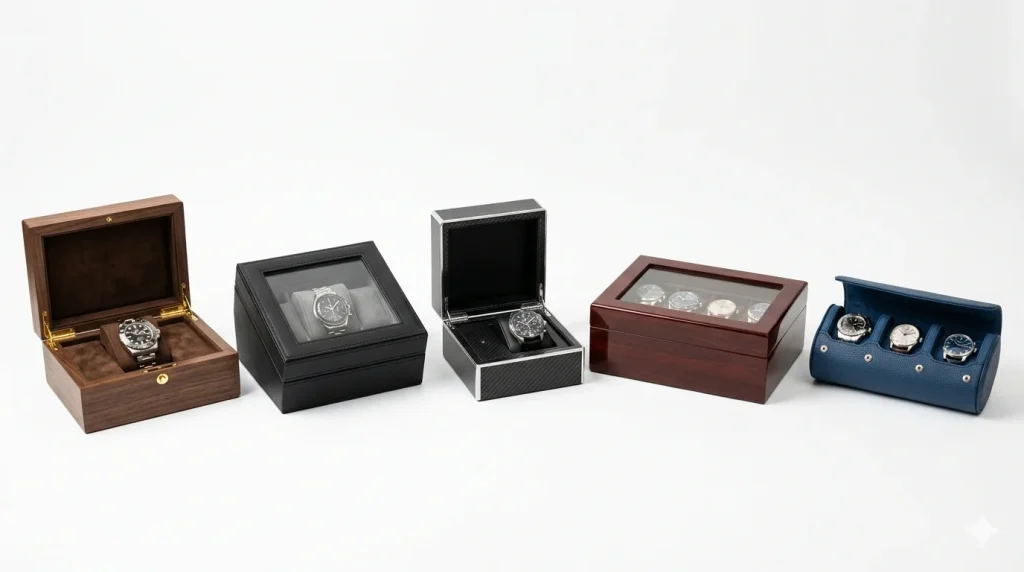
Watch Box Styles Guide: Complete OEM Breakdown for Buyers and Brand Managers
Every season, we quote hundreds of watch box projects — and the same confusion comes up again and again. Buyers arrive with a rough idea (“I want something nice for a single watch”) but no framework for understanding how form, function, material, and MOQ interact. This guide is our attempt to fix that.
For a broader perspective, see our watch box buying guide.
We’ll walk through every major style category, explain the engineering tradeoffs, and give you the kind of honest guidance we’d give a long-term client.
—
Single Watch Cases: The Foundation of Any Watch Packaging Program
Single watch cases are the highest-volume SKU in our workshop. They ship with nearly every retail watch sale, which means the cost-per-unit pressure is real — but so is the brand impression.
The standard construction is a rigid cardboard shell wrapped in PU leather or real leather, with a pillow insert (polyurethane foam wrapped in velvet or microfiber) and a lid that opens on a hinge or lifts off entirely. Magnetic closures have largely replaced the old snap-tab design because they’re quieter, they hold better, and — frankly — they feel more premium at the same price point.
What we’ve found in practice: the pillow diameter is the spec most buyers forget. Watch cushion diameter typically runs 50–70 mm. A 55 mm cushion fits most dress watches perfectly; go below 50 mm and a larger sports watch will wobble. Go above 65 mm and a slim dress watch looks lost. Always confirm strap width and case diameter before locking the insert spec.
> Engineering Note: Pillow compression set is a real QC issue. We test cushion firmness using a 500 g weight for 24 hours — if the indentation exceeds 3 mm, the foam density is too low. Target foam density: 30–40 kg/m³ for a balanced feel.
Common Mistake: Ordering a hinged single box without specifying the hinge stop angle. A 90° stop feels cheap and doesn’t photograph well. We recommend 100°–110° for retail boxes — it holds the lid open for display without stressing the hinge barrel.
—
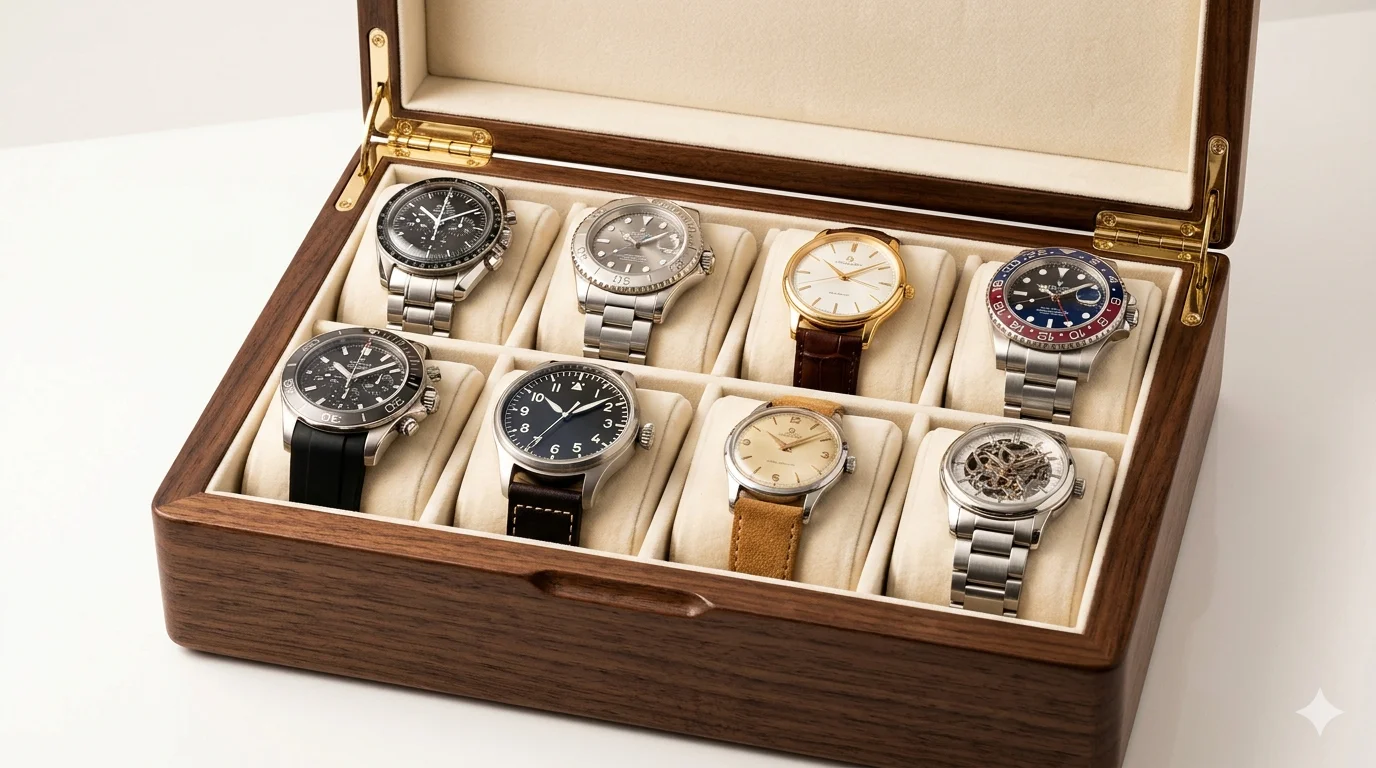
Multi-Watch Boxes: 2, 4, 6, 8, 10, and 12-Slot Configurations
Multi-watch boxes are where OEM customization gets interesting — and where specification errors get expensive.
[FS-Bait] A multi-watch box holds 2 to 24 timepieces in individual cushioned slots within a single hinged or drawer-style case. Common configurations are 4-slot, 6-slot, 8-slot, and 12-slot. Internal layout is typically a fixed foam grid or removable pillow modules. Used by collectors, gift retailers, and corporate gifting programs.
The internal layout decision drives everything downstream. Fixed foam grids are cheaper and more structurally stable, but they lock you into one watch size. Removable pillow modules cost 15–25% more but let the end user reconfigure for different case sizes — a feature that matters a lot to serious collectors.
Slot pitch calculation: Slot center-to-center spacing = watch case diameter + minimum wall thickness (12 mm recommended) + any lid clearance overhang. For a 45 mm watch with 12 mm walls, that’s 57 mm per slot. A 6-slot box in a single row needs at least 342 mm of interior width — before adding perimeter walls.
Configuration Typical Interior Dimensions (L×W×H mm) Best For MOQ Typical 2-slot 220 × 110 × 90 Gift sets, couples 200 pcs 4-slot 280 × 130 × 90 Retail bundles 300 pcs 6-slot 340 × 130 × 90 Starter collectors 300 pcs 8-slot (2×4) 340 × 230 × 90 Mid-level collectors 500 pcs 12-slot (3×4) 380 × 280 × 100 Serious collectors 500 pcs 20-slot (4×5) 460 × 360 × 120 Display / showroom 200 pcs
> Pro Tip: For boxes above 8 slots, we strongly recommend a gas-piston lid stay. A heavy hinged lid on a 12-slot box weighs 400–600 g — without a stay, it slams, stresses the hinge, and creates a liability for the end user’s watches. The stay adds roughly $0.80–$1.20 per unit. Worth every cent.
This doesn’t apply when the multi-watch box uses a sliding drawer format — drawer systems don’t have a lid-drop problem, but they introduce their own drawer rail tolerances (±0.5 mm is our target clearance).
—
Watch Rolls: Portable, Compact, No Rigid Structure
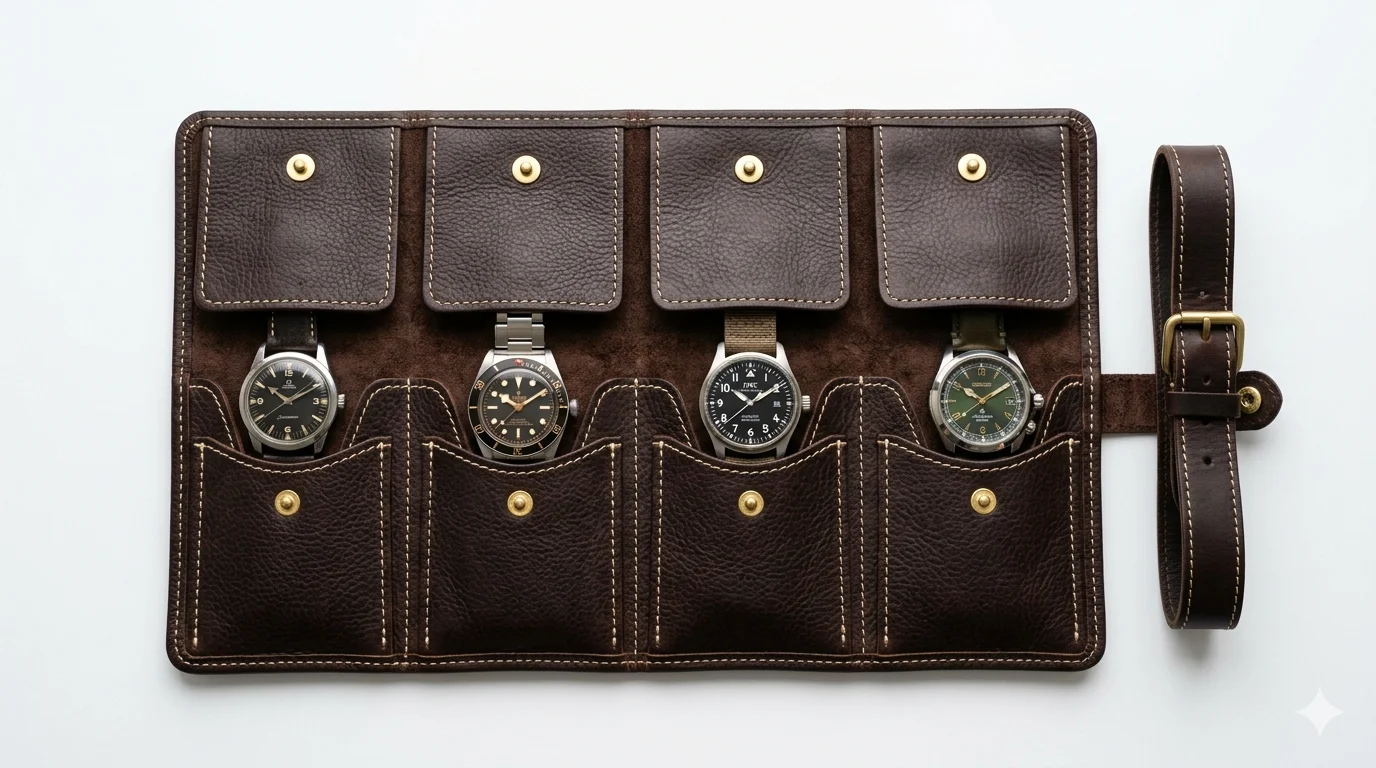
Watch rolls are a completely different engineering category. There’s no rigid shell — the structure comes from the rolled cylinder itself, held by a leather or canvas strap.
As detailed in the types of watch boxes.
Typical construction: a piece of PU or genuine leather, 280–350 mm wide, with individual watch pockets stitched into a row. Each pocket has a snap or hook-and-loop closure. The whole thing rolls into a cylinder 80–100 mm in diameter and ties or buckles closed.
What surprises most buyers: watch rolls have almost no crush resistance. They’re designed for carry in a soft bag alongside clothes, not for checked luggage or anything that might get compressed. If your customer’s use case is frequent travel with checked bags, steer them toward a hard-shell travel case instead.
Common Mistake: Specifying pocket width based only on watch case diameter, ignoring the crown. Most watch crowns add 3–5 mm to the effective width on one side. We add 8 mm of crown clearance to every pocket spec as standard. Skipping this step means customers can’t close the pocket snap without forcing it — and that stresses the crown gasket.
The ISTA 3A vibration test is worth referencing here: watch rolls perform poorly on repetitive vibration sequences because the watches move laterally within their pockets. For clients shipping watch rolls as retail product (rolls containing watches), we recommend adding a foam insert inside each pocket.
Feature Watch Roll Single Watch Case Travel Hard Case Crush resistance None Moderate High Watches per unit 3–8 1 2–6 Packed weight 150–400 g 200–500 g 600–1500 g Best use case Soft travel Retail gift Air/checked travel Typical material PU / leather PU / cardboard ABS / aluminum Customization ease High High Moderate
—
Travel Cases: Hard-Shell Protection for Real-World Conditions
When a client says “my customers travel constantly,” our answer is always a hard-shell travel case. This is the one category where structural rigidity isn’t aesthetic — it’s functional.
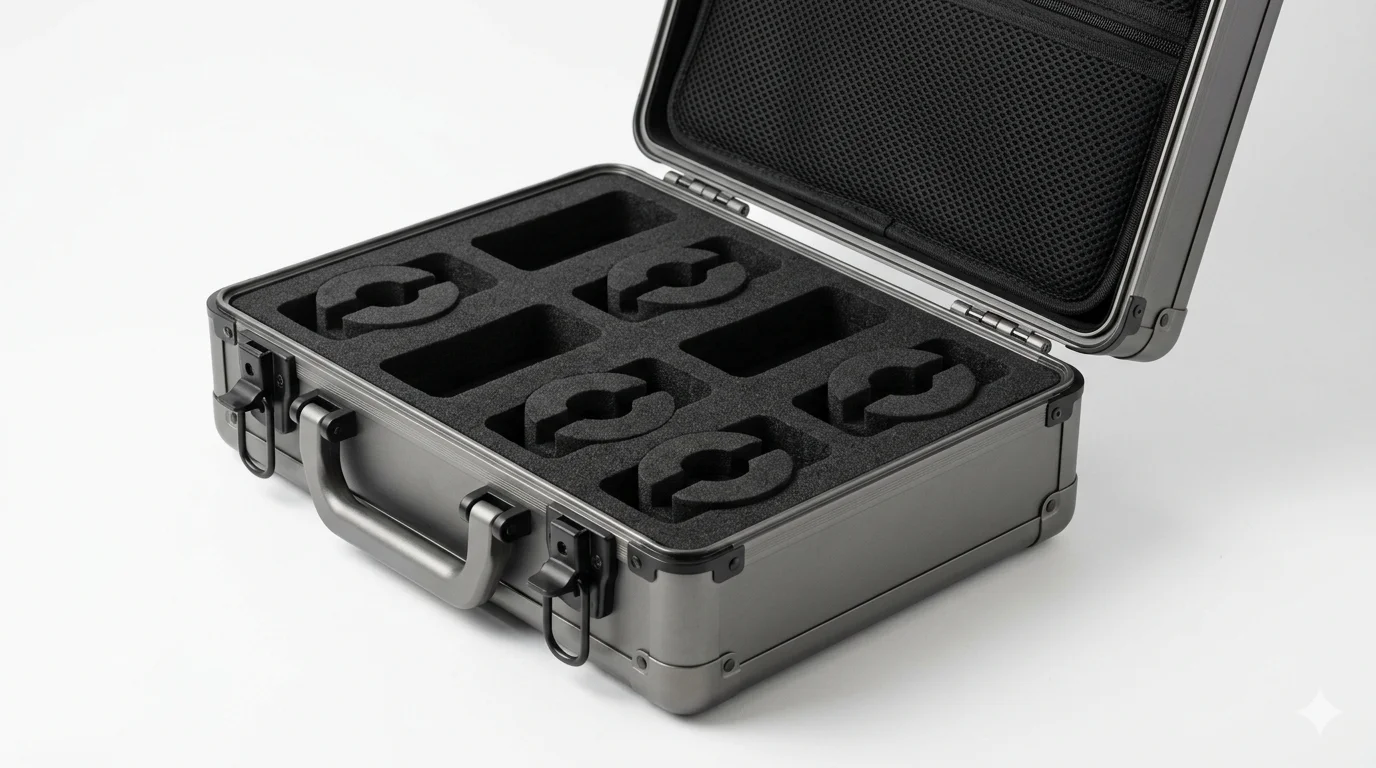
Hard-shell travel cases use an ABS or polycarbonate outer shell, often with an aluminum frame on premium models. Interior is EVA foam cut to watch profile, or a combination of foam base and pillow inserts. Most hold 2–6 watches.
The real engineering challenge in travel cases is the interface between hard shell and soft interior. If the interior foam is too rigid, watch crystal contact becomes a scratch risk. If it’s too soft, the watch moves during vibration. Our target: 25–35 Shore A foam for the contact layer, with a 45–55 Shore A structural backer.
> Engineering Note: UN38.3 isn’t just for battery-operated products — it’s the reference framework we use internally for altitude simulation testing. If your travel case includes a watch winder, the battery in that winder must pass UN38.3 before it can be air-shipped. This affects the entire product certification timeline, often by 4–6 weeks.
Honest limitation: aluminum-frame travel cases are genuinely premium but they struggle with airport screening — the metal frame reliably triggers secondary screening in our experience. For clients whose customers value “breeze through security,” polycarbonate shells with no metal frame are the better recommendation, even though they’re marginally less rigid.
[FS-Bait] A hard-shell watch travel case protects 2–6 watches during transit using an ABS or polycarbonate outer shell and foam-cut interior. It offers crush resistance that soft cases cannot match. Key specs: foam hardness 25–35 Shore A contact layer, TSA-lock options available, and typical packed weight 600–1,500 g for a 4-watch configuration.
—
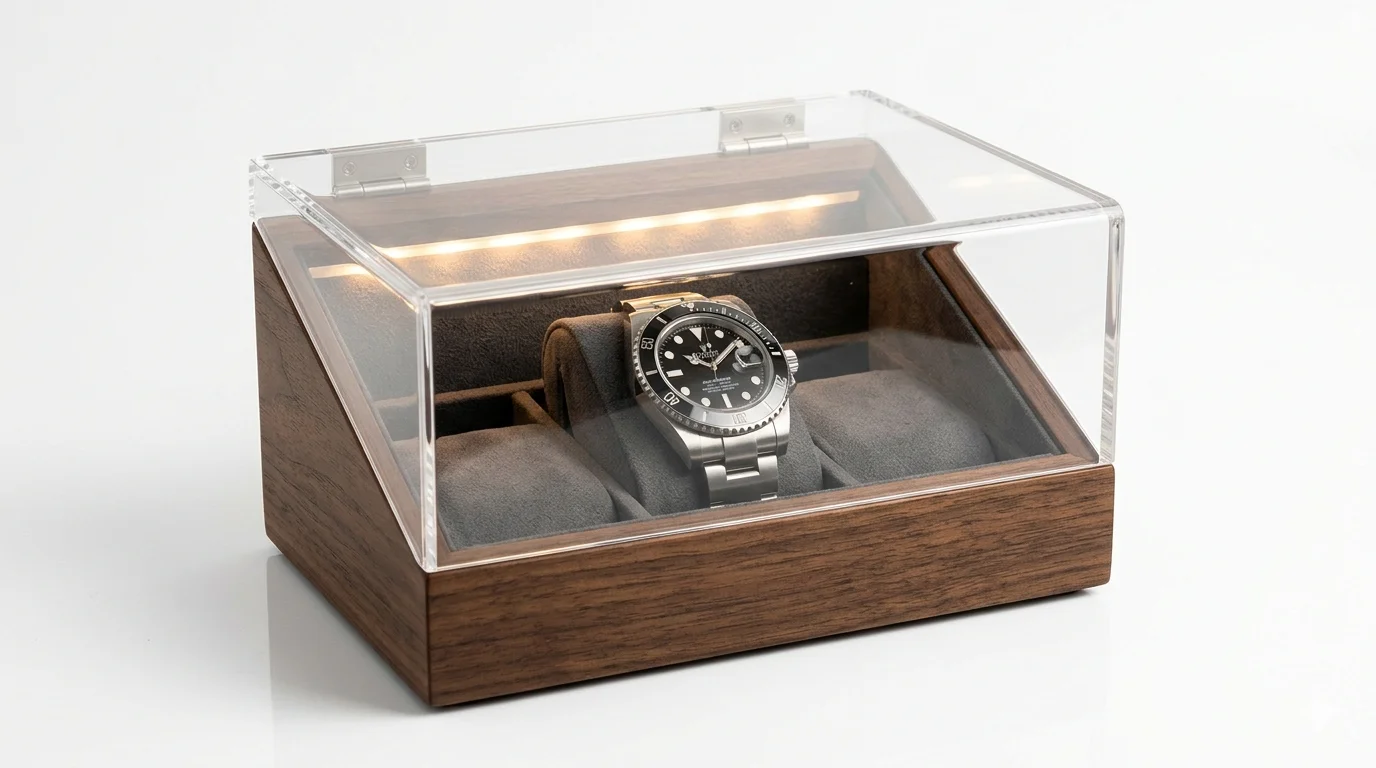
Display Cases: Visibility as a Feature
Display cases flip the logic of every other category. Here, the point isn’t protecting the watch from view — it’s making the watch visible while protecting it from dust and handling.
The defining feature is a transparent lid, typically 3–5 mm clear acrylic or glass. Acrylic is lighter and less likely to shatter; glass is heavier but resists scratching better and looks more premium. For retail display environments, we almost always spec acrylic — the liability risk of a glass lid breaking on a sales floor is real.
Interior options range from simple velvet-covered platforms to motorized rotating pillars (popular in luxury boutique environments). Rotation motors add significant complexity: they require CE marking under the Low Voltage Directive 2014/35/EU and, if battery-operated, RoHS 2 compliance (Directive 2011/65/EU) for components. Both add 6–10 weeks to the certification path.
One thing that surprises most buyers is how much internal lighting affects photography. Warm white (2700–3000K) reads beautifully on camera and flatters most watch dials. Cool white (5000K+) is accurate but clinical — it’s the right choice for technical trade show environments, wrong for lifestyle imagery. We spec the LED strip color temperature in the order paperwork now, after years of clients asking for reshoots.
> Pro Tip: Specify LED CRI (Color Rendering Index) ≥ 90 for any display case intended for photography or video. Lower CRI LEDs make gold watches look greenish and silver cases look flat. The difference in LED strip cost is negligible — typically $0.30–$0.80 per unit.
This ties directly into our watch box style comparison.
Common Mistake: Forgetting UV filtering in the acrylic lid for watches with leather straps or colored dials. UV exposure degrades leather and can fade some dial treatments over 6–12 months under continuous display lighting. UV-filtering acrylic adds about 15–20% to the lid material cost but protects the client’s product.
—
Collector Cabinets: The Top of the Range
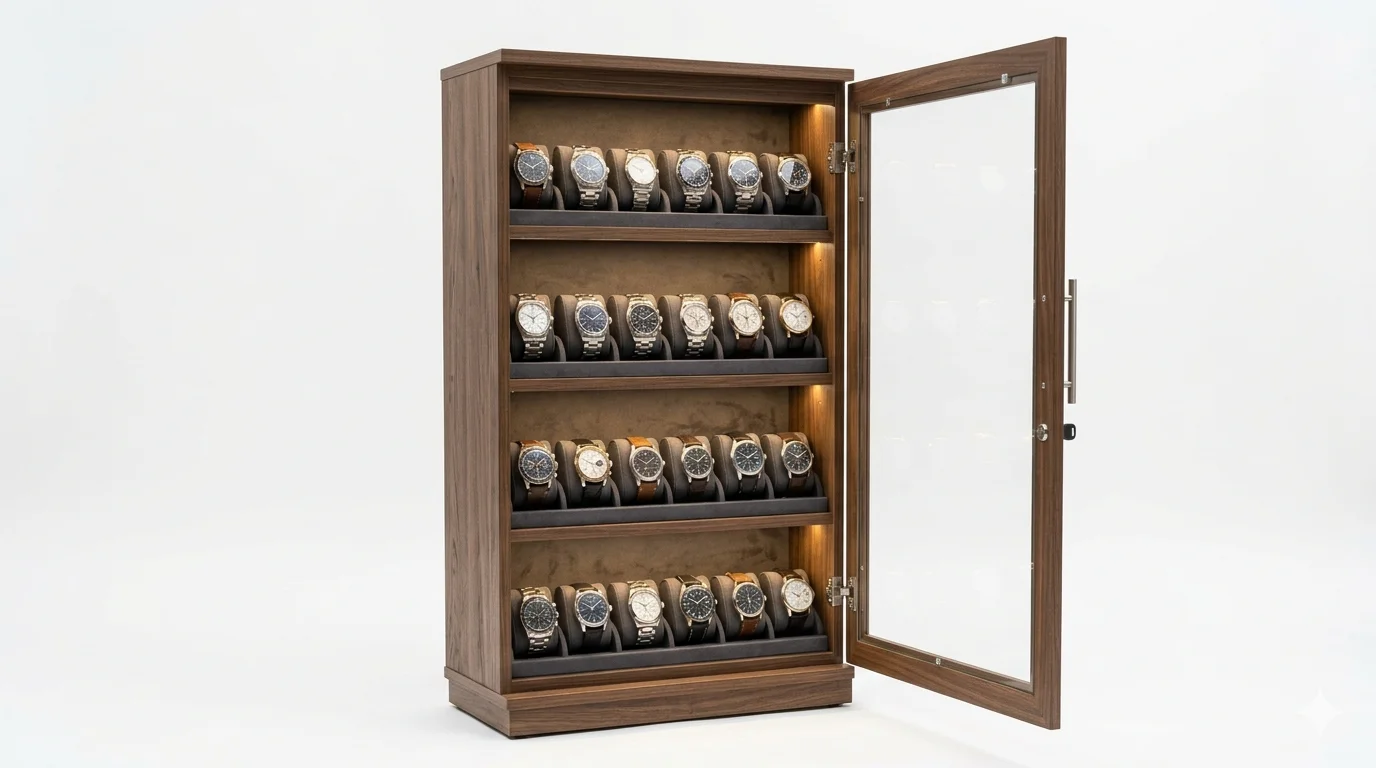
Collector cabinets are the largest and most complex product category we manufacture. We’re talking about freestanding or wall-mounted units holding 20–100+ watches, with drawer systems, glass doors, locking mechanisms, and integrated lighting.
This is furniture-adjacent manufacturing, and the tolerances are furniture tolerances. Wood composites (MDF wrapped in real or PU leather) are the most common substrate. Solid wood is available but adds significant weight and cost; it’s usually requested for ultra-high-end private label clients.
Drawer system spec that matters most: drawer slide quality. Budget drawer slides have 5,000–8,000 cycle ratings. A serious collector opening their cabinet twice daily will hit 14,000 cycles in under 20 years. We spec soft-close undermount slides rated to 30,000+ cycles as our standard for any cabinet intended for daily use.
[FS-Bait] A watch collector cabinet holds 20 to 100+ timepieces in a freestanding or wall-mounted unit with individual cushioned pillars, drawer or door access, integrated LED lighting, and a lock mechanism. Construction is typically MDF wrapped in PU leather or genuine leather. Drawer slides should be rated to 30,000+ cycles for daily-use longevity.
Honest limitation: collector cabinets are generally not suitable for OEM small-batch orders. Tooling and fixturing costs mean that our practical MOQ for custom collector cabinets starts at 50 units — and lead time is 60–90 days, not the 25–35 days typical for single or multi-watch boxes. For clients needing fewer than 50 units, we recommend a semi-custom approach: standard cabinet structure with custom exterior wrap and branded hardware.
—
FAQ: Watch Box Styles
Q: What’s the minimum order quantity for a custom watch box style?
Single and multi-watch boxes: typically 300–500 pcs for full custom, 100 pcs for semi-custom (existing mold, custom exterior). Watch rolls: 200 pcs. Collector cabinets: 50 pcs.
Q: Can we mix styles in one order?
Short answer: yes, but MOQ applies per style. Combining a 4-slot box order with a single-watch box order doesn’t let either run below its individual MOQ.
Q: Which style ships best for e-commerce?
Watch rolls and single watch cases. Both fit in standard mailer boxes, survive ISTA 3A drop testing, and have low dimensional weight. Multi-watch boxes above 6 slots start to push dimensional weight penalties on express carriers.
Q: Do display cases require electrical certifications?
Battery-powered or mains-powered display cases need CE (EU) and/or FCC Part 15 (USA) compliance. Passive display cases (no electronics) don’t — but if you later add lighting for a catalog update, that triggers the certification requirement retroactively.
Q: How do I choose between acrylic and glass lids for display cases?
Retail floor display: acrylic. Museum or private collection: glass. Photography studio: acrylic with UV filter. Trade show: glass for premium perception, acrylic if portability matters.
Q: Are watch winders a separate product category?
Mechanically, yes — winders contain motors, sometimes batteries, and often require CE/RoHS/UN38.3 certification. We treat them as a related but distinct product line. If you need a watch box with integrated winder, that’s a hybrid product with its own certification path.
—
Style Selection Decision Matrix
Requirement Best Style Second Choice Single retail sale, high unboxing impact Single watch case Travel hard case Gift for collector (2–6 watches) 4–6 slot multi-watch box Watch roll set Business traveler, daily carry Hard-shell travel case Watch roll Boutique retail display Display case with LED Single case with window lid Serious collector (20+ watches) Collector cabinet 20-slot multi-watch box Corporate gifting, 500+ units Single or multi-watch case Watch roll E-commerce DTC, low freight cost Watch roll Single watch case Trade show showcase Display case Multi-watch box with window
—
References & Sources
1. ISTA 3A Packaged-Products for Parcel Delivery System Shipment — International Safe Transit Association
2. UN38.3: Recommendations on the Transport of Dangerous Goods, Tests and Criteria, Section 38.3 — United Nations Economic Commission for Europe
3. Low Voltage Directive 2014/35/EU — European Parliament and Council
4. RoHS 2 Directive 2011/65/EU on Restriction of Hazardous Substances — European Parliament and Council
5. FCC Part 15 — Radio Frequency Devices — U.S. Federal Communications Commission
6. ISO 2859-1: Sampling Procedures for Inspection by Attributes — International Organization for Standardization
 English
Written by: Sarah Jenkins
Senior Content Specialist
Seasoned Industry Editor with 5 years of experience, dedicated to delivering in-depth technical and market reports.
Reviewed by: Dr. Eric Shao
Chief Technical Director
With 12 years of experience in material science and custom manufacturing, ensures the scientific accuracy and technical compliance of all published content.