
I’ll write this in chunks to stay within the output limit. Starting with chunk 1:
—
Table of Contents
For a broader perspective, see our complete watch box guide.
Watch Box Materials: An OEM Engineer’s Complete Guide to Wood, Leather, Hardware & Interior Options
Every season, buyers send us spec sheets that say “luxury watch box — good quality.” That’s not a spec. That’s a wish. The material choices you make determine not just how a box looks on the shelf, but how it survives a 1.2-meter drop test, whether it passes RoHS Directive 2011/65/EU compliance checks, and whether the velvet liner still looks presentable after 18 months in a display case.
This guide walks through every major material category we work with in our workshop — wood species, leather grades, velvet specs, hardware finishes, glass vs. acrylic lids, and interior lining options — with real OEM cost implications attached to each decision.
—
Wood Species: What Actually Matters Beyond Aesthetics
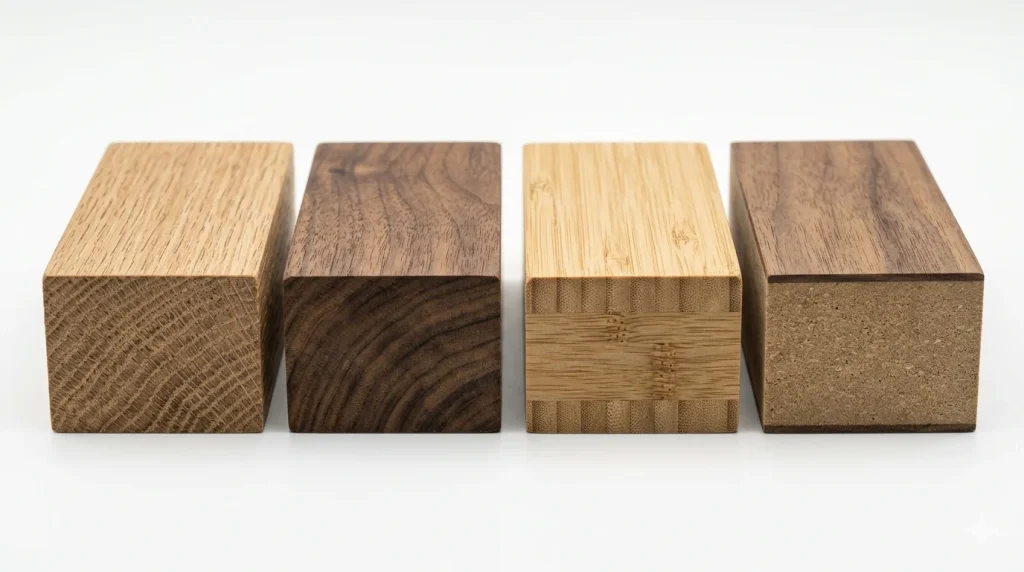
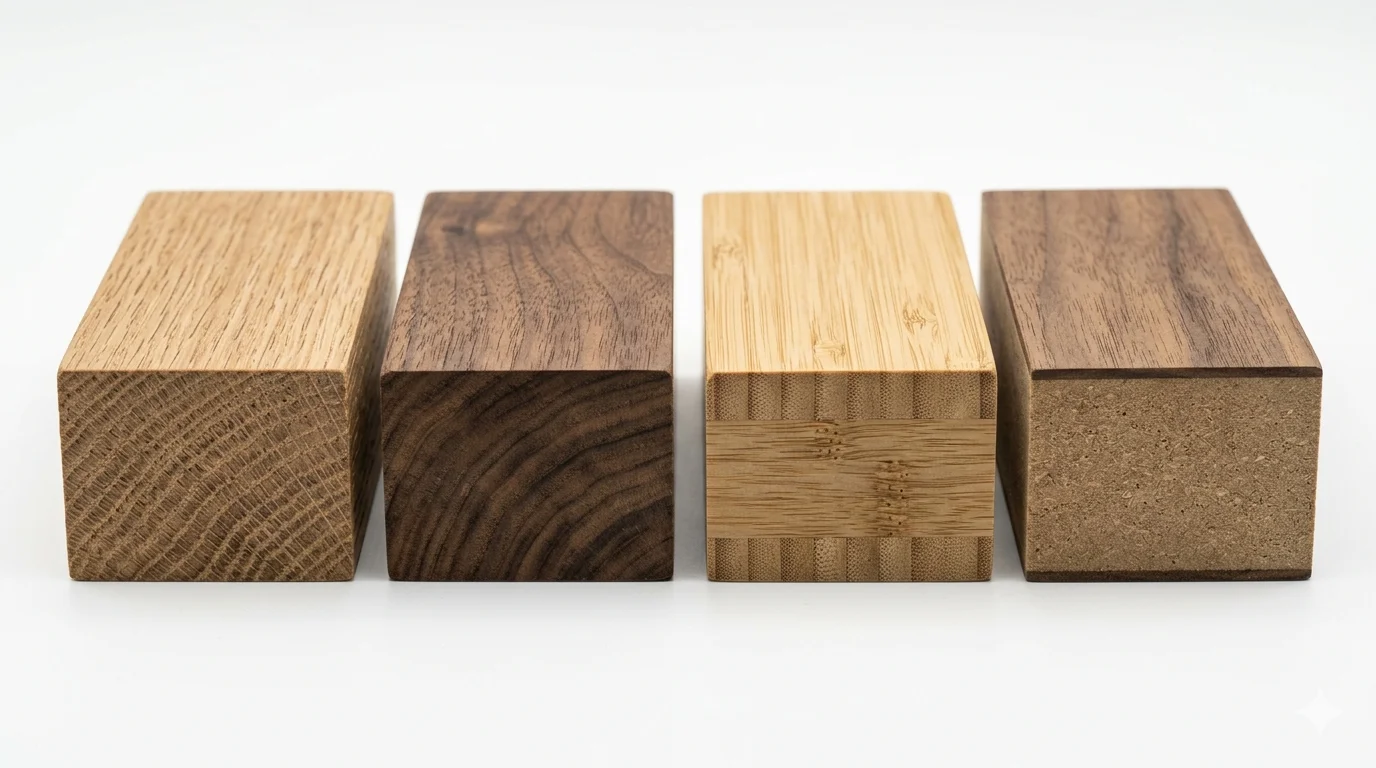
Most buyers pick wood based on color swatches. That’s understandable. But what we’ve found in practice is that wood selection affects five things simultaneously: surface hardness (Janka rating), dimensional stability under humidity, finishing compatibility, weight, and cost. Pick the wrong species and you’re fighting warping complaints six months after delivery.
Here’s how the common watch box species stack up:
Wood Species Janka Hardness (lbf) Density (kg/m³) Warp Resistance Typical OEM Tier Bamboo (engineered) 1,380 600–700 Excellent Budget–Mid Oak (European/White) 1,290 720 Good Mid Walnut (American Black) 1,010 640 Good Mid–Premium Mahogany (Genuine Honduran) 800 545 Very Good Premium MDF with veneer N/A 700–800 Poor (core) Budget Paulownia 300 280 Fair Budget
Bamboo (engineered strand) surprises most buyers. Strand-woven bamboo hits a Janka hardness of ~1,380 lbf — harder than oak — and it’s dimensionally stable because the manufacturing process cross-laminates fiber strands under high pressure. In our workshop, we use it for budget-to-mid tier boxes where the buyer wants a natural look with low shrinkage complaints. It doesn’t take traditional staining the same way hardwood does, though. This doesn’t apply when you need deep dark walnut staining — bamboo’s density and fiber structure resist penetrating stains.
Walnut is where premium retail brands typically land. The natural chocolate-brown tones reduce finishing steps, and the open grain accepts lacquer well. American Black Walnut at 1,010 lbf Janka is workable without being brittle. The limitation: genuine walnut is 30–50% more expensive than oak at the lumber level, and it’s subject to availability swings.
MDF with veneer is the budget workhorse. Core is stable (no grain = no directional warping), but the veneer layer — typically 0.3–0.6mm — is the whole show. Edge treatment is critical here. One common mistake is specifying MDF veneer without specifying edge-banding thickness. We’ve seen buyers receive boxes where the veneer peeled at the corner joints within three months because 0.3mm veneer with no edge-banding can’t survive routine handling.
> Engineering Note: Moisture content is the silent failure point for all solid wood. We target 8–12% moisture content (MC) at time of assembly per standard woodworking tolerances. At MC above 14%, you’re building in future shrinkage. Ask your supplier for their kiln-drying records, not just a verbal confirmation.
—
Leather Grades: The Hierarchy Your Buyer Agreement Should Name Explicitly
“Genuine leather” is the most misleading phrase in the packaging industry. Legally, it’s accurate — but it’s the lowest grade of real animal hide, made from the leftover fibrous layers after the top grain is split off. If your spec sheet says “genuine leather exterior,” you are likely getting the weakest structural layer of the hide.
Here’s the grade hierarchy, from the hide down:
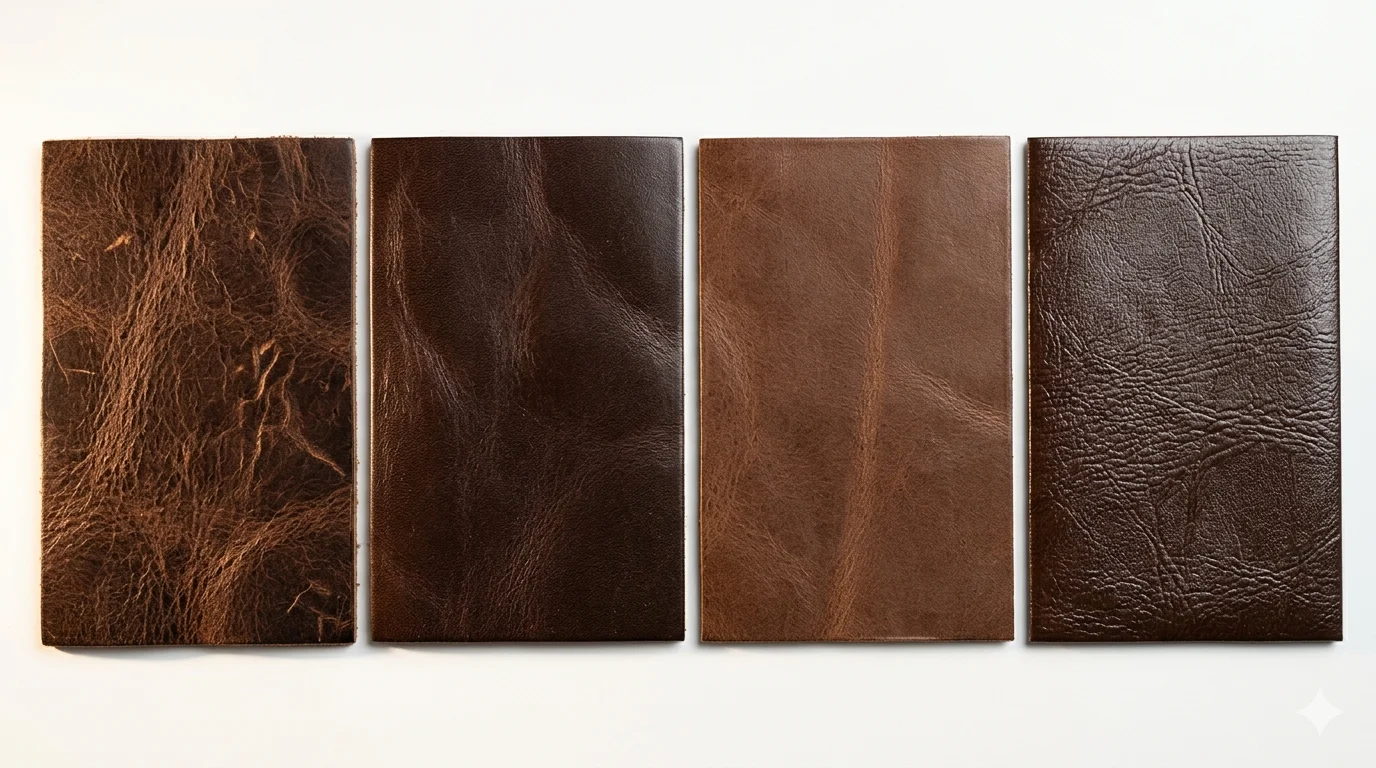
Full-grain leather is the outermost layer of the hide, untouched except for minimal buffing. The natural grain pattern is visible. Pore structure is intact. This is the most durable grade — surface scratches develop a patina rather than cracking. For watch boxes, full-grain adds meaningful tactile premium and resists moisture better than any split layer. It’s also the most expensive and has natural variation (scars, grain inconsistency) that some OEM buyers find unacceptable for uniform retail runs.
Top-grain leather has the surface sanded down and an embossed grain applied. More uniform appearance than full-grain, lower cost, slightly reduced durability. This is the sweet spot for premium retail watch boxes in our experience — consistent appearance across a 5,000-unit run, still genuine leather, still passes a scratch resistance threshold that holds up in display.
Genuine leather (split leather) — the fibrous inner layers — has poor tensile strength and will crack at flex points within 12–24 months under normal use. Fine for interior structural lining layers, not acceptable as the primary exterior surface on anything positioned as premium.
PU leather (polyurethane synthetic) is not leather at all — it’s a textile or non-woven substrate with a polyurethane coating. Don’t let anyone tell you otherwise. What we’ve found in practice is that PU leather has become technically competitive for display durability in controlled environments. Modern PU constructions with >0.6mm polyurethane coating and woven polyester backing are dimensionally stable, clean easily, and meet RoHS 2011/65/EU if the pigment system is compliant. The failure mode for PU isn’t cracking — it’s delamination of the coating from the substrate under UV exposure over 18+ months.
Vegan leather is a marketing term that covers PU, PVC, microfiber, and increasingly bio-based materials (apple fiber, cactus, mushroom mycelium). For OEM purposes, ask specifically which substrate and coating system — “vegan leather” alone tells you nothing about performance.
> Pro Tip: When evaluating leather samples from a new supplier, do a flex test: fold the sample 180° and hold for 10 seconds. Top-grain and full-grain will flex cleanly. Genuine split leather will show surface micro-cracking. PU with thin coating will show coating separation along the fold line. Do this test on corner samples, not flat panels — corners are where failures originate.
Leather Type Real Animal Hide Durability (1–5) Surface Consistency Relative Cost Full-grain Yes 5 Low (natural variation) $$$$$ Top-grain Yes 4 High $$$$ Genuine (split) Yes 2 Medium $$ PU leather No 3–4 Very High $–$$ PVC leather No 2–3 Very High $ Microfiber suede No 3–4 High $$–$$$
—
As detailed in the watch box material comparison.
Velvet Specifications: What the GSM Number Actually Tells You
Velvet is the interior liner buyers specify most often, and it’s where vague specs cause the most visible quality complaints. “Black velvet” is not a specification. The variables that matter are fiber composition, pile height, and GSM (grams per square meter).
Fiber composition affects both feel and durability:
– *Polyester velvet* (most common in watch boxes): consistent pile height, good color retention, easy to die-cut and glue, lower cost. Susceptible to static in dry environments.
– *Nylon velvet*: softer hand feel than polyester, better abrasion resistance, higher cost. Used in jewelry and watch box interiors where tactile experience is central to positioning.
– *Silk velvet*: genuine luxury, minimal use in OEM watch packaging — cost is prohibitive and requires careful handling in production.
GSM and pile height are the two numbers you need on your spec:
A typical watch box interior velvet runs 180–280 GSM with a pile height of 1.5–3.0mm. Here’s the practical formula:
*Perceived plushness ≈ (pile height mm × pile density) / substrate weight*
Short answer: higher pile height with high GSM = plush, premium feel. But there’s a constraint. Pile height above 3.5mm starts to cause fitment problems in precision-molded watch pillow compartments — the watch sits proud of the designed position and doesn’t register correctly in the cavity.
[FS-Bait]
What GSM should watch box velvet be? For standard OEM watch boxes, interior velvet should be 180–240 GSM with a 1.8–2.5mm pile height. Below 180 GSM, the backing substrate shows through under compression. Above 280 GSM, the material adds measurable cost without proportional tactile improvement in most retail applications.
[/FS-Bait]
One thing that surprises most buyers: velvet color changes meaningfully under different cutting angles. Pile direction affects how light reflects — what looks charcoal grey from one angle reads nearly black from another. In our workshop, we specify pile direction relative to the box orientation on every production order. This doesn’t apply to flocked interiors, which have no directional pile.
> Common Mistake: Specifying velvet by color name only (e.g., “navy blue velvet”) without a Pantone or RAL reference AND a pile direction. We’ve had buyers receive boxes where the lid interior and the base interior were cut from the same roll but appear two different shades — because pile was cut in opposing directions.
—
Hardware Finishes: Beyond “Gold” and “Silver”
The hardware specification on a watch box covers hinges, clasps, corner guards, and any decorative escutcheons. Every one of these has a plating specification that determines longevity.
Electroplating thickness is the number that matters, not the color name. The industry measures plating in microns (μm):
– *Decorative gold plating (flash)*: 0.1–0.5 μm. Will show base metal through normal wear within 6–12 months. Only appropriate for display-only applications.
– *Standard gold plating*: 0.5–2.0 μm. Adequate for retail watch boxes with normal handling. This is where most mid-tier OEM hardware sits.
– *Heavy gold plating*: 2.0–5.0 μm. Premium tier. Appropriate for high-end retail and branded watch packaging.
Formula for plating cost estimation:
*Plating cost ∝ (surface area cm² × plating thickness μm × gold content g/cm³ × gold spot price)*
Base metals matter too. Zamak (zinc alloy) is the most common substrate for watch box hardware — good casting resolution for detail, lower cost. Brass substrate adds cost but gives better plating adhesion and more weight, which reads as quality at point of sale. Aluminum hardware is lighter and cheaper but accepts plating less consistently.
For finish types:
– Polished (mirror): shows fingerprints immediately. Requires microfiber buffing pads in packaging.
– Brushed/satin: hides fingerprints, more forgiving in production handling.
– Antique/oxidized: deliberate patina effect, common in vintage watch box styling.
– PVD (Physical Vapor Deposition): harder coating than traditional electroplating, better wear resistance, premium cost. PVD coatings achieve hardness of 1500–3000 HV vs. 150–200 HV for standard gold plate.
> Engineering Note: All metal hardware shipped into the EU must comply with REACH Regulation EC 1907/2006 restrictions on nickel release. If the hardware contacts skin (clasps, handles), nickel release must be below 0.5 μg/cm²/week per EN 1811. Specify this to your hardware supplier explicitly — many budget Zamak hardware runs don’t meet this threshold.
—
Glass vs. Acrylic Lids: The Trade-off Most Buyers Get Wrong
Display watch boxes with transparent lids present a recurring decision: glass or acrylic (PMMA). Buyers often default to glass because it “feels premium.” The engineering reality is more nuanced.
Property Mineral Glass Acrylic (PMMA) Polycarbonate (PC) Scratch resistance (Mohs) 5–6 2–3 2–3 Impact resistance Low (shatters) Medium High Optical clarity Excellent Very Good Good (slight yellowing over time) Weight (relative) 2.5× denser than PC 1× baseline 1.2× acrylic UV transmission Blocks UVB naturally Transmits UV unless treated Transmits UV unless treated Cost (relative) $$$ $ $$ ISTA 3A drop compliance Risk Pass with adequate thickness Pass
What we’ve found in practice: for retail display boxes shipped in individual units, acrylic with 3mm thickness survives ISTA 3A drop testing reliably. Glass at 4mm passes the display phase but fails corner-drop scenarios at 1.2m. The liability question matters — a shattered glass lid during unboxing is a customer service incident; a scratched acrylic lid is a polish-and-replace.
This doesn’t apply when the watch box is a permanent display fixture in a controlled retail environment and will not be shipped after initial installation. In that context, glass delivers optical quality and scratch resistance that acrylic can’t match.
Acrylic scratch hardness is the limitation buyers must accept: Mohs 2–3 means keys and metal surfaces scratch it. Specify an anti-scratch coating (AS coating) on the inner and outer surfaces if acrylic is the choice for any box that will be handled regularly.
This ties directly into our best material for watch box.
> Pro Tip: For museum-quality or archival watch display, specify low-iron glass (also called “ultra-clear” or “Optiwhite”). Standard float glass has a green tint from iron content that’s invisible in small panes but becomes visible at sizes above 200mm. Low-iron glass costs ~40% more but gives optical neutrality that standard glass can’t match.
—
Interior Lining Options Beyond Velvet
Velvet dominates watch box interiors, but it’s not always optimal. Here’s a brief engineer’s survey of the alternatives:
Suede microfiber is the luxury alternative to velvet. Microfiber suede — a split-microfiber substrate with a napped finish — offers better abrasion resistance than velvet pile, cleans more easily, and has a flat-matte surface that photographs well in product photography. In our workshop, it’s the interior of choice when buyers want a modern, understated luxury aesthetic without the directional pile complexity of velvet.
Foam-backed satin is common in jewelry-adjacent watch boxes. The satin overlay gives a high-sheen look, but the foam backing (typically 3–5mm EVA or polyurethane) provides both cushioning and the structural base for watch pillow cavities. Satin is less forgiving of interior dimension inconsistencies — any surface unevenness shows through the satin weave.
Thermoplastic pillow systems (TPR/silicone) are appearing in modern watch boxes aimed at collectors. A molded TPR pillow holds the watch at the correct wrist-radius angle and prevents movement during transit. This is both an aesthetic and a functional spec — the pillow geometry must be designed to the average case lug width of the target watch category (typically 44–50mm for sports watches, 38–42mm for dress watches).
EVA foam inserts with cut-and-peel cavities are the budget-category standard. The insert is precision-die-cut or CNC-routed to the watch silhouette. Function is good; perceived quality is low. Fine for protective shipping inserts, not for retail-positioned watch boxes.
> Common Mistake: Specifying watch pillow height without accounting for crown protrusion. A pillow that holds the watch perfectly flat doesn’t account for the crown at 3 o’clock extending 2–4mm beyond the case. In a tight-fitting cavity, this puts mechanical stress on the crown stem. Always spec pillow clearance with crown protrusion in mind.
—
Material Cost Hierarchy: How OEM Buyers Should Think About Budget Allocation
Short answer: the exterior material and hardware dominate perceived quality. The interior material dominates functional quality. Don’t invert this allocation.
Here’s a practical cost-hierarchy framework based on a normalized 100-point budget unit:
Material Category Budget Tier Allocation Mid Tier Premium Tier Exterior shell (wood/MDF) 30% 25% 20% Exterior cover (leather/PU) 20% 22% 25% Hardware (hinges, clasps) 10% 15% 18% Interior lining (velvet/suede) 15% 15% 17% Glass/acrylic lid 5% 8% 10% Foam/pillow system 10% 8% 5% Assembly & finishing 10% 7% 5%
One thing that surprises most buyers: upgrading from PU leather to top-grain leather on the exterior (a significant perceived quality jump) typically costs $2–5 per unit at OEM scale. Upgrading from standard gold-flash hardware to 2μm gold plate costs $0.50–1.50 per unit. The hardware upgrade has a higher ROI on perceived quality per dollar spent than most buyers expect.
> Engineering Note: For OEM orders above 1,000 units, request a material cost breakdown from your supplier showing BOM-level line items. A supplier who won’t provide this has something to hide — or doesn’t actually know their own COGS. Either scenario should give you pause.
—
FAQ: Watch Box Materials
Q: What’s the minimum wood thickness for a watch box that passes drop testing?
A: For solid wood panels, 9mm is our practical minimum for 6-watch boxes under ISTA 3A test conditions. MDF panels need 12mm due to lower core strength. These are workshop minimums — actual requirements depend on box dimensions and locking hardware design.
Q: Does RoHS apply to watch box packaging?
A: RoHS Directive 2011/65/EU applies to electrical and electronic equipment. A watch box with LED lighting is in scope. A watch box without any electrical components is not directly in scope for RoHS — but leather pigments and hardware plating still need to comply with REACH EC 1907/2006 on hazardous substances.
Q: How do I spec velvet to avoid the “two-tone” effect across a run?
A: Specify fiber type, GSM, pile height, and Pantone color reference. Add a note: “Pile direction: parallel to box length axis, lid interior and base interior aligned.” Request pre-production samples cut from the same roll used for production.
Q: What’s the shelf life of PU leather watch boxes in warehouse storage?
A: Under controlled conditions (< 25°C, < 60% RH, no UV exposure), modern PU leather with polyester backing is stable for 3–5 years. PVC leather degrades faster — plasticizer migration causes brittleness within 2–3 years in non-climate-controlled storage. This is a meaningful difference for wholesale buyers holding inventory.
Q: Can bamboo watch boxes get FSC certification?
A: Engineered strand bamboo can carry FSC certification if the manufacturer’s supply chain is certified. Bamboo itself is botanically a grass, not a tree, but FSC certifies bamboo products under its chain-of-custody framework. Ask your supplier for their FSC COC certificate number and verify it on the FSC database.
Q: What hardware finish is most durable for daily-use watch boxes?
A: PVD-coated hardware is the most durable finish available at commercial scales — 1500–3000 HV hardness compared to 150–200 HV for standard electroplate. The cost premium is 30–60% over standard gold plate, but for a watch box that opens and closes daily, PVD pays for itself in longevity.
—
References & Sources
1. RoHS Directive 2011/65/EU — EUR-Lex, European Union
2. REACH Regulation EC 1907/2006 — EUR-Lex, European Union
3. EN 1811 — Reference test method for release of nickel from products — CEN, European Committee for Standardization
4. ISTA 3A Packaged-Product for Parcel Delivery System Shipment — International Safe Transit Association
5. FSC Chain of Custody Certification — Forest Stewardship Council
6. Physical Vapor Deposition (PVD) overview — ScienceDirect / Elsevier Materials Science
7. ISO 2859-1: Sampling procedures for inspection by attributes — International Organization for Standardization
8. Low Iron / Ultra-Clear Glass technical specifications — Pilkington / NSG Group
 English
Written by: Sarah Jenkins
Senior Content Specialist
Seasoned Industry Editor with 5 years of experience, dedicated to delivering in-depth technical and market reports.
Reviewed by: Dr. Eric Shao
Chief Technical Director
With 12 years of experience in material science and custom manufacturing, ensures the scientific accuracy and technical compliance of all published content.