
Best Watch Winder Box for Private Label Brands: How to Evaluate Quality, Noise, Motors, and Finish
If you are sourcing the best watch winder box for a private label line, we suggest you start with four hard numbers: motor noise below 30 dB at 10 cm, return rate below 2%, MDF wall thickness of 9–12 mm, and carton drop survival from 80 cm in a 5-layer export box. In our factory experience, a private label watch winder that lands in the US$38–95 ex-works range at MOQ 100–300 pcs can be commercially strong, but only if the motor, hinge alignment, surface finish, and QC standard are controlled from sample stage.
That is the short answer buyers usually need first.
The longer answer is this: most problems in watch winders do not come from the outer box. They come from the interaction between the motor module, the inner rotor bracket, the power board, the lid fit, and the final assembly tolerance. A unit can look premium in photos and still fail after 60 days because the pillow is too hard, the rotor center is off by 1.5 mm, or the adapter plug runs hot.
If you are building a branded line, this guide is written for the OEM buyer who wants fewer surprises, lower warranty cost, and packaging that actually supports price positioning.
> Hook: If a supplier only talks about PU color cards and logo stamping, but avoids motor life and dB test method, slow down. That is usually where the future complaints are hiding.
Quick Navigation
– [What makes the best watch winder box for private label brands](#what-makes-the-best-watch-winder-box-for-private-label-brands)
– [Quality checkpoints that matter before you place an order](#quality-checkpoints-that-matter-before-you-place-an-order)
– [How to evaluate watch winder motors and winding programs](#how-to-evaluate-watch-winder-motors-and-winding-programs)
– [How to judge noise honestly](#how-to-judge-noise-honestly)
– [Finish, materials, and brand presentation](#finish-materials-and-brand-presentation)
– [MOQ, pricing, and sampling expectations](#moq-pricing-and-sampling-expectations)
– [QC, compliance, and shipment risk](#qc-compliance-and-shipment-risk)
– [FAQ](#faq)
– [Get a quote](#get-a-quote)
– [References & Sources](#references–sources)
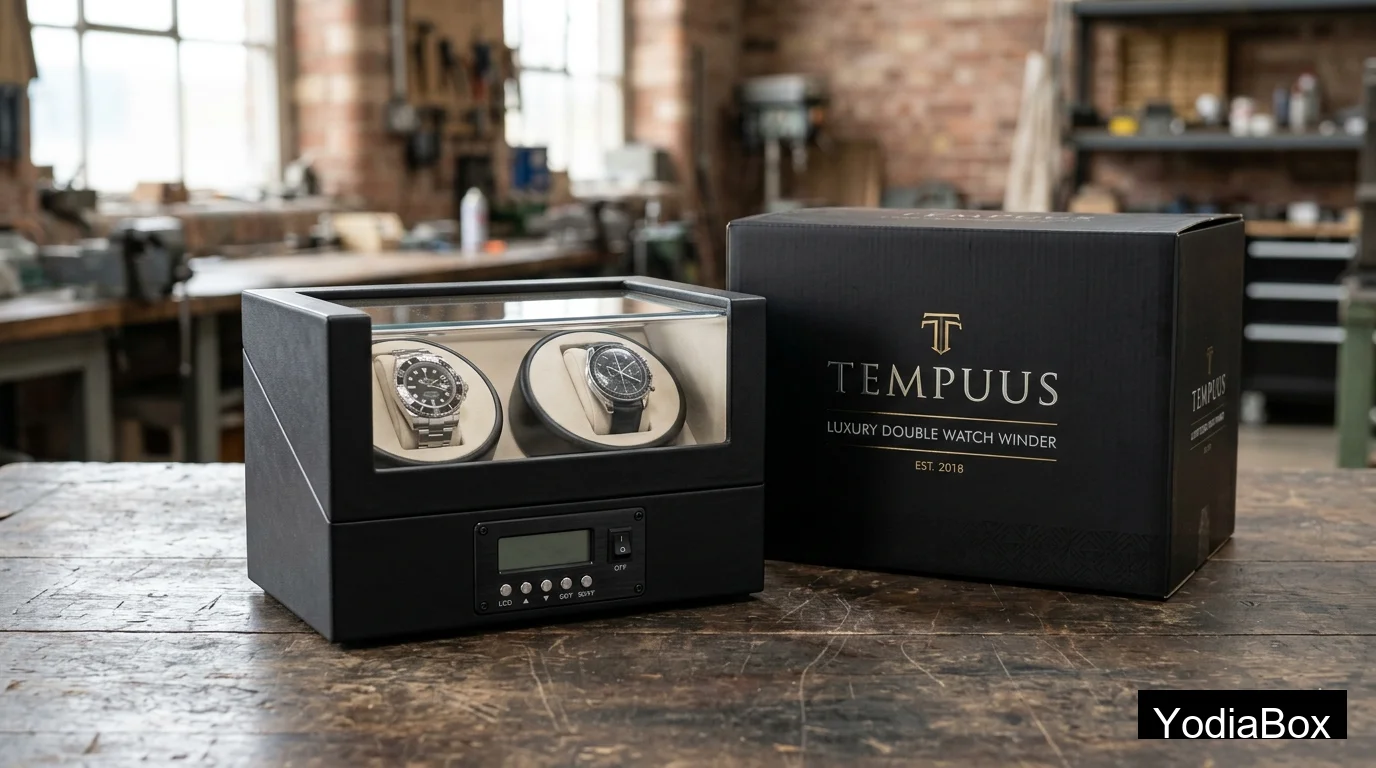
What makes the best watch winder box for private label brands
For private label, the best watch winder box is not simply the most luxurious-looking unit. It is the one that balances:
1. Stable winding performance
2. Low operating noise
3. Consistent cosmetic finish
4. Safe electrical compliance
5. MOQ and margin that fit your brand model
In our experience, most buyers fall into three product tiers:
– Entry private label: 1 or 2-watch winders, PU wrap, MDF body, Japanese-style Mabuchi-type motor equivalent, ex-works US$38–58, MOQ 100–200 pcs
– Mid-tier: 2 to 4-watch winders, piano lacquer or carbon-fiber-look PU, LCD or multi-mode board, ex-works US$59–110, MOQ 100 pcs
– Premium gift retail: real veneer or high-gloss lacquer, tighter panel gaps, quieter motor selection, better presentation carton, ex-works US$120–220, MOQ often 50–100 pcs if semi-custom, 200+ pcs if fully customized
A good commercial watch winder should also support a wide enough range of watch cases. We normally target:
– Watch pillow circumference: 170–190 mm compressible range
– Maximum watch dial diameter: 53 mm recommended
– Clear lid-to-watch height: 65–75 mm for safer fit
– Rotor load capacity: around 250–400 g per watch position, depending on motor spec
> Hook: A watch winder can pass sample review and still fail after launch because no one tested it with a 42 mm diver on a stiff steel bracelet. Always test with real heavy watches, not only empty pillows.
Comparison: what buyers should compare first
| Factor | Entry-level acceptable spec | Better private label spec | Why it matters |
|---|---|---|---|
| Noise at 10 cm | 35-40 dB | 25-30 dB | Lower returns from bedroom-use customers |
| MDF body thickness | 6-9 mm | 9-12 mm | Better structure, hinge holding, less panel warp |
| Pillow fit range | 175-185 mm | 170-190 mm | Fits more bracelet and strap sizes |
| Motor cycle options | 1-2 modes | 3-5 TPD programs + direction | Better compatibility across automatic watches |
When buyers ask us what separates a decent unit from a bad one, the answer is usually tolerance control. We see the same surface material on two factories’ samples, but one has lid gaps of 0.8 mm, the other 2.5 mm. One rotor sits centered, another wobbles visibly. That is not branding. That is engineering and assembly discipline.
Quality checkpoints that matter before you place an order
If we were auditing a new watch winder supplier for ourselves, we would start with these seven checkpoints.
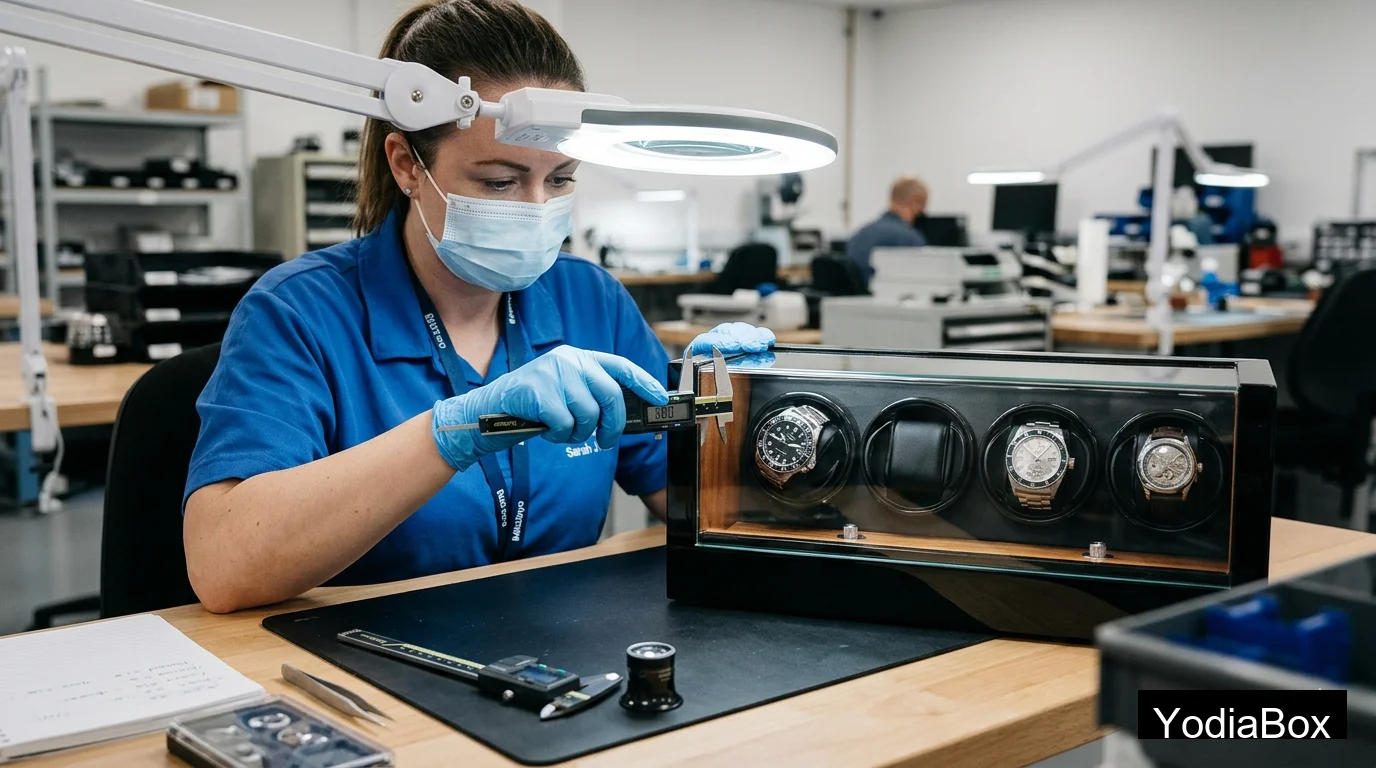
1) Lid alignment and gap consistency
Check the front and side lid gaps with a feeler gauge or caliper. A good target is:
– 0.8–1.5 mm side gap
– left/right deviation under 0.5 mm
– smooth opening with no hinge scratching
If the lid rubs the body in sample stage, it usually gets worse in bulk when humidity changes.
2) Rotor centering
Look at the spinning cup from the front. If the axis is off-center by even 1–2 mm, users notice wobble immediately. It also increases vibration and noise.
3) Pillow compression
Too soft: the watch slides and knocks.
Too hard: customers with 6.5–7 inch wrists cannot mount the bracelet.
For most commercial designs, we prefer PU foam or EVA core pillows compressed to a usable wrist range of 170–190 mm.
4) Interior lining adhesion
Velvet and microfiber failures are common. We have seen adhesive bleed-through in summer container conditions above 35°C. Ask what glue is used and whether the supplier has done heat aging for 48 hours at 45–50°C.
5) Surface wrap and corner treatment
This is where many low-cost units show their real level. Inspect:
– corner wrinkle
– PU edge lifting
– lacquer orange peel
– dust nibs under gloss finish
– logo placement deviation
For private label gift retail, we suggest keeping logo placement tolerance within ±1.5 mm.
6) Control panel and adapter fit
Buttons should actuate cleanly without sinking. DC jack looseness is one of the most common service complaints. We target 100 insert/remove cycles minimum in internal checking.
7) Carton drop performance
A pretty winder is not enough. The packaging system has to survive courier handling. For export, we usually want:
– 1 unit per inner gift box
– EPE or EVA end protection
– 5-layer outer carton
– drop test from 80 cm on corner/edge/face
> Common Mistake
> Many buyers approve the watch winder and treat the gift box as a separate afterthought. In reality, poor insert design causes cracked glass lids, detached rotors, and scratched lacquer. The product and packaging should be tested together as one system.
How to evaluate watch winder motors and winding programs
The motor is the center of the product, but suppliers often describe it vaguely: “silent motor,” “Japanese motor,” or “high quality motor.” That is not enough for a private label program.
Ask for specifics:
– motor type or supplier family
– rated voltage
– no-load current
– loaded current
– duty cycle
– life test hours or cycles
– noise test method
– gearbox material
– single-direction or bi-direction board logic
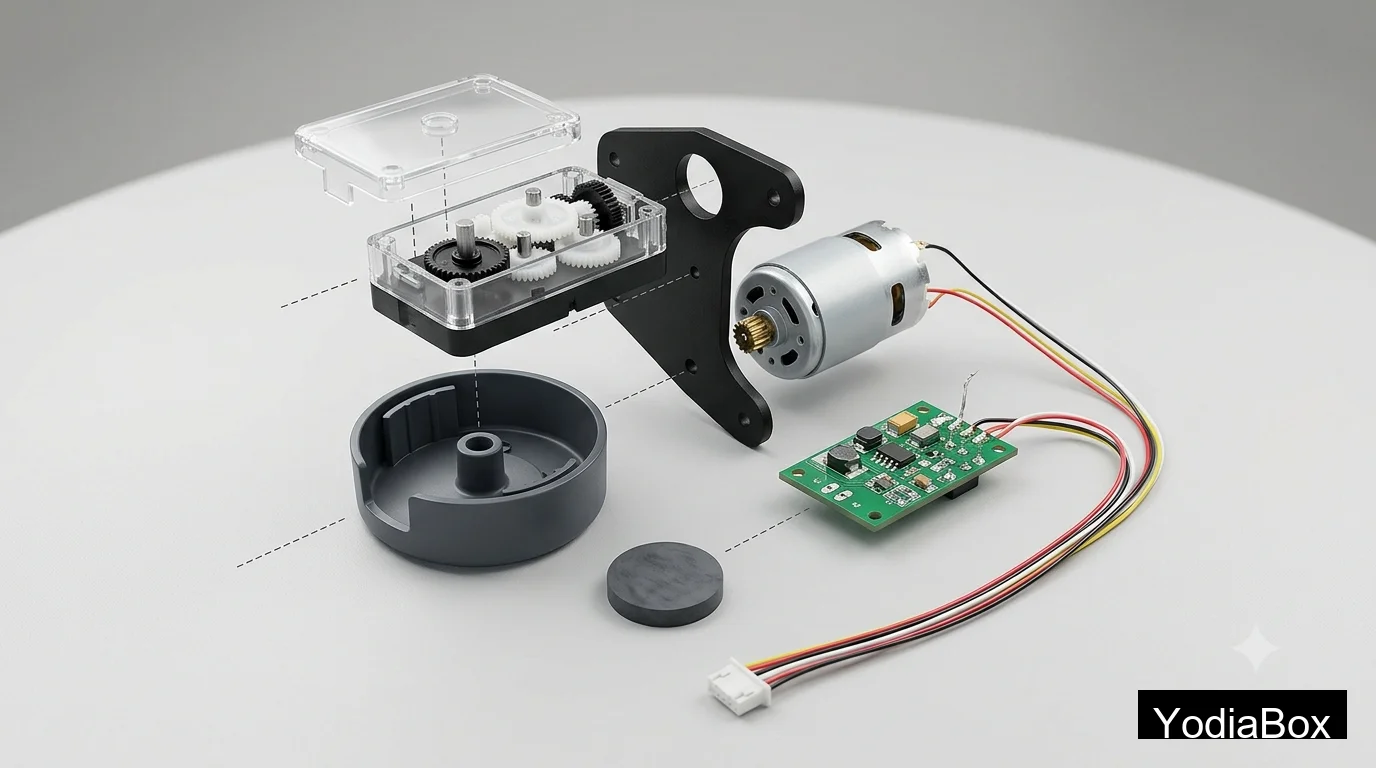
In our factory-side sourcing, a watch winder motor system usually includes:
1. DC motor
2. gearbox
3. mounting bracket
4. control PCB
5. power adapter
6. wiring harness
7. rotor cup coupling
Any one of these can cause failures.
Why winding program matters
Most automatic watches do not need continuous spinning. A better winder uses turns per day (TPD) programs and rest cycles. Common commercial ranges are:
– 650 TPD
– 900 TPD
– 1200 TPD
– clockwise, counterclockwise, and alternating
The “best” setting depends on the watch movement, so we avoid promising one mode fits everything. What matters for your product line is that the board offers enough options and that the mode labeling is clear for end users.
> Hook: If the supplier cannot explain the actual TPD logic in one sentence, they may be buying a generic control board and relabeling it.
What we look for in motor validation
For a serious private label launch, ask the supplier to run:
– 72-hour continuous function test on pilot samples
– 7-day intermittent mode test with normal stop/start cycles
– load test with 250 g, 300 g, and 350 g watches or weighted dummies
– noise spot checks before and after aging
– adapter temperature check after 4 hours operation
For products sold into Europe, electrical safety and market access claims should not be casual. If the winder is mains-powered or sold with an adapter, discuss the applicable requirements around the Low Voltage Directive 2014/35/EU and CE Marking. Material restrictions for electronic components are also commonly referenced under RoHS Directive 2011/65/EU. Exact obligations depend on the final product configuration and destination market, so your compliance file should match your actual SKU.
Comparison: common watch winder configurations for private label
| Configuration | Typical ex-works price | Typical MOQ | Best use case |
|---|---|---|---|
| 1-watch PU wrapped MDF, basic 2-mode motor | US$38-52 | 200 pcs | Entry online retail, promo sets |
| 2-watch glass-lid PU or lacquer, 3-5 modes | US$55-95 | 100-200 pcs | Core private label collection |
| 4-watch premium lacquer or veneer, LCD controls | US$98-165 | 100 pcs | Gift retail, collectors, higher AOV |
| 6-watch cabinet style with storage drawer | US$145-220 | 50-100 pcs | Niche premium line, showroom use |
If your brand already sells custom jewelry boxes or broader jewelry packaging, adding a 1-watch or 2-watch winder often works better than jumping straight to 6-watch cabinets. The smaller units are easier to test, ship, and merchandise.
> Pro Tip
> Ask your supplier to record a 30-second video of three winders running side by side on the same table, with the phone microphone 10 cm away and then 1 meter away. One unit can be quiet alone but sound different in a real pack-out environment.
How to judge noise honestly
“Silent” is one of the most abused words in this category.
No motorized watch winder is truly silent. What buyers should ask is: how noisy, measured where, under what load, and on what surface?
In our internal evaluation, we check:
– distance: 10 cm and 1 m
– environment: quiet room under 35 dB ambient
– load condition: empty and with a 300 g watch
– surface: wood table and foam pad
– operation state: startup and steady rotation
For a bedroom-use product, we like to see:
– 25–30 dB at 10 cm for better units
– under 35 dB at 1 m in stable running condition
Cheap units often spike on startup or during direction change.
Where the noise really comes from
It is not only the motor. Noise can come from:
– gearbox backlash
– loose rotor cup
– MDF cavity resonance
– glass lid vibration
– screw torque inconsistency
– poor rubber feet
– wire rubbing inside body
This is why two factories using similar motors can produce very different results.
> Engineering Note
> We often add 1–2 mm EVA damping pads between the motor bracket and MDF mounting wall on mid-tier winders. It adds a small cost, usually under US$0.20 per unit, but it can reduce perceived vibration enough to matter in customer reviews.
What real users complain about
When we review community comments, the same issues repeat. One Reddit-style complaint is basically: *“It was quiet for the first week, then started clicking at every turn.”* Another common forum complaint is: *“Looks great, but I can hear it from across the room.”* Those comments usually trace back to gearbox quality, rotor fit, or assembly torque, not just motor branding.
> Hook: If a supplier sends only beauty photos and no running video with sound, assume the noise is average until proven otherwise.
If your wider brand program includes custom packaging or you are working with a full jewelry box manufacturer, it helps to have the same supplier coordinate product body, insert, gift box, and shipping carton. That reduces the “not our responsibility” problem when noise or transport damage appears.
Finish, materials, and brand presentation
Buyers often spend most of the meeting on color and logo. Those matter, but finish quality is broader than that.
Common outer finishes
1. PU leather wrap over MDF
– Lowest tooling complexity
– Easy for black, brown, navy, carbon pattern
– Cost-effective at US$38–80
– Risk: edge lifting, wrinkle at corners
2. Piano lacquer
– Premium visual impact
– Common in black, walnut-tone, white
– More handwork, longer cure time
– Risk: scratches, dust points, orange peel
– Usually adds US$12–30 over PU version
3. Real wood veneer
– Strong gift and collector appeal
– Each grain varies; good for premium storytelling
– Risk: color variation, veneer cracking if process is weak
– Usually MOQ and reject sensitivity are higher
4. Aluminum or ABS hybrid body
– Less common in classic luxury look
– Useful for modern travel or tech style
– Depends heavily on mold quality
Interior materials
We most often see:
– short plush
– velvet
– microfiber
– PU interior pads
For luxury feel without too much lint pickup, microfiber is often a safer middle ground than low-grade velvet.
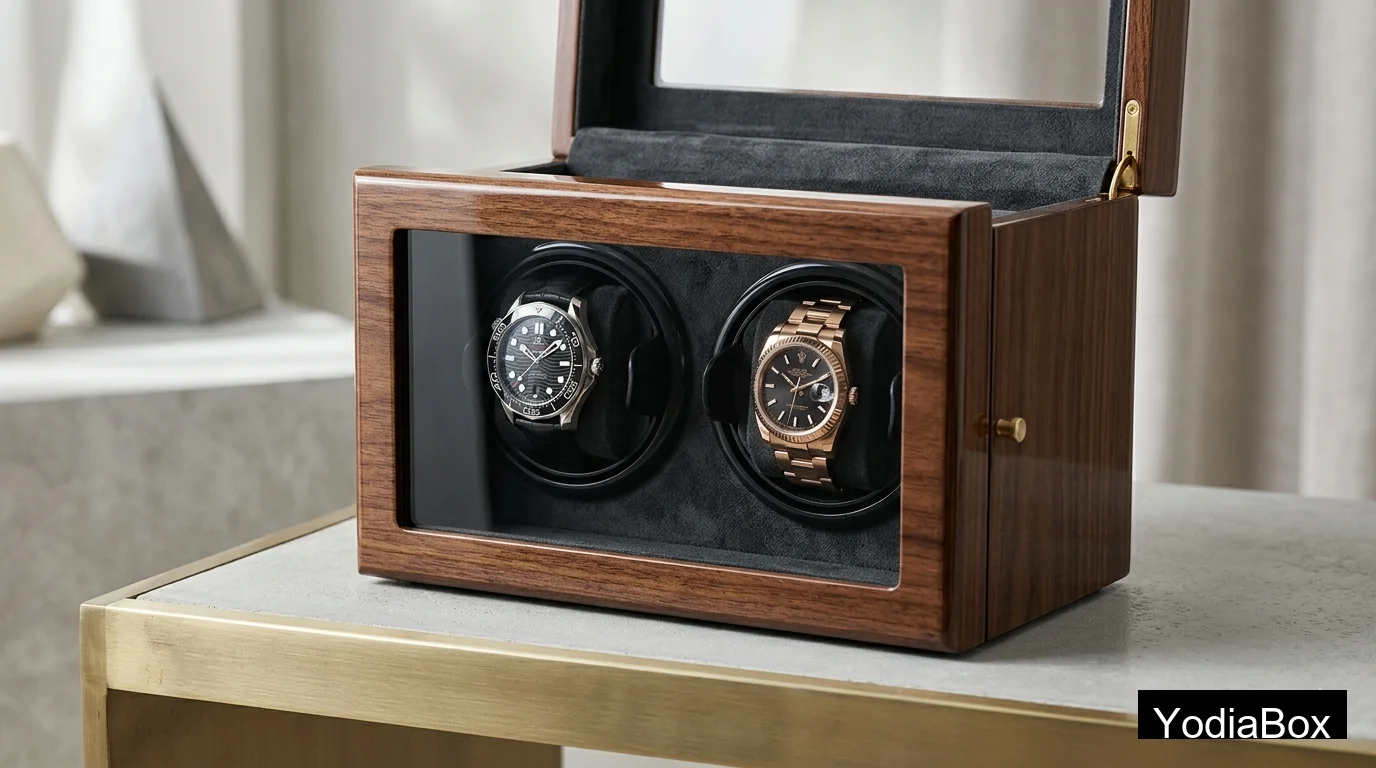
Window material: glass or acrylic
– Glass lid: better scratch resistance, more premium feel, but heavier and breakable
– Acrylic: lighter, safer in transit, but scratches more easily
For a 2-watch winder, a tempered-look glass panel around 3 mm thick is common. On lower-cost SKUs, acrylic can save US$1.20–2.50 per unit depending on size.
> Hook: The finish customers touch first is usually the lid edge and the pillow. If those two points feel cheap, no amount of foil logo can fix the impression.
Branding details that actually change perceived value
– debossed logo on front panel
– metal plaque logo
– laser-etched interior plate
– custom color-matched adapter
– branded dust bag
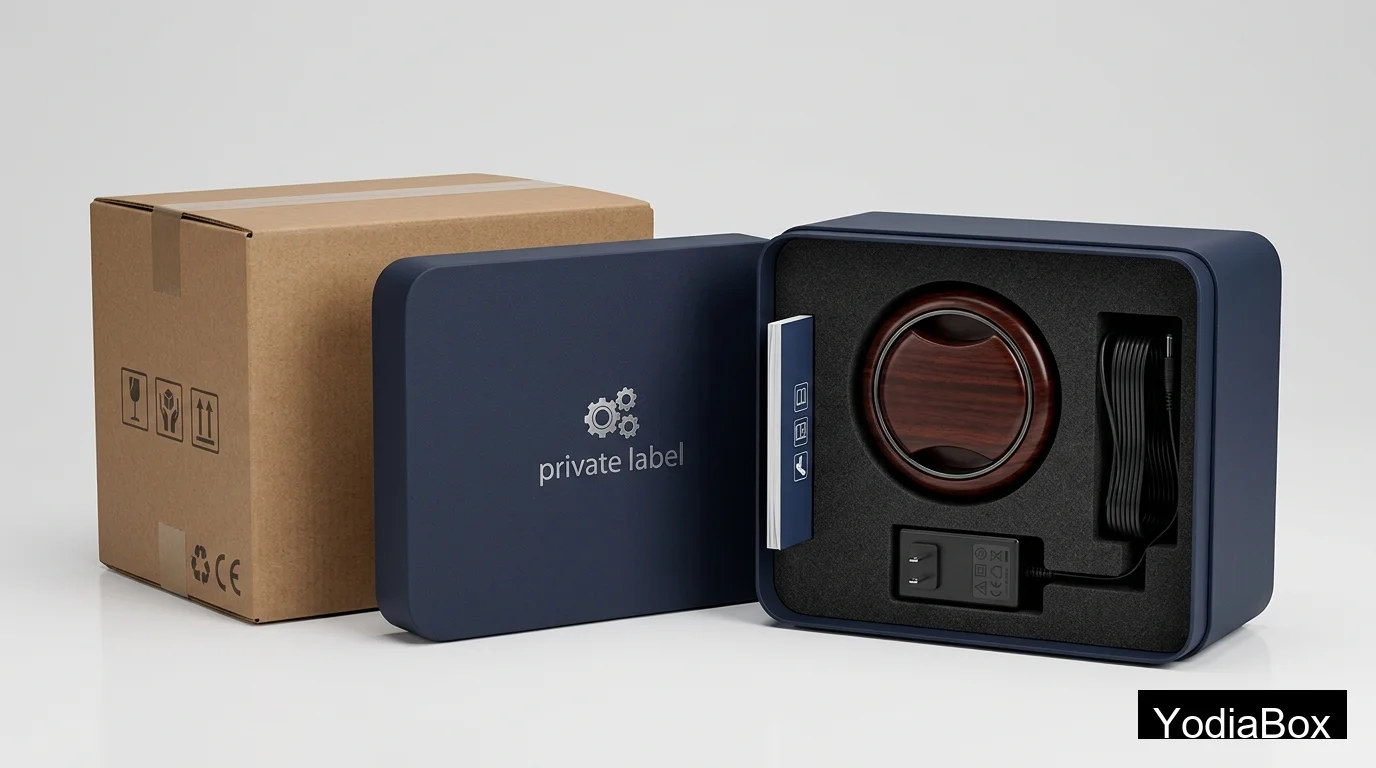
– premium rigid gift box with foam insert
A lot of private label brands overbuild the main unit but underbuild the unboxing. If your retail target is US$129–199, a plain white carton weakens the whole story. A proper rigid or corrugated gift box usually adds US$2.50–6.00, which is often worth it.
If you are also sourcing custom gift packaging or planning a lower-volume launch under a low MOQ model, ask whether the supplier can standardize one gift box structure across multiple SKUs. That can reduce tooling and inventory complexity.
MOQ, pricing, and sampling expectations
Let’s talk numbers honestly.
Typical cost structure
For a 2-watch winder in private label format, ex-works pricing often breaks down like this:
– MDF body and machining: US$6–10
– outer PU or lacquer finish: US$5–18
– motor + gearbox + bracket set: US$8–18
– PCB, switch, adapter, wiring: US$4–8
– interior lining and pillows: US$3–6
– assembly and QC: US$4–7
– gift box + shipping protection: US$3–8
That is why a “luxury-looking” sample at US$42 usually means something is basic inside: thinner MDF, cheaper gearbox, fewer inspections, or simpler packaging.
Realistic MOQ ranges
– Stock model with custom logo: 50–100 pcs
– Semi-custom color/material change: 100–200 pcs
– Full custom structure or new tooling: 300–500 pcs minimum in most cases
If a buyer wants custom body dimensions, unique control panel layout, and exclusive rotor shape at 50 pcs, that is usually not realistic without very high unit cost.
Sample expectations
For OEM watch winder projects, we usually advise:
– plain sample lead time: 7–12 days
– logo sample: 10–15 days
– pre-production sample after changes: 7–10 days
– mass production: 30–45 days after approval and deposit
A common sampling budget is US$80–250 per piece depending on complexity, with partial or full refund after order.
> Hook: The cheapest sample is often the most expensive decision if it hides the real bulk quality level.
If your company already buys wholesale jewelry boxes or display items such as custom jewelry displays, try bundling adjacent products with the same supplier only if they are genuinely strong in both. Watch winders are part packaging, part electronics. Not every packaging factory is good at the motor side.
QC, compliance, and shipment risk
This is the area buyers skip when timelines get tight, and then regret later.
AQL and inspection planning
For bulk orders, use a clear inspection plan. Many importers work with AQL-based sampling under the framework referenced by ISO 2859 Sampling. The exact level depends on your quality policy, but in practice we often see buyers classify:
– critical defects: 0
– major defects: low tolerance
– minor defects: moderate tolerance
Typical watch winder defect list should include:
– unit not powering on
– motor not rotating
– abnormal clicking noise
– lid scratched
– logo crooked
– pillow too loose
– adapter overheating
– carton crush damage
Compliance points worth checking
For electronic gift products sold into different markets, compliance depends on voltage, adapter type, labeling, and destination. At minimum, buyers should confirm:
– product label content
– adapter certification for destination market
– material declarations for restricted substances
– user manual warnings
– traceability marking
For electronics-related material restrictions, the RoHS Directive 2011/65/EU is a common reference point in EU-facing projects. For market access claims, suppliers should understand CE Marking, but the declaration must match the actual finished product and its applicable directives.
Packaging tests we recommend
Before approving shipment, we suggest:
– 100% function test before packing
– aging test on at least 1–3% of batch for 4–8 hours
– drop test on packed samples
– carton vibration simulation if shipping premium lacquer units
– humidity exposure check if sending by sea in hot season
> Hook: A watch winder may pass factory QC and still arrive damaged if the insert lets the rotor swing during courier shock.
If you need a supplier that understands both product body and retail presentation, look for a partner that is closer to a packaging-engineering house than a trading-only source. That matters especially when combining electronics with gift presentation.
Video check buyers should request before approval
Because this category is partly about motion and sound, a video check is useful even before in-person inspection.
Ask for one continuous video showing:
– lid opening and closing
– startup
– clockwise rotation
– pause and reverse
– sound at close range
– watch mounted on pillow
– adapter connection
– carton packing sequence
That gives you more truth than polished studio photos.
For schema implementation on your product page later, your web team can add VideoObject markup around the demonstration video. That helps usability and can improve how product content is presented in search, though execution depends on your site setup.
How we would shortlist the best watch winder box supplier
If we were the buyer, we would score suppliers on this simple 100-point matrix:
– motor and electronics reliability: 30
– noise performance: 20
– finish consistency: 15
– packaging protection: 10
– compliance documentation: 10
– MOQ flexibility: 5
– sampling speed: 5
– communication clarity: 5
A supplier can win on price and still lose the account if they cannot answer motor life, dB method, or adapter certification questions clearly.
FAQ
FAQ
How quiet should the best watch winder box be?
For a product positioned as bedroom-friendly, we recommend targeting 25–30 dB at 10 cm and under 35 dB at 1 meter in a quiet room. More important than the number alone is the test method: ask whether the unit was measured empty or with a 300 g watch, and whether startup clicking was included.
What motor is best for a private label watch winder?
There is no single best motor for every SKU. For most 1–4 watch winders, a stable low-speed DC motor with a reliable gearbox and proven board logic is the safest choice. We care more about life test data, load performance, and noise consistency than generic claims like “Japanese motor.”
What is a good MOQ for custom logo watch winders?
For a stock structure with custom logo, 50–100 pcs is possible with some factories. For color, material, or packaging changes, expect 100–200 pcs. If you want a new mold, new body size, or exclusive internal structure, 300–500 pcs is more realistic.
Is lacquer better than PU leather for watch winder boxes?
It depends on your price point and shipping risk. Lacquer gives a stronger premium look and can support higher retail pricing, but it scratches more easily and has a higher reject risk in production. PU is more cost-effective and practical for e-commerce, especially in the US$79–149 retail band.
How do I reduce return rates on watch winders?
Focus on three things first: motor noise, pillow fit, and transit protection. In our experience, many returns come from units that are “too loud,” do not hold smaller wrists, or arrive with internal movement after courier handling. Testing with real watches and a proper EVA/EPE insert makes a big difference.
Should I source the watch winder and gift box from the same supplier?
Usually yes, if the supplier truly controls both product assembly and packaging engineering. When the winder and gift box are developed together, it is easier to solve rotor protection, adapter placement, and drop-test issues. If sourced separately, responsibility often gets split when damage appears.
Get a quote
If you are comparing suppliers for the best watch winder box under your own brand, we suggest you ask for three things first:
1. a running sample video with sound
2. a clear spec sheet with dimensions, materials, motor mode, and adapter details
3. a packaging drop-test plan for the final boxed unit
If you want, we can help review your target spec, propose an MOQ-friendly structure, and quote a private label program based on your price band, finish, and packaging requirements.
Get a quote with your target quantity, watch positions, finish preference, destination market, and logo method.
References & Sources
1. [Low Voltage Directive 2014/35/EU](https://eur-lex.europa.eu/legal-content/EN/TXT/?uri=CELEX:32014L0035)
2. [CE Marking](https://single-market-economy.ec.europa.eu/single-market/ce-marking_en)
3. [[RoHS Directive 2011/65/EU](https://eur-lex.europa.eu/legal-content/EN/TXT/?uri=CELEX:32011L0065)](https://eur-lex.europa.eu/legal-content/EN/TXT/?uri=CELEX:32011L0065)
4. [ISO 2859 Sampling](https://www.iso.org/standard/16578.html)
Written by: Sarah Jenkins
Senior Content Specialist
Seasoned Industry Editor with 5 years of experience, dedicated to delivering in-depth technical and market reports.
Reviewed by: Dr. Eric Shao
Chief Technical Director
With 12 years of experience in material science and custom manufacturing, ensures the scientific accuracy and technical compliance of all published content.
Recommended Reads
Gift packaging
10 产品
Jewelry display
12 产品
Jewelry Organizer
12 产品
Jewelry pouch
7 产品
Jewelry suitcase
6 产品
Leather jewelry box
13 产品
LED Jewelry box
8 产品
Paper jewelry box
10 产品
Velvet Jewelry box
11 产品
Watch box
7 产品
Wood jewelry box
6 产品
Automatic Watch Winder Box: Features, Materials, and OEM Customization Options
If you are developing an automatic watch winder box for your brand, the hard part [...]
Jun
Box Hoop Earrings Packaging: The Complete B2B Sourcing & Selection Guide
Box Hoop Earrings Packaging: The Complete B2B Sourcing & Selection Guide Choosing the right box [...]
Jewelry Organizer Ideas: Complete Guide to Storing & Displaying Every Type
We’ve worked in jewelry packaging for more than a decade, and the question we hear [...]
Jun
Watch Box OEM/ODM Buyer Guide: Materials, Customization, MOQ, Pricing & Supplier Selection
A good watch box protects the product, supports brand positioning, and reduces returns before the [...]
Jun
Custom LED Jewelry Box OEM/ODM: Your Expert Partner for Integrated Solutions
Introduction In the highly competitive world of jewelry, presentation is paramount. A beautifully crafted [...]
May
Box for Watches and Jewelry: The Complete B2B Buyer’s Guide to Types, Materials, Customization & Supplier Sourcing
Box for Watches and Jewelry: The Complete B2B Buyer’s Guide to Types, Materials, Customization & [...]