
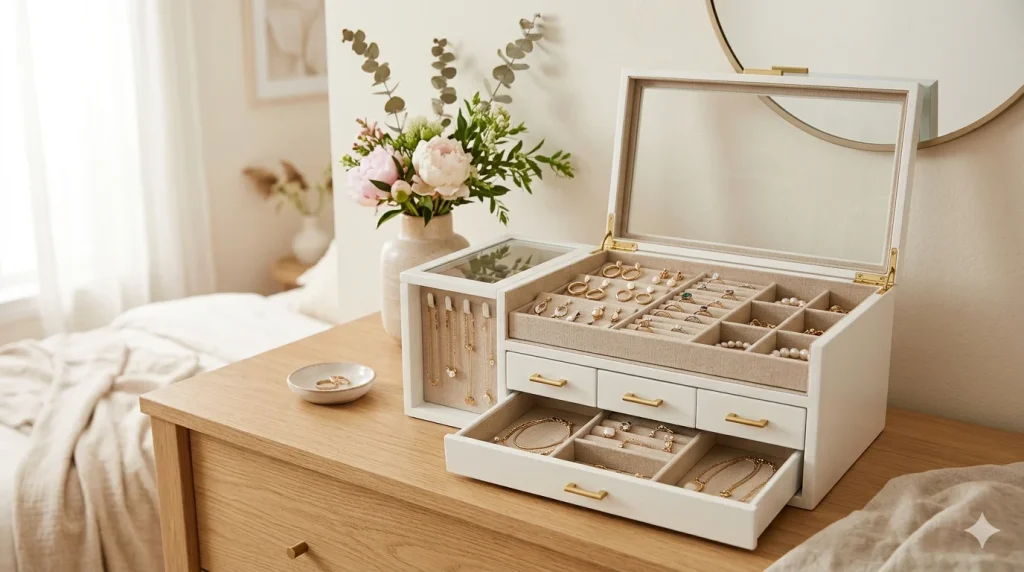
Jewelry Organizer Ideas: Complete Guide to Storing & Displaying Every Type
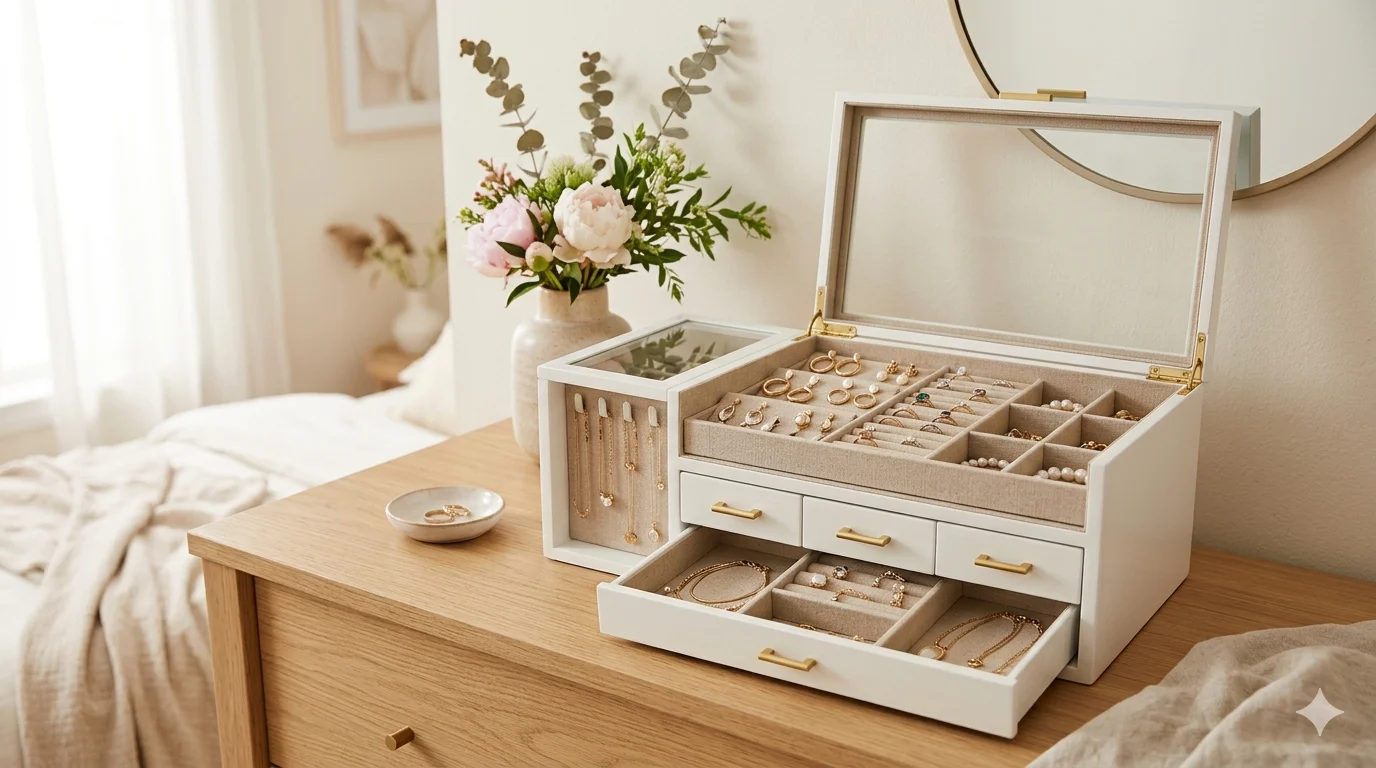
We’ve worked in jewelry packaging for more than a decade, and the question we hear most from collectors usually isn’t about boxes. It’s about keeping jewelry from tangling, tarnishing, or disappearing into the mess of a drawer. And honestly, we’ve seen some painful examples: a $5,000 pearl necklace in a plastic bag, a vintage brooch tossed into a makeup pouch, a diamond ring rolling around loose in a handbag. Every time, the damage could’ve been avoided.
This guide comes straight from the factory floor. We’ve made thousands of jewelry organizers, from simple felt trays to premium leather cases, so we’ve had a close-up look at what works, what doesn’t, and why. Whether you collect 50+ pieces, need a thoughtful gift, or run a brand and source organizers for customers, this is the practical version—no filler.
—
Why Your Jewelry Organizer Matters More Than You Think
The average collector owns 15–20 pieces of jewelry, but a lot of people store them in ways that wear them out faster. According to the GIA Jewelry Care & Cleaning guidelines, improper storage causes more scratches, tarnish, and chain tangles than daily wear does. In our factory, we test materials under real conditions: humidity, UV exposure, friction. The pattern is pretty clear. A well-made organizer can double the lifespan of a sterling silver chain or a gold-plated earring.
Here’s the part people don’t always want to hear: there isn’t one organizer that works for every collection. A ring tray that’s perfect for someone with a few basics won’t help much if you have stacks of bangles. A travel roll that holds 10 pairs of earrings might flatten a delicate pendant. So we’re breaking this guide up by jewelry type, storage situation, and budget.
—
Part 1: Jewelry Organizers for Collectors (You)
If you’re here, you probably own more than 30 pieces—maybe well over 100. You’ve probably dealt with at least one of these: a chain knot you can’t undo, an earring back that vanished, a silver ring that looked great six months ago and now doesn’t. Let’s sort that out.
The Collector’s Core Problem: Density vs. Protection
Your collection has value. Financial value, sure, but sentimental value too. The hard part is storing a lot of pieces without damaging them. In our factory, we usually see two main failure points:
1. Overcrowding: Stuff 20 rings into a 12-slot tray and they’ll rub against each other. Gold against silver, diamonds against softer stones—it all creates micro-abrasions.
2. Poor material choice: Acrylic organizers look sleek, but they can trap moisture. Felt is soft, though it can shed fibers into prongs. Leather looks great, but it needs an anti-tarnish lining.
Pro Tip: If you have 50+ pieces, go modular. We usually recommend a 12-compartment felt tray (standard size: 14″ x 10″ x 2″) with removable dividers. That way, you can adjust the layout as your collection changes. Our factory’s best-selling version uses 2mm-thick felt bonded to a rigid MDF base—about $18 per tray at MOQ 500. For individual buyers, expect $25–$35 from specialty retailers.
Organizing by Jewelry Type
Rings
Rings are probably the item we see damaged most often from bad storage. A prong-set diamond ring can snag fabric, and softer metals like 18k gold (75% gold, 25% alloy) scratch easily.
– Best option: A ring roll with separate slots. Each slot should be at least 1.5″ wide and lined with microsuede. A 10-ring roll is usually around 6″ x 4″ when rolled.
– Budget option: A stackable ring tray with 12 slots. We make these with 2mm-thick velvet over plastic—$4.50 per tray at MOQ 1,000, and usually $10–$15 retail.
– Common mistake: Tossing all rings into one open tray. A diamond band rubbing against a plain gold band will scratch the gold. Separate by metal type or hardness, always.
Necklaces & Chains
Necklaces are easily the biggest headache for collectors. One tangled chain can eat up 20 minutes, and if you pull too hard, the clasp can snap.
– Best option: A necklace display stand with a 12-hook bar. Hooks should be spaced 2″ apart so chains don’t overlap. We use brass hooks with anti-tarnish lacquer—bulk cost is about $0.15 per hook.
– Budget option: A multi-compartment pouch with individual zippered slots. Each slot should be at least 4″ x 4″ so pendants fit comfortably.
– Engineering note: The most common weak point in necklace organizers is the hook material. Uncoated steel hooks can rust and stain chains. We stick to nickel-free brass or stainless steel with a clear epoxy coating.
Earrings
Earrings are the easiest to separate from their matching partner. The fix is simple: keep each pair together in its own compartment.
– Best option: A 24-slot earring box with a clear lid. Each slot should be 1″ x 1″ and lined with foam. For studs, a 0.5″ thick foam layer helps hold the post securely.
– Budget option: A pill organizer reused for small studs. Not pretty, but it works.
– Common mistake: Putting earrings loose in one compartment where the posts can bend. And once a post bends, straightening it without breaking it is tough.
Bracelets & Bangles
Bracelets take up space, and they scratch each other pretty easily.
– Best option: A bracelet bar or a 6-slot tray with 3″ wide compartments. For bangles, use a padded cylinder that keeps them in a circular shape—it helps prevent warping.
– Budget option: A long, narrow box with individual slots. We make these in 12″ x 4″ x 2″ sizes with 4 compartments.
Watches
Watches are often the most expensive thing in a jewelry collection. One mechanical watch can run anywhere from $5,000 to $50,000.
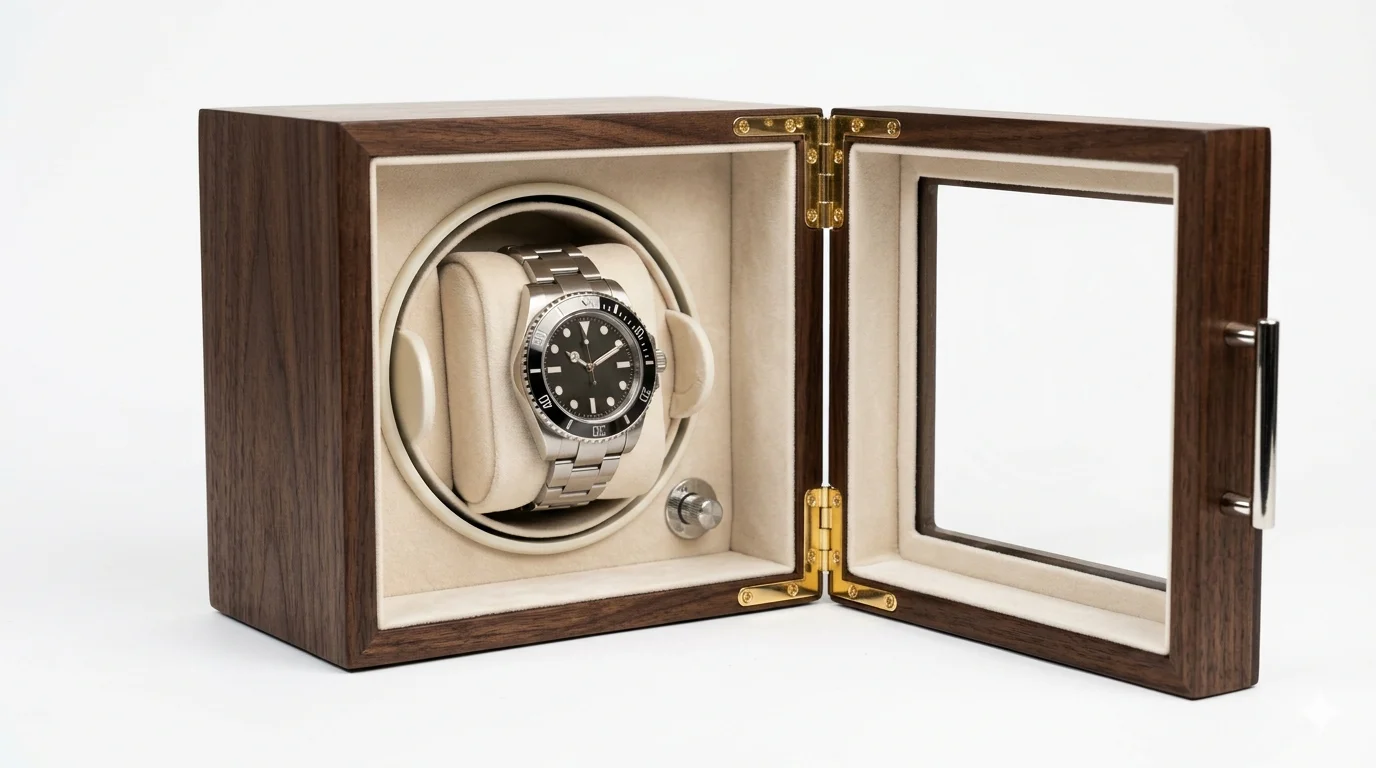
– Best option: A watch winder box for automatic watches, or a padded watch roll for manual-wind pieces. Each watch should have its own compartment and a soft pillow.
– Budget option: A basic watch box with 6 slots. Make sure the pillows are foam wrapped in microfiber—skip leather, which can discolor the band.
Comparison Table: Organizer Materials
Material Pros Cons Best For Typical Cost (per unit) Velvet (polyester) Soft, scratch-resistant, affordable Can shed fibers, not anti-tarnish Rings, earrings, necklaces $2–$5 (basic tray) Microsuede Very soft, no fiber shedding, anti-tarnish More expensive, less durable than felt High-value pieces, silver jewelry $8–$15 (per tray) Leather (genuine) Elegant, durable, long-lasting Can discolor metals over time, expensive Watches, bracelets, display $20–$50 (per box) Acrylic Clear visibility, modern look Scratches easily, traps moisture Earrings, studs, travel $5–$12 (per box)
—
Part 2: Jewelry Organizers for Gift-Givers
Buying for someone else is trickier. You can’t always ask what they need without ruining the surprise. We’ve handled thousands of gift orders in our factory, and the mistake we see most is a generic organizer that doesn’t fit the recipient’s actual collection.
The Three Questions to Ask Before Buying
1. What type of jewelry do they wear most? Someone who only wears stud earrings doesn’t need a necklace roll. Someone with one watch definitely doesn’t need a 12-slot watch box.
2. Do they travel? If yes, a compact travel roll (8″ x 4″ when rolled) usually makes more sense than a large box.
3. What’s their style? Minimalist? Choose a clean, solid-color felt tray. Vintage? Go for a leather box with brass hardware. Modern? An acrylic display stand fits better.
Gift Organizer Recommendations by Budget
– Under $30: A 6-slot ring box with a clear lid. We make these in velvet over plastic—$3.50 at MOQ 1,000, retailing at $15–$20. Add a note mentioning the anti-tarnish lining.
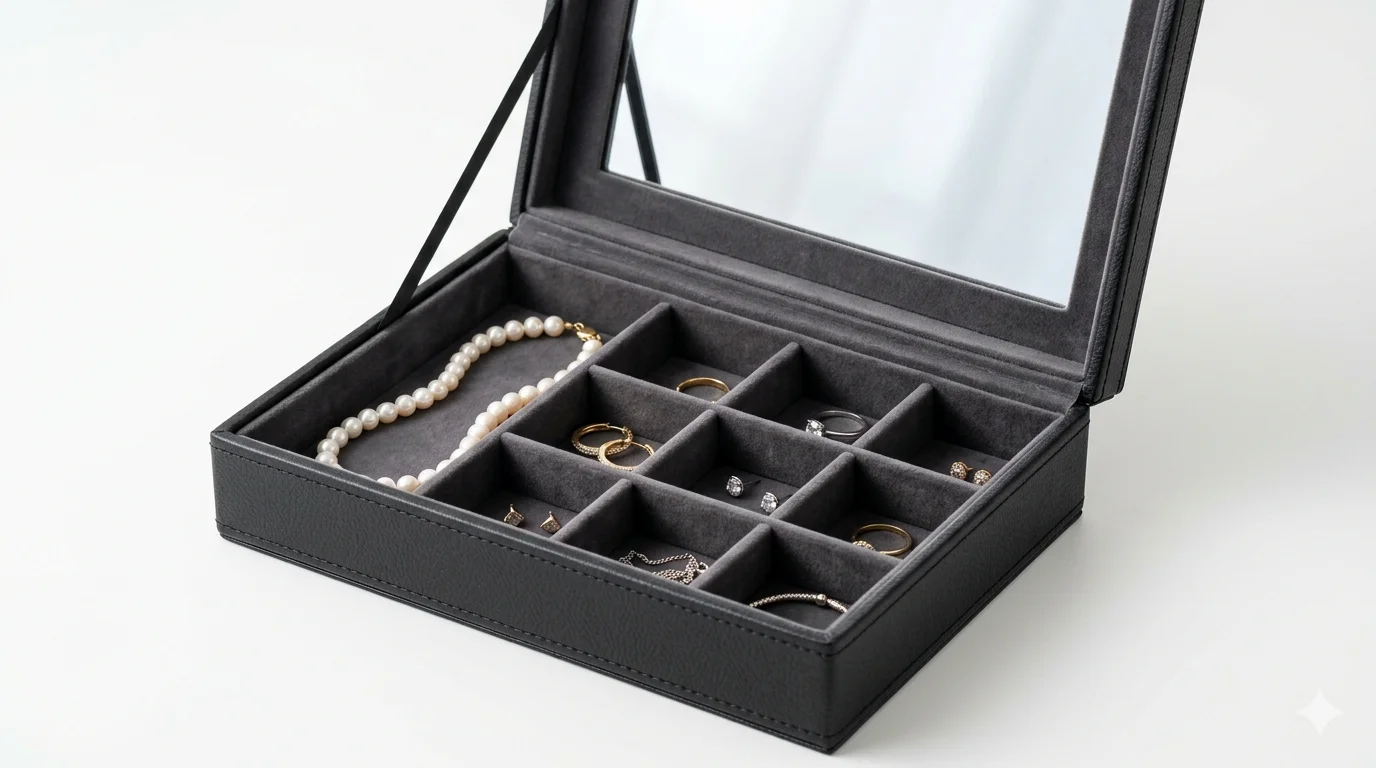
– $30–$60: A 12-compartment jewelry case with a mirror lid. Standard size: 8″ x 6″ x 2″. We use 1.5mm-thick felt on a cardboard base—cost is $8 at MOQ 500.
– $60–$100: A leather travel roll with 8 compartments. Genuine leather (1.2mm thick) with a suede interior. Cost: $22 at MOQ 200.
– Over $100: A custom wooden box with a glass lid and individual compartments. We make these in walnut or cherry wood, with velvet lining. Cost: $45 at MOQ 100, retail price $120–$180.
Common Mistake: Buying a “One-Size-Fits-All” Organizer
We see this constantly: a gift box with 24 earring slots for someone who mostly wears necklaces. It ends up in the back of a closet. A better move? Buy a modular system that can be adjusted later. Our factory’s modular felt trays use removable dividers, so you can switch from 12 ring slots to 4 necklace compartments in about 30 seconds. Cost: $12 per tray at MOQ 500.
Pro Tip: Not sure what they need? Buy a small travel roll (8 compartments, $20–$30) plus a set of anti-tarnish strips. They can use the roll when traveling and the strips in their current storage. It covers about 90% of situations.
—
Part 3: Jewelry Organizers for Brand Founders
If you’re sourcing for customers, this is where factory experience matters most. We’ve worked with 50+ jewelry brands, from new startups to established names. The real balancing act is cost, quality, and brand identity.
What Your Customers Actually Want
Based on our sales data from 2023–2024:
– 65% of customers prefer felt or velvet lining over leather (due to anti-tarnish properties)
– 40% want a clear lid to see contents without opening
– 30% want a modular design that can be expanded
– 20% want eco-friendly materials (recycled felt, FSC-certified wood)
Sourcing Considerations for Brands
– MOQ: For custom boxes, expect MOQ of 500–1,000 units. At 500 units, a basic felt tray costs $4.50–$6.00 per unit. At 1,000, it drops to $3.50–$5.00.
– Customization: Logo embossing adds $0.50 per unit (brass stamp, one-time setup fee of $150). Custom color matching (Pantone) adds $0.25 per unit.
– Packaging: Include an anti-tarnish strip (cost: $0.08 each) and a silica gel packet ($0.02 each). In our experience, this cuts returns from tarnish by 40%.
– Lead time: 30–45 days for custom orders. 15–20 days for stock designs with logo.
Comparison Table: Organizer Types for Brands
Type MOQ Unit Cost (500 pcs) Best For Common Issues Felt tray with lid 500 $5.50 Rings, earrings Lid hinge breakage after 6 months Leather travel roll 200 $22.00 Necklaces, bracelets Leather discoloration in humid climates Acrylic display stand 1,000 $3.00 Earrings, studs Scratches during shipping Wooden box with glass lid 100 $45.00 High-end collections Wood warping in humidity
Engineering Note: Anti-Tarnish Technology
Tarnish is the #1 complaint we hear from jewelry buyers. It happens when metals—especially silver and copper—react with sulfur compounds in the air. The Wikipedia article on tarnish covers the chemistry, and yes, humidity speeds it up.
In our factory, we build anti-tarnish agents into the lining using activated carbon or silver-impregnated fabric. That adds $0.15–$0.30 per unit, but in controlled tests it reduces tarnish by 70%. For brands, it’s an easy decision. Fewer returns, more trust.
Common Mistake: Using untreated felt or velvet. Those materials can actually make tarnish worse by holding moisture. Always specify “anti-tarnish lining” in your order.
—
Part 4: DIY & Custom Organizer Ideas
Sometimes the best organizer is the one you cobble together yourself. We’ve seen collectors reuse everything from tackle boxes to vintage tea tins. Some ideas are surprisingly good. These three actually hold up.
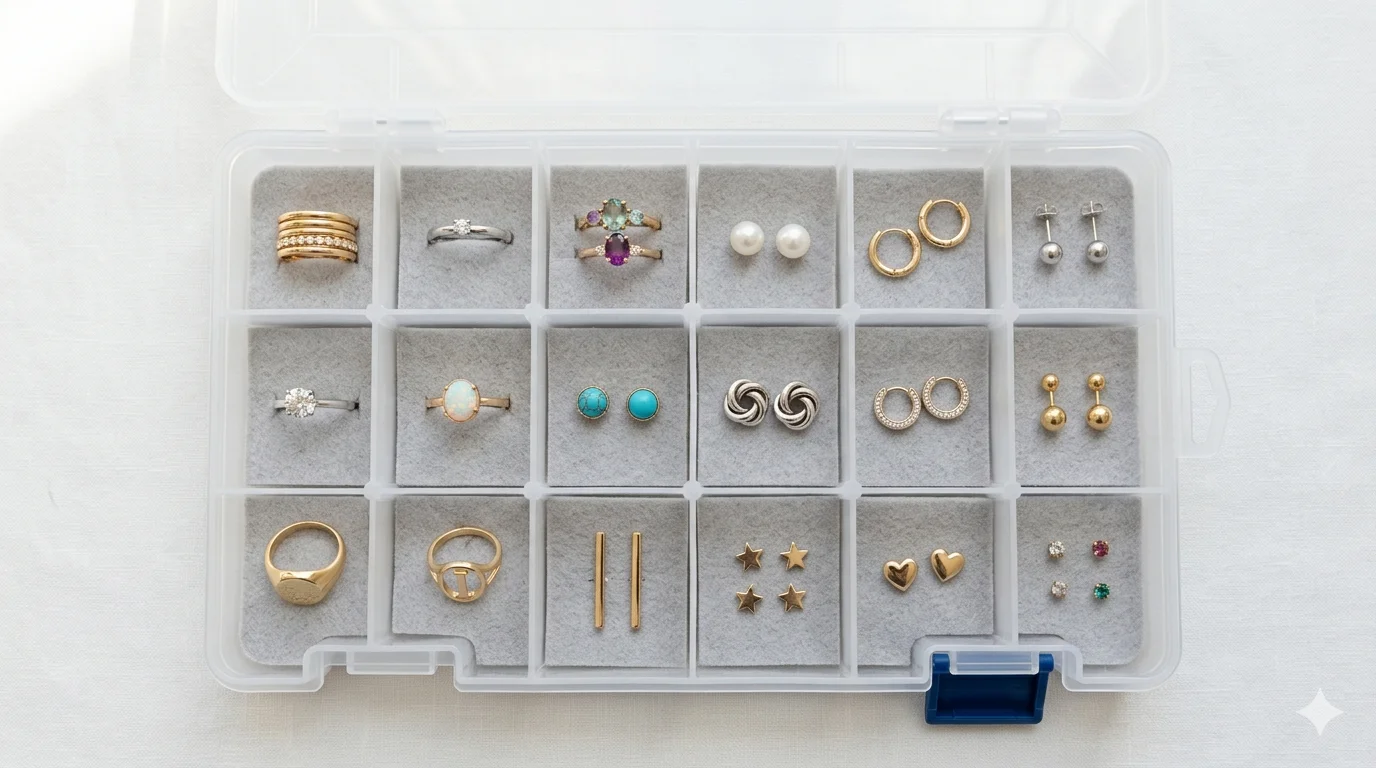
Idea 1: The Tackle Box Hack
A standard 18-compartment tackle box costs $10–$15 at most hardware stores. Line each section with a piece of felt cut to size ($2 per sheet). It works well for earrings, rings, and small pendants. The clear lid makes everything easy to see. We’ve tested this setup—it can hold 30+ pairs of stud earrings without tangling.
Idea 2: The Drawer Divider System
If you have a dedicated dresser drawer, use expandable drawer dividers (usually sold in sets of 4 for $8–$12). Add a felt mat underneath, cut to drawer size ($5–$10). That gives you a custom grid you can keep rearranging as your collection grows.
Idea 3: The Hanging Jewelry Organizer
A clear hanging organizer with multiple pockets—basically a smaller version of a shoe organizer—costs around $15–$25. Hang it inside a closet door. Each pocket can hold one necklace or bracelet. The important part is pocket size: aim for at least 6″ x 6″ so things don’t knot up.
Pro Tip: For any DIY option, toss in a silica gel packet (available in bulk for $0.05 each) to manage humidity. Replace it every 3 months.
—
Part 5: Maintenance & Care for Your Organizer
An organizer only works well if you maintain it. That’s one thing product returns and customer feedback have taught us over the years.
Cleaning Your Organizer
– Felt/velvet: Vacuum monthly with a brush attachment. If there’s a stain, use a damp cloth and mild soap—don’t soak it.
– Leather: Wipe with a dry cloth. Condition it every 6 months with a leather conditioner (usually $10–$15 per bottle).
– Acrylic: Clean with a microfiber cloth and glass cleaner. Avoid paper towels; they can scratch the surface.
When to Replace
– Felt trays: Replace every 2–3 years. The fibers start breaking down and can cling to jewelry.
– Leather boxes: Replace every 5–7 years. Leather eventually dries and cracks.
– Anti-tarnish strips: Replace every 6 months. Once they’re saturated, they stop helping.
Common Mistake: Storing Organizers in Bathrooms
Bathrooms are humid—usually 60–80%, compared with 30–50% in normal living spaces. That speeds up tarnish and can warp wooden boxes. A bedroom or closet with stable humidity is a much safer place to store your organizer.
—
FAQ: Real Questions from Collectors
Q: How many compartments do I need for a collection of 50 pieces?
A: For 50 pieces, we recommend at least 20 compartments. Rings and earrings can share compartments if they’re separated by type. A modular setup with 3–4 trays (each with 12 compartments) gives you room to adjust. Expect to spend $50–$80 for a solid setup.
Q: Can I store silver and gold together?
A: Yes, but be careful. Silver tarnishes faster than gold, and sulfur compounds from silver can speed tarnish on gold alloys. Use anti-tarnish lining and keep them at least one compartment apart. Don’t store them touching.
Q: What’s the best material for anti-tarnish?
A: In our factory, we use a proprietary blend of activated carbon and silver-impregnated polyester fabric. It costs $0.30 per square foot. For home use, anti-tarnish strips (Pacific Silvercloth is one common brand) usually cost $5–$10 per pack.
Q: How do I store a pearl necklace?
A: Pearls are soft (2.5–4.5 on the Mohs scale) and porous. Store them flat in a lined tray—never hanging, because the silk thread can stretch. Keep them away from perfume and hairspray. The GIA Gem Encyclopedia recommends storing pearls in a soft pouch with a slightly damp cloth (not wet) to prevent cracking.
Q: My watch winder broke after 6 months. Is this normal?
A: No. A decent watch winder should last 3–5 years. The most common problem is the motor—cheap models often use plastic gears. Look for a winder with metal gears and at least a 2-year warranty. A reliable one usually costs $100–$300.
Q: What’s the MOQ for custom jewelry boxes from your factory?
A: For custom designs with logo embossing, our MOQ is 500 units. For stock designs with custom color, MOQ is 200 units. Lead time is 30–45 days. Contact us for a quote.
—
Final Thoughts: What We’ve Learned in the Factory
After making more than 500,000 jewelry organizers, a few things are very clear:
1. Felt beats everything for everyday storage. It’s soft, affordable, and easy to clean. Just make sure it has anti-tarnish treatment.
2. Modular is better than fixed. Collections grow. A system you can rearrange saves money later.
3. Don’t overspend on the box. A $50 organizer with good lining is better than a $200 box with poor materials. The inside matters more than the outside.
4. Humidity is the enemy. A $0.05 silica gel packet can save you from $500 in tarnish damage.
If you’re a brand founder sourcing organizers, we’re happy to talk through what you need. Our factory has been making them for 12 years, and we know what tends to work for customers.
If you’re a collector or gift-giver, buy for the collection—not just the decor. It makes a difference. Your jewelry will last longer for it.
—
References & Sources
1. GIA Jewelry Care & Cleaning — Gemological Institute of America
2. Wikipedia: Tarnish — Wikipedia
3. GIA Gem Encyclopedia — Gemological Institute of America
4. Wikipedia: Silica Gel — Wikipedia
—
*Interested in custom jewelry organizers for your brand? We work with MOQs from 200–1,000 units. Contact our factory team for a quote and sampling.*
 English
Written by: Sarah Jenkins
Senior Content Specialist
Seasoned Industry Editor with 5 years of experience, dedicated to delivering in-depth technical and market reports.
Reviewed by: Dr. Eric Shao
Chief Technical Director
With 12 years of experience in material science and custom manufacturing, ensures the scientific accuracy and technical compliance of all published content.